
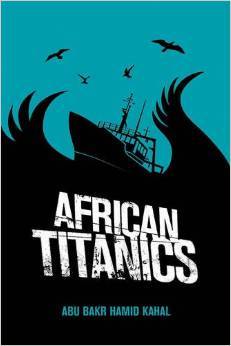
African Titanics by Abu Bakr Khaal is a lyrical, harrowing, and deeply moving novel that chronicles the perilous journeys of African migrants attempting to reach Europe across the Sahara Desert and the Mediterranean Sea.
Written by Eritrean author Abu Bakr Khaal who experienced these precarious transit routes firsthand the novel is structured around the memories of its narrator, Abdar, alongside the poems, stories, and manuscripts of his companions.
The “Migration Bug” and the Call of the Sorcerer (Eritrea and Sudan)
The novel opens with the metaphor of a “migration bug” or a turbulent swell sweeping across the African continent. Abdar describes how the youth of Africa are suddenly gripped by a frantic desire to leave, feeling as though their home is being hollowed out. He attributes this collective obsession to a dark sorcerer striking a magnificent bell (“dong, dong, dong”) that lulls the youth into a daze, drawing them toward a promised European “paradise”.
Abdar willfully ignores this call for five years while working as an auto mechanic in Eritrea. He remains immune partly because of his youthful creation a play titled The Phantom and the Mask, which warned of deceptive, hypnotic ideas. He notices the false illusions of migration: friends sending back photographs posing with luxury cars they do not own (when they are actually just dogwalkers) or writing letters claiming immense wealth that does not exist.
Eventually, the “bug” catches Abdar. He is plucked from Eritrea and swept across the Sudanese border into Khartoum and Omdurman. There, he tirelessly tracks smuggling networks, earning the nickname “Awacs” (Airborne Warning and Control System) because of his obsessive research into boat departures and smuggling rates. In Omdurman, he meets Malouk, a thin, tall Liberian traveler and musician who carries a guitar in a leather case and is deeply traumatized by the civil war in his homeland. Malouk shares his manuscript, The Adventures of Kaji, a folk story about using traditional music (“The Song of Joy”) to cure a young relative of the migration bug.
The Death-Strewed Sahara Crossing
Abdar, Malouk, and a young Eritrean woman named Terhas prepare for the brutal trans-Saharan crossing to Libya. They meet their Sudanese driver, Naji, and cram into a Range Rover with twenty-one other passengers, its seats entirely removed to pack in as many bodies as possible.
The desert crossing quickly transforms into a nightmare:
- The Hambata: Naji is constantly on edge, watching his mirrors for the Hambata brutal highway bandits who drive armed four-by-fours and leave stranded travelers to die in the sand.
- The Loss of Water: The car crashes into a sandbank, splitting open their water containers and spilling priceless gallons of water.
- The Dehydration Void: The vehicle gets lost, fuel runs low, and water runs out entirely. Passengers begin “dropping like flies” under the scorching sun and freezing night temperatures.
- The Sacrifice of Terhas: A young Eritrean soldier named Assgedom Mesfin hovers near death. In an extraordinary act of devotion, Terhas cleans the sand from his mouth and feeds him her own saliva and urine to keep him conscious. Assgedom temporarily revives raving about the absurdity of the border war where identical soldiers slaughtered and buried one another before dying at midnight.
After burying Assgedom and three other corpses, and with Naji collapsing from a burning fever, the survivors finally crawl out of the desert and reach a stone house in Libya.
The Smugglers’ Hideout and the Flight to Tunisia
Terhas, Abdar, and Malouk travel to Tripoli, where they seek out smugglers. They board an old truck that deposits them at a low-walled hideout outside the city. The courtyard is a claustrophobic monument to vanished travelers, littered with discarded clothes, broken watches, used sanitary towels, and wigs. The smugglers collect $1,000 from each passenger and lock the doors from the outside, leaving them in the sweltering August heat.
While cooped up, Abdar and Terhas find an old love letter written by a Nigerian traveler to a woman named Malfanita, describing a narrow escape from death and gunshots in the desert. They also read the walls, which are covered in multilingual graffiti left by preceding migrants expressing their terror, hope, and regrets.
As they wait, they monitor satellite weather forecasts. Attiah, an experienced Egyptian fisherman, mockingly ridicules their hopes for a calm sea. He notes that seventy percent of these unseaworthy vessels sink, declaring that “Titanikaat” (or “The Doomed”) is a fitting name for them.
Before they can board a vessel, hundreds of flashing blue and red police lights surround the hideout. Abdar screams “Police!” and a chaotic stampede ensues. Abdar, Terhas, and Malouk escape through a kicked-down door and flee down the coast back to Tripoli. Fearing more raids, they decide to head to Tunisia, where the sea crossing to Italy is much shorter.
Crossing the Wire and the Alhalfa Hostel
The companions travel to the Tunisian border, crawling behind gorse bushes to evade searchlights. They reach a high barbed-wire fence. To save Malouk’s beloved guitar, Malouk climbs onto Abdar’s shoulders and launches the instrument over the wire, where their friends catch it.
After crawling through the wire, they are stopped near a police station. When asked where they are from, Abdar’s response of “Eritrea” is misheard by a policeman as “Mauritania”. Playing along with the mistake, they are allowed to pass safely as Mauritanian citizens. They hire a driver to take them to Tunis without papers.
In Tunis, they check into the Alhalfa Hostel, run by the elderly Si Najih, who is famous for harboring undocumented migrants without asking for passports. He advises them to curl up in a hole, avoid public spaces, and hope for the best. During their stay, Malouk gives Abdar another manuscript, Malouk the Second, which features The Stone That Only Spoke Once a mythic story about a stone that pities the oppressed and is buried by ungrateful people under a mountain of mute stones.
The Shipwreck and the Legend of the Wave Walker
Abdar’s Red Sea fisherman friend, Ali Khayrat, agrees to steer a migrant boat for free to secure his own passage. Abdar inspects the 18-meter vessel and is horrified to find that its fish freezers have been carelessly ripped out to create more passenger seating, leaving exposed screw holes in the deck.
The boat sets sail with Ali at the helm and Malouk among the passengers. A violent storm erupts, and water begins to leak rapidly through the unsealed screw holes in the deck. The passengers try to scoop the water out, and Malouk presses his hands and feet against the leak, but the engine is drenched and dies.
On the eighth day of drifting, twenty people die of hunger and thirst. A massive oil tanker passes by; the desperate migrants wave and even throw corpses into the water to show their distress, but the tanker’s sailors merely stand with folded arms, sniggering and smiling as they sail away. That night, a massive wave strikes, wood splinters, and the boat sinks. Malouk manages to haul himself onto a wooden plank, reciting fragments of Rimbaud in the freezing water before drowning among drifting corpses.
The Epilogue: Arrest, Deportation, and Memory
Back at the Alhalfa Hostel, Tunisian police launch a raid. Though Abdar and Terhas maintain a cover story that they were shipwrecked from an Egyptian cargo ship, the police search a compatriot and discover a 10-dinar Libyan banknote featuring Omar al-Mukhtar. This “incontrovertible evidence” exposes their route from Libya. They are imprisoned at al-Wardiah Prison, deported back to the Libyan border, and eventually flown back to Eritrea.
Malouk, who was away running an errand during the raid, escaped arrest only to die on the ill-fated boat. Years later in Eritrea, Abdar is haunted by Malouk’s memory. However, a legend grows in internet chatrooms among fishermen and travelers: they claim that Malouk survived, seen by sailors walking calmly on the crest of a wave with a guitar on his back, rescued by a giant sailboat while his voice rose in a final, liberated song of defiance against the sea.
Characters
Abdar (The Narrative Witness)
Abdar is the novel’s central protagonist and first-person narrator. Originally from Eritrea, he worked as a theatrical writer and mechanic, willfully ignoring the migration bug for years before eventually succumbing to its influence. Throughout his journey, Abdar is a collector of stories, names, and memories. His physical and psychological changes are cataloged by a succession of nicknames conferred upon him by his fellow travelers:
- “Limpsalot”: Given during his transit in Omdurman due to a painful, untreated wound on the arch of his foot that causes him to limp.
- “Awacs” (Airborne Warning and Control System): Given in Khartoum because of his obsessive, sleepless tracking of migrant smuggling data, boat departures, and price variations.
- “The Bat”: Given during the Sahara crossing because of his poor eyesight but extraordinarily sharp hearing, which allows him to detect distant sounds in the desert night.
- “Al-Shammam” (Sniffer): His childhood nickname in Eritrea, born from a false rumor that he enjoyed sniffing petrol-soaked rags, which replaced his original Tigré nickname “Ambsa” (meaning Lion).
Terhas (The Matriarchal Force of Survival)
Terhas is a young Eritrean woman whose journey intersects with Abdar’s in Sudan. She is described by their driver, Naji, as a “mother enough for the whole world” due to her boundless, self-sacrificing care for her compatriots. Terhas is the moral anchor of the traveling group, demonstrating extraordinary resilience during the Sahara crossing. She cleans the sand from the throat of the dying soldier Assgedom, feeding him her own saliva and urine to keep him conscious. Terhas possesses a sharp, defensive dignity, rejecting the crude sexual gestures of male travelers with cold, silent contempt.
Malouk (The Tragic Bard of Liberia)
Malouk is a tall, thin Liberian storyteller and musician who wears a persistent khaki cap and carries a long guitar in a dark leather case. Named after his ancestor, Malouk the First (a heroic fisherman who spent his life building an unfinished ship to rescue his wife from pirates), Malouk is the poetic soul of the migration trail. He is deeply traumatized by the Liberian civil war, which claimed the life of his beloved Waninabanda. Malouk is a chronicler of the migrants’ experiences, writing manuscripts and composing poems like ‘Crossing’ to capture the agonies of their displacement. He refuses to let the sea silence his music, standing on the Tripoli beach to spit on the waves and shout insults at the “heartless” water. He ultimately drowns during the catastrophic sinking of their boat, floating on a plank while reciting Rimbaud.
Assgedom Mesfin (The Ghost of War)
Assgedom is a young Eritrean soldier who, just three months prior to the journey, was fighting the Ethiopians on the border. He is severely traumatized and quickly succumbs to dehydration during the desert crossing. In his final, heat-maddened ravings, Assgedom exposes the ultimate absurdity of the border war, noting that the soldiers on both sides were identical in features, clothing, language, and weapons, and were buried together because they could not be told apart. He dies in a violent struggle and is buried in a shallow, midnight grave in the Sahara.
Supporting Characters
- Naji (The Desert Charioteer): A talkative, hyperactive, and highly experienced Sudanese driver who transports the group across the Sahara. He driving a Range Rover with the seats removed, navigating by the stars and racing sandstorms to escape the Hambata.
- Captain Attiah: An Egyptian fisherman who acts as the sarcastic, experienced critic of the migration trail. He ridicules the term “Titanics” and calls the Mediterranean a “great pool of poison”. After successfully reaching Sicily and traveling to Norway, he is deported after 9/11 when his employer catches him praying and reports him as a terrorist.
- Ali Khayrat: An Eritrean Red Sea fisherman and smuggler’s sailor who agrees to steer the ill-fated vessel to Europe to secure a free passage. He possesses no knowledge of GPS navigation beyond a single rule: if the device flashes red, he must turn the rudder to make it stop. His body is recovered from the wreck and flown back to Eritrea.
- Malkita: An Ethiopian traveler from Kuma Kaffa, the home of the coffee bean. While initially presenting a calm, joyful, and friendly demeanor, he undergoes a monstrous psychological transformation during the shipwreck, turning into a savage predator who steals money from the pockets of the dying.
- Si Najih: The elderly, understanding owner of the Alhalfa Hostel in Tunis. He harbors illegal migrants without asking for passports, repeating his comforting life motto: “One day at a time… Just one day at a time.”.
Settings
Khaal constructs a detailed, visceral map of migration, divided into distinct, hostile zones of transit, enclosure, and liquidation:
The Urban Transit Nodes of Khartoum and Omdurman
The journey begins in the sister cities of Khartoum and Omdurman, divided by the Nile and linked by the historic iron Cooper Bridge and the wide Shambat Bridge. This urban space is characterized by sweltering heat, constant movement, and dense anxiety. The migrants live in crowded, rented rooms in al-Arba’in, sharing information on smugglers and boat rates. The Nile Garden serves as a temporary sanctuary where officials, soldiers, and migrants sit beneath the trees, passing more than thirty international newspapers from hand to hand to read without getting up.
The Sahara Desert: The Lethal Void
The Sahara is portrayed not as a romantic wilderness, but as a shifting, volatile void where sandstorms change the lay of the land entirely, moving mountains of sand so that they become mere specks in the eye. It is a zone of physical liquidation, where temperature shifts from scalding midday heat to biting night cold, accelerating the effects of dehydration. The desert is also a militarized minefield governed by the Hambata brutal highway robbers driving top-of-the-range four-by-fours and carrying heavy weapons, who strip travelers of their vehicles and water, leaving them to die.
The Tripoli Hideout: The Zone of Enclosure
Outside Tripoli, the migrants are locked inside a low-walled building with a large courtyard. This hideout is a claustrophobic monument to previous, vanished travelers, its floor strewn with their discarded belongings: iron bedsteads, broken watches, wigs, used sanitary towels, sugar bags, and foreign cigarette packets. It is a space of extreme heat, commercial transactions, and psychological suspension, where smugglers collect one thousand dollars per head and lock the doors from the outside, transforming the migrants into commodities awaiting shipment.
The Mediterranean Sea: The Liquid Hell
The sea is the final, ultimate boundary what Naji calls a “liquid hell” and Attiah calls a “great pool of poison”. It is a space where all human identities are diluted and dissolved. On the unseaworthy “Titanikaat,” the physical boundaries between life and death, sanity and madness, are completely erased. It is a landscape of absolute indifference, where passing international oil tankers ignore the screams of the drowning, and sailors stand with folded arms, sniggering as the migrants throw corpses into the water to prove their desperation.