
Introduction
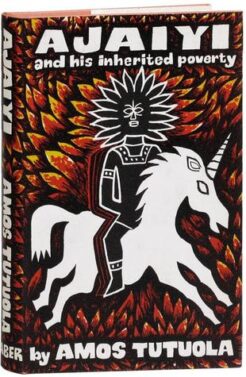
Ajaiyi and His Inherited Poverty is a remarkable novel by Nigerian author Amos Tutuola, first published in 1967. The book stands as a significant work in African literature, blending Yoruba folklore, myth, allegory, and social commentary into a sprawling narrative that follows the journey of its protagonist, Ajaiyi, as he attempts to escape the poverty he inherited from his parents. The novel is written in Tutuola’s characteristic style a unique form of English that reflects Yoruba oral tradition, characterized by repetition, proverbial wisdom, and a dreamlike, episodic structure that draws heavily on traditional African storytelling techniques.
The novel is divided into several sections, each detailing a different phase of Ajaiyi’s journey. What begins as a simple tale of a poor family becomes an epic quest that takes the protagonist through encounters with kidnappers, slave traders, spirits, gods, and even the Creator himself. Throughout his journey, Ajaiyi is accompanied by various companions, faces countless trials, and ultimately learns profound lessons about poverty, morality, and the nature of wealth.
This comprehensive analysis will provide a detailed chapter-by-chapter summary, explore the major characters, examine the thematic concerns of the novel, and offer critical analysis of its literary techniques, cultural significance, and philosophical underpinnings.
Part One: The Funeral Ceremony of My Father and Mother
Chapter Summary
The novel opens with Ajaiyi introducing himself as a fifteen-year-old boy living in a small village with his twelve-year-old sister, Aina. The narrative is set approximately two hundred years in the past, during a time when there were no cars or airplanes, and people traveled on foot or by handmade canoes. Ajaiyi explains that he is telling this story from a future perspective, having been born again through different parents a reference to the Yoruba belief in reincarnation.
Ajaiyi’s parents are described as a hunchbacked couple, mockingly called “The hunchback family” by the villagers. Despite being the hardest workers in the village, they are also the poorest. The family’s poverty is so severe that they live in a house with mud walls, thatched roofs, and a sitting room filled with rags, old baskets, and broken utensils. The irony of their situation is that the more they work, the poorer they seem to become.
Ajaiyi’s father often warns his children with the cryptic phrase, “Remember The Day After Tomorrow,” whenever they misbehave. This warning becomes a recurring motif throughout the novel, though its meaning remains unclear to the young children.
One day, as the family sits together, the parents express their sorrow about dying and leaving their children in poverty. Ajaiyi asks his father why they are poor despite working harder than anyone else. His father explains that hard work alone does not guarantee wealth and warns that poverty can persist across generations unless one continues to work hard. Aina, however, notices that their mother works harder than any other woman in the village yet remains the poorest, suggesting that hard work alone cannot explain their situation.
A joker from the village arrives and mocks the family’s poverty, suggesting that they will never escape it until they die. This comment enrages the family, who chase him away with sticks. Shortly after, Ajaiyi’s mother falls seriously ill and dies, leaving the family in deeper sorrow. Before her death, she advises her children to continue working hard and not to be discouraged by their poverty.
After the mother’s death, the father comforts his children by telling them that their mother has gone to “riches in heaven.” However, when Ajaiyi points to his father’s hunchback and suggests it might be the cause of their poverty, his father denies this, insisting that a hunchback does not make a person poor.
That night, the family has nothing to eat except cold water. They drink the water as their dinner and go to sleep. The next morning, Ajaiyi’s father is gravely ill. He prays for his children, warning them to remember “The Day After Tomorrow” and to avoid kidnappers. He dies shortly after, leaving Ajaiyi and Aina orphaned.
The children’s neighbors ask for white cloth and a coffin to bury their father, but the children have no money. Ajaiyi goes to a woodcarver in the next village who, upon learning the name of Ajaiyi’s father, agrees to carve a coffin for free because of the father’s kindness during his lifetime. Aina, meanwhile, goes to a cloth-seller who also gives her white cloth for free for the same reason. A tailor sews the cloth for free as well.
The father is buried with dignity, and the community’s generosity demonstrates that despite his poverty, Ajaiyi’s father was rich in kindness and good relationships. This is the first hint that “The Day After Tomorrow” may relate to the principle of cause and effect that one’s actions eventually return to them.
Analysis
The opening section establishes the central conflict of the novel: inherited poverty and the struggle to escape it. Tutuola uses the hunchback as a physical manifestation of the family’s burden a visible mark of their difference and misfortune. However, the father’s insistence that the hunchback is not the cause of poverty suggests that the real causes are more complex and perhaps spiritual or moral in nature.
The phrase “Remember The Day After Tomorrow” serves as a riddle that drives the narrative forward. It is clearly a warning about consequences that one’s actions will eventually catch up with them. The father’s dying words emphasize this principle, though the children are too young to understand it fully.
The community’s response to the father’s death providing coffin, cloth, and tailoring for free demonstrates the Yoruba concept of communal support and the importance of good character. Despite being poor, the father was rich in kindness, and this kindness is repaid after his death. This is a crucial lesson for Ajaiyi, though he does not yet fully grasp it.
The mother’s death and the father’s subsequent death leave the children completely alone, setting the stage for their journey. The children’s poverty is so severe that they cannot even afford food, and they drink water for dinner. This extreme deprivation emphasizes the stakes of Ajaiyi’s quest.
Part Two: I Pawned Myself for Money
Chapter Summary
After their father’s death, Ajaiyi and Aina are left alone in the house. Neighbors advise Ajaiyi to pawn himself for money to fund the funeral ceremony. He goes to a pawnbroker, a woman, who is initially doubtful about his strength but eventually agrees to give him two pounds in exchange for his labor. He will work for her from morning until two o’clock each day without being fed, until he can repay the debt.
The funeral ceremony is performed with the money, and the community’s generosity providing food, drinks, and services for free demonstrates the respect they had for Ajaiyi’s father. The phrase “Remember The Day After Tomorrow” is mentioned as having come true because everything needed for the burial and funeral was provided for free.
Ajaiyi begins working for the pawnbroker while also farming his late father’s land to feed himself and Aina. They continue to ponder the meaning of “Remember The Day After Tomorrow,” eventually concluding that it must be the name of their eldest brother who left the village before they were born.
Months later, a stranger arrives at their house. He is the kidnapper who had overheard their father’s dying words. He has placed a flat stone on his back to simulate a hunchback and wears expensive clothes to appear wealthy. He claims to be their eldest brother, “Remember The Day After Tomorrow,” and uses the hunchback as proof of his identity. The children believe him and welcome him into their home.
The kidnapper lives with them for a few days, then suggests taking them to another town where they can work and become rich within a year. He hangs a protective juju on the door to keep thieves away and leads them away before dawn. He takes them to a wealthy slave-buyer who is also a powerful idol worshipper. The slave-buyer’s house is filled with terrifying idols dripping with fresh blood, indicating human sacrifice.
The kidnapper sells both children to the slave-buyer for ten pounds each (down from his initial asking price of twenty pounds) and receives two garments and caps as part of the deal. When the children protest, he denies being their brother and reveals the truth: “Remember The Day After Tomorrow” was not a person’s name but a warning. If they had asked their father for its meaning before he died, they would not have been deceived.
The slave-buyer ties the children up and throws them into a shrine filled with terrifying idols. The children are to be sacrificed during the next festival. They struggle to free themselves, and Ajaiyi manages to cut the ropes with a sword that was hanging near the idol. He frees Aina and hides her in a corner of the shrine.
When the slave-buyer and his followers enter the shrine for the sacrifice, Ajaiyi attacks them with the sword. They flee in terror, and Ajaiyi chases them into the bush. The children escape from the town, though they encounter the kidnapper again, who mocks them and explains the meaning of “Remember The Day After Tomorrow” it means “One will reap what he sows.” If one sows evil, one will reap evil in the future.
Analysis
This section introduces the central theme of deception and the consequences of naivety. The kidnapper exploits the children’s ignorance of their father’s warning, demonstrating the importance of understanding the wisdom passed down from elders. The phrase “Remember The Day After Tomorrow” is finally explained: it is a principle of cause and effect, a reminder that actions have consequences.
The episode with the slave-buyer introduces the theme of human cruelty and the exploitation of the vulnerable. The idols dripping with blood represent the dark side of religious practice, where human sacrifice is used to appease gods. Ajaiyi’s courage in fighting back demonstrates his growth and determination to survive.
The children’s escape marks the beginning of their journey through a world filled with supernatural dangers. The sword Ajaiyi takes from the shrine becomes a symbol of his agency and his willingness to fight for survival.
The father’s kindness, which resulted in free coffin, cloth, and tailoring, contrasts sharply with the kidnapper’s cruelty. This contrast reinforces the novel’s moral framework: kindness is rewarded, while evil eventually brings its own consequences.
Part Three: We Were Kidnapped and Sold
Chapter Summary
This section continues the narrative of the children’s journey after their escape from the slave-buyer. They travel through a forest, eating wild mangoes from a dika-nut tree. Their hunger is so severe that they eat the fruits with more enjoyment than they would have had with cooked food.
Their meal is interrupted by a terrifying creature the Spirit of Fire who appears with six followers. The Spirit of Fire is described in vivid detail: his head is three times bigger than his body, his mouth is permanently open, and fire continuously sparks from it. His nose is as thick as a pillar and curved like a sickle, and his eyes spark fire in all directions. His entire body is made of fire.
The Spirit of Fire accuses the children of eating his fruits and sentences them to be burned to ashes in his town of fire. He tells them his story: he is the most cruel creature on earth, the owner of the fire that humans use for cooking. He hates humans because they use water to quench his fire. He lives in the greatest fire under the mountain of desperation. He sends his messengers to destroy human property, just as the Goddess of River sends her messengers to damage human belongings.
The Spirit of Fire and his followers push the children to the mountain of desperation, a six-mile-high mountain with thick black smoke rising from it. The mountain opens to reveal a town of fire, where everything houses, animals, and people is made of fire. The Spirit of Fire is the king of this town.
The children are imprisoned in a room without food for three days. On the fourth night, the guard falls asleep, and they escape. They hide in ashes as high as a hill, where they remain for many days while the Spirit of Fire’s followers search for them. Eventually, a heavy rain carries the ashes and the children to a large river, where they sink to the bottom.
At the bottom of the river, they find dry white sand and are able to walk freely. They see a beautiful house and approach it. A woman with a smiling face comes out and asks how they came to be there. Ajaiyi explains their story, and the woman takes them to the Queen of the River.
The Queen of the River is a beautiful old woman wearing a crown made of tiny beads. She is kind and gentle, and she tells the children that the Spirit of Fire is her enemy because he is cruel to all living creatures. She gives them food and promises to take them back to the Spirit of Fire to revenge on him.
The Queen changes her dress and takes two women covered in white cowries who carry pitchers of water. She leads the group to the town of the Spirit of Fire. When the Spirit of Fire sees her, he becomes angry and threatens to burn her and her followers. The Queen remains calm and explains that she is powerful in her own way she gives children to barren women and is kind to all creatures.
The Spirit of Fire boasts about his power and his fire. As he prepares to burn the Queen, she commands her women to throw the pitchers of water on him. The water creates a powerful flood-tide that carries away the Spirit of Fire, his followers, and his entire town. The Queen and her followers float on the flood-tide, while Aina and Ajaiyi are carried back to the fruit tree where they were captured.
The Queen and her followers bid the children goodbye and disappear. The children continue their journey eastward, not knowing where they are going but determined to find their way home.
Analysis
The Spirit of Fire episode introduces the theme of elemental forces and their personification in Yoruba cosmology. Fire and water are depicted as living creatures with their own kingdoms and agendas. The Spirit of Fire represents destruction and cruelty, while the Queen of the River represents kindness and nurturing.
The Spirit of Fire’s claim that he is “the most cruel creature on earth” and that humans hate him despite his importance for cooking suggests a complex relationship between humans and natural forces. Fire is necessary but dangerous, and humans must constantly manage their relationship with it.
The Queen of the River’s power over the Spirit of Fire demonstrates that kindness and gentleness can overcome cruelty and destruction. Water, which the Spirit of Fire hates, is ultimately his undoing. This reinforces the novel’s moral framework: good triumphs over evil, and humility over arrogance.
The children’s journey through these supernatural realms serves as an education in the nature of power and morality. They learn that not all powerful beings are evil (the Queen of the River) and that even the most terrifying creatures can be defeated through courage and the help of kind allies.
Part Four: The Cruel King
Chapter Summary
After escaping from the Spirit of Fire, Ajaiyi and Aina travel through a forest until they come to a town. They meet a young man named Ade, who introduces himself as “Ade, the Traitor.” Despite the ominous name, Ajaiyi befriends him, believing that “a cruel man cannot change another man’s destiny.”
Ade provides the children with food, drink, and a place to stay. He helps Ajaiyi find work, taking him to the king of the town. The king is described as cruel and selfish, with a bush reserved for killing offenders. This bush is home to a terrible creature a human dead-body eater who lives in a pond.
Ade is eventually accused of offending the king and is sentenced to death. He is tied to a tree in front of the palace for public viewing until the day of his execution. Despite Ajaiyi’s efforts to save him, Ade is beaten to death in the dreadful bush.
Ajaiyi stays with Ade’s dead body, weeping and driving away flies. A strange creature with the voice of a human but the appearance of an ape the dead-body eater appears and tells Ajaiyi to leave so he can eat the body. Ajaiyi begs him to spare Ade’s body, explaining that Ade was his friend.
The creature asks if Ade was truly faithful to Ajaiyi. When Ajaiyi confirms this, the creature gives him a small gourd containing juju powder that can bring the dead back to life. However, the creature warns Ajaiyi that Ade was not truly faithful and may cause his death in the future.
Ajaiyi uses the powder to revive Ade, and they return to the town. Ajaiyi becomes famous for his ability to wake the dead and earns a lot of money. He shares half of his earnings with Ade, but Ade is not satisfied he wants to know how to use the juju powder.
One day, while Ajaiyi is away, Ade steals the juju gourd and replaces it with a similar-looking one. He throws the real gourd into a river, where it is carried to the pond and swallowed by the dead-body eater. Ade then tells the king that Ajaiyi plans to refuse to wake any of the king’s family members as revenge for the king’s treatment of Ade.
When the king’s son dies, Ajaiyi is called to wake him. He takes the fake gourd from the rack, but instead of juju powder, it contains sand. He fails to wake the prince, and Ade accuses him of deliberately failing as revenge. The king orders Ajaiyi to be beaten to death in the same bush where Ade was killed.
Ajaiyi is beaten to death, and Ade steals his savings of two hundred pounds. Aina stays with her brother’s body, weeping. The dead-body eater creature appears again and revives Ajaiyi, asking where Ade is. When Ajaiyi explains that Ade caused his death, the creature reminds him that he had warned him about Ade’s unfaithfulness.
The creature decides to eat Ajaiyi instead, but Aina begs him to spare her brother. The creature relents and warns Ajaiyi to stay away from Ade. Ajaiyi and Aina return to the town, where they discover that their money has been stolen. They leave the town and return to their village.
Back in the village, their creditors demand payment of debts. Ajaiyi begs for time and is granted a few days. Aina’s friend Babi comes to visit, and the two resume their friendship.
Analysis
The Ade episode is a powerful exploration of betrayal and false friendship. Ade’s name “the Traitor” is a warning that Ajaiyi ignores at his peril. The creature’s warning that Ade will cause Ajaiyi’s death proves accurate, demonstrating the importance of heeding wise counsel.
The dead-body eater is an ambiguous figure terrifying in appearance but ultimately capable of mercy and justice. He spares Ade’s body at Ajaiyi’s request, gives Ajaiyi the means to revive the dead, and ultimately saves Ajaiyi’s life. Yet he also warns Ajaiyi about Ade’s true nature and refuses to eat Ajaiyi only because Aina begs him to.
The theme of faithfulness versus treachery is central to this section. Ajaiyi is faithful to Ade despite Ade’s betrayal, but this faithfulness nearly costs him his life. The novel suggests that while loyalty is a virtue, it must be tempered with wisdom and discernment.
The episode also explores the corrupting influence of money. Ajaiyi’s wealth from waking the dead becomes a source of conflict, and Ade’s desire for the juju powder leads to betrayal and murder. The two hundred pounds that Ajaiyi saves becomes a symbol of his hope for freedom from poverty, but it is stolen by the very person he trusted.
The cruel king represents arbitrary power and injustice. His willingness to sentence people to death for minor offenses and his refusal to pardon offenders demonstrate the dangers of unchecked authority.
Part Five: I Visited the Creator in Respect of My Poverty
Chapter Summary
After returning to their village, Ajaiyi and Aina face pressure from creditors. Aina’s friend Babi becomes a source of conflict when she demands the return of a broken pitcher head that Aina used to protect her kola-nut tree. The tree had become a source of wealth for Aina, and Babi’s jealousy leads to a legal dispute. The judge rules in Babi’s favor, and the tree is cut down.
Later, Aina gives Babi a brass ring for her newborn daughter. Ten years later, Aina asks for the ring back, but it cannot be removed without cutting off the child’s head. Aina sues Babi, and the case is judged in Aina’s favor. However, Aina ultimately forgives Babi, declaring that “if we continue to pay bad for bad, bad shall never finish on earth.”
Ajaiyi, unable to bear his creditors’ pressure, decides to leave the village to find work. He travels until he comes to a town where he meets two poor men, Ojo and Alabi, who become his friends. The three of them live together, working hard but becoming poorer. They decide to visit the Creator to ask for money.
The journey to the Creator’s town takes more than six months and is filled with dangers. They encounter one-legged ghosts, water creatures with powerful beams of light from their eyes, and other harmful beings. They fight these creatures and eventually reach the town of the Creator, guided by drummers who serve the Creator.
In the town of the Creator, they witness the punishment of sinners in a great fire and the happiness of righteous people. They are told that sinners cannot share in the happiness of the righteous. The head of the drummers takes them to see the fire where sinners are punished, and they recognize some people from their village who had been dishonest in life.
When they finally get to present their complaints to the Creator, they ask for money. The holy man who represents the Creator reads out their sins and tells them that they are not qualified to see the Creator personally because of their sins. He writes down their complaints, and after seven days, he returns with the Creator’s response: since they have asked for money rather than heavenly things, they should go to the Devil, who is the possessor of money. They are sent away from the Creator’s town with empty hands.
Analysis
The visit to the Creator represents the culmination of Ajaiyi’s quest for a solution to his poverty. However, the Creator refuses to give him money, instead directing him to the Devil. This suggests that money is not a heavenly concern but an earthly one, associated with evil rather than righteousness.
The section also explores the theme of justice and forgiveness through the story of Aina and Babi. Aina’s forgiveness of Babi, despite Babi’s attempt to destroy her kola-nut tree, demonstrates the principle that “if we continue to pay bad for bad, bad shall never finish on earth.” This is a crucial moral lesson that contrasts with the earlier episodes where characters suffered for their kindness or naivety.
The journey to the Creator’s town is an epic in itself, filled with dangers and trials that test the travelers’ courage and endurance. The creatures they encounter one-legged ghosts, water creatures with deadly light beams represent the hostile forces that stand between humans and the divine.
The town of the Creator is described as a place of perfect justice, where sinners are punished in a great fire and the righteous live in eternal happiness. The punishment of sinners is described in detail: they are burned repeatedly, and thunderbolts dash upon them. The sinners include judges who took bribes, murderers, liars, thieves, deceivers, and politicians who embezzled state money.
The Creator’s refusal to give money reflects a philosophical position: money is the root of evil, and those who seek it are turning away from heavenly things. The Creator directs them to the Devil, acknowledging that the Devil is the ruler of the material world. This dualistic worldview God for spiritual matters, Devil for material matters is a central theme of the novel.
Part Six: At Last We Reached the Town of the Creator / We Left the Town of the Creator with Empty Hands
Chapter Summary
After leaving the Creator’s town, Ajaiyi, Ojo, and Alabi continue their journey. They decide to visit the god of Iron, hoping he might give them money. They travel through forests and jungles for about four months, encountering no harmful creatures except wasps and bees.
They come to a gate that leads to the god of Iron’s town. The gatekeeper, a giant-like figure, warns them that the god of Iron is busy preparing for his yearly festival and will not be available for ten days. He also warns them that the god of Iron will sacrifice them to his gods if they insist on seeing him.
The three men insist on seeing the god of Iron or his deputy. The gatekeeper leads them to the deputy, who beats them and throws them into a fence of iron where more than two thousand captives are being held for the festival. The fence is near the god of Iron’s smithery shop, where they can see him working.
The god of Iron is described as about ten feet tall, very corpulent, and covered in long hair. He wears rough leather trousers and a huge cap. Skulls of animals and humans surround his shop and the fence. He forges a big iron into the shape of a fearful image, and he drinks blood from a bowl containing more than forty-four gallons.
The god of Iron prepares for his yearly festival by carving images of all kinds of living creatures. He bathes in blood instead of water and dresses in palm fronds soaked with blood. On the day of the festival, he orders his bearers to behead all the captives and pour their blood into bowls. The god of Iron and his deputies drink the blood as they celebrate.
As the bearers raise their matchets to behead Ajaiyi, Ojo, and Alabi, the three men jump into the circle of dancers and begin to dance. However, their dancing style is different from the others, and they are soon discovered. The god of Iron orders them to be brought before him.
Ojo remembers that his mother used to flatter the god of Iron by his original family name. He begins to flatter the god, who is so pleased that he jumps into the circle and dances with joy. The god of Iron spares their lives and tells them that he is not the possessor of money the Devil is. He gives each of them a matchet and a heavy lump of raw iron weighing more than one ton, instructing them to worship the iron lumps when they return to their village.
The three men carry the heavy iron lumps until they are too tired and throw them into the bush. The lumps come alive and chase them, warning them to carry them along. They eventually escape to the country of the witches.
Analysis
The god of Iron episode continues the theme of powerful beings who control aspects of human life but are not the ultimate source of wealth. The god of Iron is a terrifying figure who demands blood sacrifices and rules through fear, yet he too directs the seekers to the Devil.
The iron lumps that come alive represent the burdens that come with false worship. The god of Iron gives them iron to worship instead of money, and the iron becomes a literal burden that chases them and forces them to carry it. This is a powerful metaphor for the ways in which material pursuits can become oppressive burdens.
The three men’s insistence on seeing the god of Iron despite warnings demonstrates their desperation and their willingness to risk death for the chance at wealth. Their survival is due to Ojo’s knowledge of the god’s family name, which he learned from his mother a reminder that ancestral knowledge and tradition can be powerful tools.
The god of Iron’s festival, with its mass human sacrifice and blood drinking, represents the dark side of religious practice. The god of Iron is not a benevolent deity but a cruel and bloodthirsty one, demanding human lives in exchange for his favor.
The episode also reinforces the theme that different gods and powers have different domains. The Creator deals with spiritual matters, the god of Iron with iron and war, but the Devil is the ultimate source of money. This division of divine responsibilities reflects a worldview in which different aspects of life are governed by different supernatural forces.
Part Seven: We Escaped to the Country of the Witches / The Witch Mother Turned into the Pupil of the Eyes
Chapter Summary
The three men escape from the god of Iron’s town but are chased by the three iron lumps, which have become living evil creatures. The lumps warn them that if they carry them, they carry troubles and misfortunes; if they don’t, they fail to carry good luck. The lumps also threaten to tear off their right arm and left leg if they catch them.
The men run until they enter a small country where they hide behind a house. The iron lumps find them and chase them into a house owned by an old woman. The old woman uses palm-oil to stop the iron lumps, which become motionless when the oil is poured on them.
The old woman introduces herself as Adeola, the Chairwoman of all the witches in the country. She tells them that the country is inhabited only by witches and wizards. She has four other members: Ayinke (Secretary), Odere (President), Awele (Vice-President), and Abeke (Messenger). She reveals that she killed her own daughter for her witch members and that her son Ishola does not know she is a witch.
Adeola tells the three men that they are her captives and will be sacrificed to her witch members when it is her turn to prepare a feast. She puts one iron lump at the foot of a tree in her garden, one at the entrance to the garden, and one at the front entrance, so that the men cannot escape without being caught by the iron lumps.
The men are forced to work in Adeola’s garden, make baskets, and kill field rats. Ishola, Adeola’s son, befriends them. One midnight, Ajaiyi digs a hole through the wall, and the three men escape. The iron lumps chase them and force them back to the house. A second escape attempt also fails.
One day, Ishola takes a dead rat and a basket to the market. Three spirits Ajala, Fola, and Bola appear and price the goods below their value. When Ishola calls them thieves, they command the dead rat to become alive and run back into the bush. Ishola is amazed and runs home to tell his mother.
Adeola is alarmed when she hears about the three spirits. She asks Ishola if he told them that she is a witch. He is shocked to learn that his mother is a witch. Adeola confesses that she killed his sister and that she plans to sacrifice the three men (Ajaiyi, Ojo, and Alabi) instead of Ishola.
The next day, Adeola follows Ishola to the market to confront the three spirits. When they meet, the spirits command the dead rat to come alive and the basket to become palm fronds again. Adeola uses her own powers to reverse their commands, and the spirits are impressed. They invite her to their dwelling place in the jungle.
The spirits plan to murder Adeola because she has powers greater than theirs. They decide to give her a white cover cloth and have her sleep with their old mother, who will be covered with a black cloth. Bola volunteers to club her to death. However, Adeola overhears their plan and switches the cloths, so that Bola clubs their own mother to death instead.
Adeola escapes and the three spirits chase her. She uses her magic to cross a river and quench a fire, but eventually she hides in the eyes of a blacksmith. She becomes the pupils of his eyes and refuses to come out. The spirits give up and return to their jungle.
With Adeola gone, Ishola is free, but the iron lumps still prevent the three men from leaving. Eventually, when all the food in the house is gone and they are nearly starved, Ishola tells them to leave and helps them carry the iron lumps away.
Analysis
The country of the witches represents a world of female power and cruelty. Adeola is a complex figure she is a witch who kills people, including her own daughter, but she is also a mother who loves her son Ishola and wants to protect him. Her decision to sacrifice the three men instead of her son shows that even evil characters can have attachments and loyalties.
The story of Adeola turning into the pupils of the eyes is an origin myth that explains why human eyes have pupils. Before this event, the eyes were “quite clear.” This etiological tale is characteristic of Tutuola’s style, which often incorporates folk explanations for natural phenomena.
The three spirits Ajala, Fola, and Bola are interesting because they are not evil in the same way as Adeola. They are tricksters who use their powers to humiliate Ishola, but they also plan to murder Adeola for defeating them. Their plan to club her to death backfires when she outwits them, and they end up killing their own mother.
The theme of deception and counter-deception is central to this section. Adeola deceives her son about her nature, the spirits deceive Adeola about their intentions, and Adeola deceives the spirits about which cloth she is using. In each case, the deceiver becomes the deceived, reinforcing the principle that “one will reap what he sows.”
The iron lumps continue to function as a burden and a curse. Even after escaping from Adeola, the men cannot leave the country without carrying the iron lumps, which chase them and force them to comply. The lumps represent the inescapable nature of the burdens that come with false worship and the pursuit of wealth through improper means.
Part Eight: We Returned to the Village with Our Poverty and the Talking Lumps of the Iron
Chapter Summary
The three men return to their village with the three iron lumps, which continue to talk and cause trouble. The villagers mock them for carrying iron instead of money. The iron lumps prevent the men from going anywhere without carrying them, making it impossible for them to work or socialize.
Ojo and Alabi eventually decide to go to the Devil to get money. They visit a wizard who is an agent of the Devil. The wizard tells them to bring ten white cocks, ten white hens, ten white ducks, ten white drakes, ten white rams, ten white she-goats, ten white he-goats, and ten yards of white cloth. He warns them that their sisters will die and their lives will be shortened to six years if they accept the Devil’s money.
Ojo and Alabi agree to the terms and steal the required animals and cloth. Ajaiyi refuses to participate, not wanting to sacrifice his sister Aina or shorten his life. The wizard takes Ojo and Alabi to meet the Devil on a mountain top.
The Devil is described as a huge, black figure surrounded by fifty disciples in black. His augur rings a bell of augury, and the Devil introduces himself as the possessor of money, the enemy of God, and the friend of thieves, murderers, and idol worshippers. The new members make vows to serve the Devil, cause accidents, and return to him after death.
Ojo and Alabi receive two hundred thousand and four hundred thousand pounds respectively, along with other earthly things. Their lives are shortened to six years, and their sisters’ lives are forfeited. The Devil takes away their iron lumps. Ajaiyi is rejected because he did not bring the required sacrifices.
Ajaiyi returns to the village with his iron lump and his poverty. Ojo and Alabi become rich, rebuild their house, and bury their money. However, their sisters die suddenly, and they become fearful when they remember their vows to the Devil.
Ajaiyi, unable to bear his poverty and the burden of the iron lump, leaves the village to find work elsewhere. He meets a middle-aged man who tells him about a Devil-doctor who can help him get rid of the iron lump.
Analysis
This section represents a turning point in the novel’s moral framework. Ojo and Alabi choose to serve the Devil for money, accepting the death of their sisters and the shortening of their lives. Ajaiyi refuses, choosing poverty over evil. This contrast sets up the novel’s ultimate message: that wealth obtained through evil means comes at too high a price.
The Devil’s self-introduction is a catalogue of evil: he is the enemy of God, the friend of thieves and murderers, and the source of all worldly wealth. His disciples pray for more blood to drink, and the Devil’s book contains the names of all his followers. This depiction of the Devil draws on Christian imagery but is adapted to the Yoruba context, where evil forces are seen as real and powerful.
The vows that Ojo and Alabi make are binding contracts with the Devil. They promise to be cruel to non-followers, cause accidents, and return to the Devil after death. These vows are a critique of the ways in which people compromise their values for material gain.
The death of Ojo and Alabi’s sisters fulfills the wizard’s warning and demonstrates the terrible cost of their choice. Their wealth becomes a source of fear rather than happiness, as they realize the consequences of their vows.
Ajaiyi’s refusal to participate marks him as a moral hero. Despite his poverty and his desperate desire for money, he will not sacrifice his sister or compromise his soul. This decision sets him apart from his friends and prepares the way for his eventual redemption.
Part Nine: I Became Servant to the Devil-Doctor / The Witch Doctor and I in My Village
Chapter Summary
Ajaiyi travels to a town where he meets a Devil-doctor who agrees to take away the iron lump. The Devil-doctor pours oil on the iron and incantates, and the evil spirit leaves the iron and disappears into the grove. Ajaiyi becomes the Devil-doctor’s servant, working for him for nearly six years without pay.
The Devil-doctor has many wives, including a young, beautiful wife who hates her husband and is attracted to Ajaiyi. She tries to convince Ajaiyi to escape with her to his village, but he refuses. One day, the Devil-doctor finds a pot of corals in the grove of the evil spirits but cannot carry it home because his evil spirit forbids him from carrying loads on his head. He tells his wife about the pot, and she convinces Ajaiyi to go and fetch it.
Ajaiyi goes to the grove and finds the pot, but when he puts it on his head, it becomes extremely heavy and warns him to carry it to the Devil-doctor’s shrine. The evil spirits in the grove whip him and force him to carry the pot to the shrine. The Devil-doctor is delighted, believing that his evil spirit has brought him the pot.
The youngest wife is angry with Ajaiyi for not following her plan to hide the pot and escape with her. They argue and slap each other. The Devil-doctor’s family intervenes, and Ajaiyi is accused of planning to elope with the wife. The Devil-doctor takes back the iron lump, restores the evil spirit to it, and drives Ajaiyi away from the town.
Ajaiyi returns to Ojo’s and Alabi’s village, only to learn that they both died in the same midnight, fulfilling the Devil’s promise to shorten their lives to six years. He returns to his own village, where he is reunited with Aina, who is now married.
The iron lump continues to cause problems, preventing Ajaiyi from socializing or working. His sister’s husband takes him to a god of Iron worshipper who agrees to take the iron lump for eight pounds. Ajaiyi pawns himself to the worshipper to pay the debt.
Later, Ajaiyi marries a woman after pawning himself to another pawnbroker for twenty pounds. He works for three pawnbrokers, leaving him with little time to farm his own land. His poverty worsens.
His wife advises him to consult the village Witch Doctor. The Witch Doctor tells him to buy nine rams and nine empty sacks, put the rams alive in the sacks, and place them on his father’s grave at midnight. Ajaiyi cannot afford nine rams, so he buys six with money from a third pawnbroker.
That night, Ajaiyi places the six rams on his father’s grave and explains that he will bring the remaining three when he has money. The next morning, only the empty sacks remain on the grave, and Ajaiyi believes his father has taken the rams. However, the Witch Doctor and his servants had actually taken the rams and returned the empty sacks.
Months pass, and the empty sacks are not filled with money. Ajaiyi returns to the Witch Doctor, who tells him he must bring the remaining three rams before his father will fill the sacks. Ajaiyi, now desperate, plans to confront his father in the grave.
At midnight, Ajaiyi fills two sacks with earth and places them on the grave along with an empty third sack. He hides in the third sack with his matchet. The Witch Doctor and his servants come to take the sacks, and when they open the third sack, Ajaiyi jumps out with his matchet. He forces the Witch Doctor to reveal where he keeps his money and takes a pot containing more than six thousand pounds.
Ajaiyi considers the money to be tainted by evil, so he uses it to build four churches. He becomes a Christian and teaches people about God. Many people join the churches, and Ajaiyi receives donations that allow him to pay off his debts. He becomes free from his inherited poverty “in a clean way.”
Analysis
The final section of the novel brings Ajaiyi’s journey to a close with his conversion to Christianity and his liberation from poverty through honest means. This ending represents a significant shift from the earlier sections, where Ajaiyi sought wealth through supernatural means and was repeatedly disappointed.
The Devil-doctor episode continues the theme of false promises and exploitation. The Devil-doctor promises to pay Ajaiyi but never does, and he uses Ajaiyi’s labor for years without compensation. The youngest wife’s seduction attempts and the pot of corals incident create a crisis that leads to Ajaiyi’s expulsion.
The iron lump, which has been a burden throughout the novel, is finally removed by a god of Iron worshipper for a price. Ajaiyi pawns himself yet again, adding to his already crushing debt burden. This cycle of pawning and debt represents the trap of poverty, where every attempt to escape only creates new obligations.
The Witch Doctor episode is a turning point. Ajaiyi discovers that the Witch Doctor has been deceiving him, stealing the rams he thought his father had taken. His violent confrontation with the Witch Doctor and his theft of the six thousand pounds is a morally ambiguous act Ajaiyi takes what is not his, but he does so to survive and to escape the Witch Doctor’s exploitation.
Ajaiyi’s decision not to use the money for personal gain but to build churches represents his rejection of the worldly values that have dominated his quest. He recognizes that “money is the father of sins and insincerities” and chooses to use the money for spiritual purposes.
The building of churches and Ajaiyi’s conversion to Christianity represents a new beginning. Through his faith and the support of his congregation, he is finally able to pay off his debts and achieve financial stability. His poverty is overcome not through magic, trickery, or servitude to evil forces, but through honest work, community support, and faith in God.
The novel thus ends on a note of redemption and hope. Ajaiyi’s long journey, filled with trials and temptations, has led him to a place of peace and prosperity. He has learned the meaning of “Remember The Day After Tomorrow” that actions have consequences and that one will reap what one sows and he has chosen to sow goodness and faith rather than evil.
Character Analysis
Ajaiyi
Ajaiyi is the protagonist and narrator of the novel. He is fifteen years old at the beginning of the story, a poor boy who has inherited poverty from his parents. His journey is both physical traveling through forests, towns, and supernatural realms and spiritual, as he learns about the nature of wealth, morality, and faith.
Ajaiyi’s defining characteristic is his persistence. Despite repeated failures and betrayals, he never gives up his quest to escape poverty. He is also morally upright, refusing to sacrifice his sister or serve the Devil even when offered wealth. His kindness and faithfulness are demonstrated in his relationship with Ade, even though Ade betrays him.
Ajaiyi’s naivety is both a weakness and a strength. He is easily deceived by the kidnapper, Ade, and the Witch Doctor, but his innocence also allows him to trust in the goodness of others and to maintain his moral integrity. His willingness to learn and grow is evident in his decision to build churches and become a Christian at the end of the novel.
Aina
Aina is Ajaiyi’s younger sister, twelve years old at the beginning of the story. She is loyal, hardworking, and resourceful. She supports her brother throughout their journey, staying with his dead body and begging the dead-body eater to spare him.
Aina’s story arc includes her marriage and her friendship with Babi. The conflict over the kola-nut tree and the brass ring demonstrates Aina’s sense of justice and her capacity for forgiveness. Her decision to spare Babi’s daughter, declaring that “if we continue to pay bad for bad, bad shall never finish on earth,” is one of the novel’s most important moral statements.
The Father and Mother
Ajaiyi’s parents represent the burden of inherited poverty. They are hardworking and kind but remain poor throughout their lives. The father’s dying words “Remember The Day After Tomorrow” set the novel’s central mystery in motion, and his kindness to others is repaid after his death through the community’s generosity.
The mother’s deathbed advice to her children to continue working hard reflects the parents’ belief that hard work is the key to escaping poverty. However, their own lives demonstrate the limitations of this belief, as their hard work does not lift them out of poverty.
The Kidnapper / “Remember The Day After Tomorrow”
The kidnapper is the novel’s first major antagonist. He exploits the children’s ignorance of their father’s warning to deceive them into believing he is their eldest brother. His disguise a flat stone simulating a hunchback mocks the father’s physical appearance and the family’s identity.
The kidnapper’s revelation that “Remember The Day After Tomorrow” is a warning rather than a name is a turning point in the novel. He explains that the phrase means “one will reap what he sows,” and his own deception of the children demonstrates this principle he will eventually face consequences for his evil actions, though the novel does not show this.
The Spirit of Fire
The Spirit of Fire represents the destructive forces of nature and the cruelty of power unchecked by compassion. He is described in vivid, terrifying detail, with fire constantly sparking from his permanently open mouth. His hatred of humans is based on their use of water to quench his fire, and he sends his messengers to destroy human property.
The Spirit of Fire’s defeat by the Queen of the River demonstrates that even the most powerful and terrifying beings can be overcome by forces of kindness and gentleness.
The Queen of the River
The Queen of the River is a benevolent supernatural figure who helps the children escape from the Spirit of Fire. She is kind, gentle, and powerful in her own domain. Her willingness to confront the Spirit of Fire and her victory over him demonstrate the superiority of kindness over cruelty.
The Queen of the River also represents the nurturing aspect of nature, providing children to barren women and protecting the vulnerable.
Ade, the Traitor
Ade is a complex character who embodies the theme of betrayal. His name warns of his nature, but Ajaiyi chooses to trust him anyway. Ade provides food and shelter to the children but later steals Ajaiyi’s juju gourd, accuses him of planning revenge against the king, and causes his death. He also steals Ajaiyi’s savings of two hundred pounds.
Ade’s betrayal is a lesson in the dangers of trusting the wrong people. However, Ajaiyi’s willingness to forgive and his faithfulness to Ade, even after death, demonstrate his moral superiority.
The Dead-Body Eater
The dead-body eater is an ambiguous figure who lives in a pond in the dreadful bush. He appears terrifying but is ultimately merciful, sparing Ade’s body at Ajaiyi’s request and later reviving Ajaiyi when he is beaten to death. He warns Ajaiyi about Ade’s unfaithfulness and advises him to stay away from him.
The dead-body eater represents the possibility of redemption and the idea that even terrifying creatures can be capable of kindness.
Ojo and Alabi
Ojo and Alabi are Ajaiyi’s companions on his journey to the Creator and the god of Iron. They are also poor and desperate to escape poverty. Unlike Ajaiyi, they are willing to serve the Devil for money, sacrificing their sisters and shortening their lives.
Ojo and Alabi’s fate dying after only six years of wealth demonstrates the consequences of choosing evil over righteousness. Their deaths fulfill the Devil’s promise and serve as a warning to others.
The God of Iron
The god of Iron is a terrifying figure who demands blood sacrifices and rules through fear. He is described as ten feet tall, covered in hair, and drinking blood from a bowl. His yearly festival involves the mass slaughter of captives, and he shows no mercy to those who offend him.
However, the god of Iron is also capable of being flattered and pleased. When Ojo flatters him by his original family name, the god dances with joy and spares the three men’s lives. This suggests that even the most fearsome powers can be appeased through respect and knowledge of tradition.
Adeola, the Witch Mother
Adeola is the Chairwoman of the witches and one of the novel’s most complex characters. She is cruel and merciless, having killed her own daughter and planning to sacrifice the three men to her witch members. Yet she also loves her son Ishola and wants to protect him from the truth of her nature.
Adeola’s transformation into the pupils of the eyes is a fitting end for a character who lived by deception and cruelty. She becomes a permanent part of human anatomy, forever watching but unable to act.
Ishola
Ishola is Adeola’s son, a fifteen-year-old boy who is initially innocent of his mother’s true nature. When he learns that she is a witch, he is terrified and fears that she will kill him. His fear is partly justified, as Adeola had killed his sister, but she promises not to kill him and arranges for the three men to be sacrificed instead.
Ishola’s friendship with the three men and his eventual assistance in helping them escape demonstrate his good nature and his rejection of his mother’s evil ways.
The Devil
The Devil is the ultimate source of worldly wealth in the novel. He is described as a huge, black figure surrounded by disciples in black. His self-introduction “I am the possessor of money and all of the worldly wealths, the enemy of God, the friend of thieves, murderers, and idol worshippers” catalogues his evil nature.
The Devil’s power is real and immediate he gives Ojo and Alabi vast sums of money and takes away their iron lumps. But his gifts come at a terrible price: the deaths of their sisters and the shortening of their own lives. The Devil represents the temptation of wealth obtained through evil means and the inevitable consequences of such choices.
The Witch Doctor
The Witch Doctor is a charlatan who exploits Ajaiyi’s desperation for his own gain. He tells Ajaiyi to put rams on his father’s grave, then steals the rams for himself. His deception is revealed when Ajaiyi hides in a sack and confronts him, forcing him to give up his ill-gotten money.
The Witch Doctor’s fate being robbed of his money and eventually converting to Christianity demonstrates that evil ultimately brings its own downfall.
Thematic Analysis
Poverty and Wealth
The central theme of the novel is the nature of poverty and wealth. Ajaiyi’s inherited poverty is both a physical condition lack of food, clothing, and shelter and a spiritual burden. The novel explores the various ways in which people attempt to escape poverty: through hard work, through pawning oneself, through servitude to evil forces, and through faith in God.
The novel’s message is that wealth obtained through evil means is not true wealth. Ojo and Alabi become rich through the Devil but die after only six years, their wealth unable to save them from their fate. Ajaiyi, who refuses to serve the Devil, eventually escapes poverty through honest work and community support.
The phrase “One who relies on a legacy is on the road to poverty” suggests that inherited wealth (or poverty) is not destiny one must work and make choices that determine one’s future.
The Day After Tomorrow / Cause and Effect
The novel’s central motif is the phrase “Remember The Day After Tomorrow,” which is finally revealed to mean “One will reap what he sows.” This principle of cause and effect operates throughout the novel: the father’s kindness is repaid after his death; the kidnapper’s deception is eventually punished; Ade’s treachery leads to his own death; and Ajaiyi’s faithfulness is ultimately rewarded.
The novel presents a moral universe in which actions have consequences, even if those consequences are not always immediately apparent. The “Day After Tomorrow” may be far off, but it will eventually arrive.
Good versus Evil
The novel is structured around a series of encounters between good and evil forces. The Spirit of Fire is defeated by the Queen of the River; the slave-buyer’s idol worship is overcome by Ajaiyi’s courage; the witch Adeola is outwitted by the three spirits and transformed into the pupils of the eyes; and the Witch Doctor is confronted by Ajaiyi and forced to give up his money.
However, the novel also acknowledges that evil is powerful and often seems to triumph in the short term. The kidnapper succeeds in selling the children, Ade succeeds in killing Ajaiyi (temporarily), and Ojo and Alabi become rich through the Devil. But in the end, evil is defeated or punished, and good prevails.
Faith and Religion
The novel explores the relationship between traditional African religion, idol worship, and Christianity. The Creator, the god of Iron, the Spirit of Fire, and the Queen of the River are all supernatural beings with their own domains and powers. The witch Adeola and the dead-body eater represent the darker side of the supernatural.
Ajaiyi’s eventual conversion to Christianity and his building of churches represents a rejection of the traditional gods and the Devil. Through his faith, he finds a way to escape poverty that does not require sacrificing his values or his loved ones.
The novel suggests that while the traditional gods and powers are real, they are ultimately inferior to the God Almighty, who is the source of true wealth and happiness.
Friendship and Betrayal
The novel examines the nature of friendship and the pain of betrayal. Ajaiyi’s friendship with Ade ends in betrayal and death. His friendship with Ojo and Alabi is tested when they choose to serve the Devil, while Ajaiyi refuses. Even his relationship with the Devil-doctor and the Witch Doctor is marked by exploitation and deception.
The one constant relationship in Ajaiyi’s life is with his sister Aina, who remains loyal and supportive throughout. The novel suggests that family bonds and faithfulness are more valuable than friendships that are based on convenience or mutual need.
The Trickster Figure
Tutuola’s novel is filled with trickster figures who use deception and cunning to achieve their goals. The kidnapper pretends to be Ajaiyi’s brother; Ade pretends to be his friend; the Witch Doctor pretends to be helping him; and the Devil promises wealth in exchange for service. Even Ajaiyi becomes a trickster when he hides in the sack to confront the Witch Doctor.
The prevalence of tricksters reflects the novel’s view of the world as a place of deception and danger, where one must be constantly vigilant to avoid being exploited.
The Power of Knowledge
The novel emphasizes the importance of knowledge and understanding. Ajaiyi’s ignorance of the meaning of “Remember The Day After Tomorrow” leads to his kidnapping and sale. Ojo’s knowledge of the god of Iron’s family name saves the three men’s lives. The Queen of the River’s knowledge of the Spirit of Fire’s weakness (water) allows her to defeat him.
The novel suggests that knowledge is power and that ignorance is a form of vulnerability that can be exploited by others.
Transformations and Metamorphoses
Tutuola’s novel is filled with transformations. The kidnapper transforms himself with a stone to look like a hunchback. Adeola transforms into a bird, a ram, and finally the pupils of the eyes. The Wizard transforms into a lion, a crocodile, a bull, a snail, an ostrich, a boa constrictor, a beautiful lady, a boar, a bulldog, and an egg. These transformations reflect the fluid nature of reality in Yoruba cosmology, where the boundaries between human and animal, natural and supernatural, are porous and shifting.
Literary Techniques and Style
Oral Tradition
Tutuola’s style is heavily influenced by Yoruba oral tradition. The novel is structured as a series of episodes, each of which could be told as a separate story. The narrator frequently addresses the reader directly, and the prose is marked by repetition, proverbs, and formulaic expressions.
The novel’s use of proverbs such as “a cruel man cannot change another man’s destiny,” “a born and die baby makes the doctor a liar,” and “the hawk plays with the pigeon and the pigeon is happy, but not knowing that it is playing with death” reflects the importance of traditional wisdom in Yoruba culture.
Language
Tutuola’s English is distinctive and idiosyncratic. He uses Yoruba grammar and syntax, creating a style that is both foreign and fresh to English readers. The novel is filled with inventive phrases, such as “the Spirit of Fire,” “the town of fire,” “the country of the witches,” and “the talking lumps of the iron,” which have a mythic, almost biblical quality.
The language is often repetitive, with phrases and sentences repeated for emphasis or to create a rhythm. This repetition is characteristic of oral storytelling, where repetition helps listeners follow the narrative and remember key details.
Allegory
The novel can be read as an allegory of the human condition. Ajaiyi’s journey represents the struggle to escape poverty and find meaning in life. The various supernatural beings he encounters the Spirit of Fire, the Queen of the River, the god of Iron, the Devil represent different forces that shape human destiny.
The novel’s moral message that wealth obtained through evil means is not true wealth, that kindness is rewarded and cruelty punished, and that faith in God is the ultimate solution to human problems is presented through allegorical episodes rather than direct preaching.
Epic Structure
The novel follows the structure of an epic quest. Ajaiyi is the hero who must undertake a long and dangerous journey, face numerous trials, and ultimately achieve his goal. The episodic structure, with each adventure leading to the next, is characteristic of epic narratives from around the world.
The novel’s length and complexity over one hundred and sixty pages in the original edition also mark it as an epic work, comparable to other African epics such as Sunjata or The Epic of Sundiata.
Imagery
Tutuola’s imagery is vivid and surreal. The Spirit of Fire is described in detail that makes him both terrifying and fascinating. The town of fire, with its fire houses, fire animals, and fire people, is a striking image of a world that is both alien and familiar. The mountain of desperation, the river of the Queen, the grove of the evil spirits these are images that stay with the reader long after the book is finished.
The novel’s use of color is also significant. White is associated with goodness (the white cloth for the father’s burial, the white animals for the Devil’s sacrifice), black with evil (the Devil’s black garments, the black cloth that leads to the old mother’s death), and red with blood and sacrifice (the idols dripping with blood, the god of Iron’s blood bath).
Cultural Context
Yoruba Cosmology
The novel is deeply rooted in Yoruba cosmology, which includes a pantheon of gods (orishas) who govern various aspects of life. The Creator (Olodumare/Olorun) is the supreme being, while the god of Iron (Ogun) is the god of war, iron, and technology. The Spirit of Fire and the Queen of the River represent elemental forces, and the witches and wizards represent the darker side of the supernatural world.
The Yoruba belief in reincarnation is reflected in Ajaiyi’s statement that he came to the world “through another father and mother.” The belief in the power of ancestors is reflected in the Witch Doctor’s instructions to sacrifice rams to Ajaiyi’s dead father.
Colonialism and Modernity
The novel is set about two hundred years before it was written, during a time when there were no cars or airplanes. However, the novel was written in 1967, shortly after Nigeria’s independence from British colonial rule. The tension between tradition and modernity between the old ways of the ancestors and the new ways of the colonizers is a subtext throughout the novel.
Ajaiyi’s conversion to Christianity and his building of churches represents the influence of Western religion on Nigerian society. The novel’s ambivalent attitude toward Christianity it is presented as a path to redemption, but also as a departure from traditional ways reflects the complex process of cultural change in post-colonial Nigeria.
The Trickster Tradition
The trickster figure is a common element in African folklore. Characters like Ananse the spider (in Akan folklore), Tortoise (in Yoruba folklore), and Br’er Rabbit (in African-American folklore) use cunning and deception to survive and thrive in a hostile world.
Tutuola’s novel is filled with tricksters the kidnapper, Ade, the Witch Doctor, the Devil, and even Ajaiyi himself who embody the trickster’s qualities of intelligence, adaptability, and moral ambiguity.
The Role of Women
The novel presents a range of female characters, from the kind and nurturing Queen of the River to the cruel and murderous witch Adeola. Aina represents the ideal of female loyalty and forgiveness, while Babi represents the destructive power of jealousy.
The novel’s attitude toward women is complex. Women are capable of great kindness (the Queen of the River, Aina) and great cruelty (Adeola, Babi). They are also capable of sexual agency (the Devil-doctor’s youngest wife) and economic independence (Aina’s kola-nut business).
Conclusion
Ajaiyi and His Inherited Poverty is a rich and complex novel that draws on Yoruba folklore, Christian morality, and universal themes of poverty, justice, and redemption. Through the journey of its protagonist, the novel explores the nature of wealth and poverty, the consequences of moral choices, and the power of faith to transform lives.
Tutuola’s distinctive style with its repetitive cadences, vivid imagery, and surreal episodes creates a narrative that is both dreamlike and grounded in the realities of Nigerian village life. The novel’s moral vision is clear: wealth obtained through evil means is not true wealth; kindness and faithfulness are ultimately rewarded; and faith in God is the only path to true freedom.
The novel’s ending, with Ajaiyi building churches and finding freedom from poverty through his faith, is both a conclusion and a new beginning. Ajaiyi has learned the meaning of “Remember The Day After Tomorrow” that actions have consequences and that one will reap what one sows and he has chosen to sow goodness and faith rather than evil.
More than fifty years after its publication, Ajaiyi and His Inherited Poverty remains a significant work of African literature, a testament to the power of traditional storytelling to address universal human concerns. Its themes of poverty, inequality, and the search for meaning resonate as strongly today as they did when the novel was first published.