
Introduction
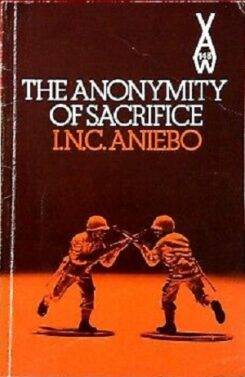
The Anonymity of Sacrifice is a compelling novel by Nigerian author I.N.C. Aniebo that provides a harrowing and unflinching look at the Nigerian Civil War (also known as the Biafran War) from the perspective of soldiers fighting on the Biafran side. The novel, structured in five parts, follows the intersecting lives of two central characters Captain Benjy Onwura and Sergeant Cyril Agumo as they navigate the brutal realities of war, grappling with issues of duty, ambition, fear, survival, and the ultimate meaning of sacrifice. Aniebo, himself a former officer in the Nigerian Army who served during the conflict, brings an authentic and deeply critical voice to the narrative, exposing the chaos, incompetence, corruption, and human cost of a war fought in the name of ideals but often undermined by human failings.
The title itself is deeply symbolic. “Anonymity” suggests that the sacrifices made by countless soldiers go unrecognized, their individual stories and deaths subsumed by the larger narrative of war. The anonymity of sacrifice is the tragedy of soldiers who die for causes they may not fully understand, whose names and contributions are forgotten, and whose deaths are often rendered meaningless by the incompetence of their leaders and the political machinations of those in power. The novel forces the reader to confront the uncomfortable truth that war, even a war of survival, demands sacrifices that are often neither noble nor remembered.
Part One: Captain Benjy Onwura – Background and Context
Chapter 1: Setting the Scene
The novel opens with a vivid, atmospheric scene. Captain Benjy Onwura, a young army officer in his late twenties, is driving through the thick jungle of night in his rectangular-nosed car. The wind rushes against the vehicle, and the rich baritone of Jim Reeves plays on the radio, creating a stark contrast between the peaceful, nostalgic music of lost love and the reality of a country at war. Benjy is returning from Port Harcourt, where he has spent time with his fiancée, Franca. He is a man divided one part of his mind focused on driving, the other reliving the sensuous hours with the woman he loves.
This opening scene establishes Benjy as a complex character. He is clean-shaven, with a thin line of moustache hugging his sharply defined upper lip, and has effeminately delicate lines on his face. He is a man of contradictions a soldier with a sensitive, almost feminine quality, a man who loves deeply but is entangled in a war that demands the ultimate sacrifice.
The journey is interrupted by a roadblock, a common feature of the wartime landscape. A young, inexperienced private soldier, barely trained, challenges Benjy. The soldier’s awkwardness and the absurdity of his rapid promotion from civilian to soldier in two weeks highlight the unpreparedness and makeshift nature of the Biafran war effort. Benjy’s irritation is palpable, but he refrains from reprimanding the soldier, recognizing that the poor bastard “did not know any better.” This encounter serves as a microcosm of the larger war a conflict where ordinary people are thrust into roles they are ill-equipped to handle, where discipline and training are sacrificed for expediency.
Benjy drives to Uyo, to the officers’ mess, a former senior civil servants’ official residence. It is here that he learns from his friend Sam that the brigade commander wants to see him urgently. The pervasive sense of foreboding that has been building since the roadblock intensifies. Benjy’s silent prayer “Oh God, let it not be for any bad thing. My Franca!” reveals his vulnerability. Despite his military rank, he is a man with a personal life, with hopes and fears, with a woman he loves and a future he wants to build.
Chapter 2: The Brigade Commander’s Summons
Benjy drives to Chalet One of the Progress Hotel, where the brigade commander is waiting. The commander is a young man in his early thirties, said to have “more brains than guts.” Benjy perceives the man’s charm and comradely air as a mask for a towering ambition that is ruthless and inflexible. The commander’s smile and smooth voice remind Benjy of a “bitter, sugar-coated pill” pleasant on the outside, but harboring something unpleasant within.
The commander reveals his purpose: the enemy is making a big push from Oji River, and Awka, Benjy’s hometown, is threatened. AHQ has nominated Benjy and Captain Okoye for battalion commands, and Benjy is to report to AHQ immediately to take command of his new battalion. The commander would have preferred Benjy to command one of his own projected battalions, but Benjy’s seniority and the opportunity the new command presents make it necessary for him to go.
Benjy’s emotions veer from jubilation to despondency. He has long desired a command of his own, and now it has come without warning, almost dropped into his lap. But the timing is terrible. He has just proposed to Franca that morning, and they have made plans for their future. Now, those plans are shattered. The commander’s words “You will be operating in a familiar area” ring hollow. Benjy is from Awka, and he will be defending his own hometown, a fact that adds an extra layer of poignancy to his mission.
The commander gives Benjy five hours to sort out his administrative problems. Benjy requests permission to go to Oron to collect his belongings and leave them with his next-of-kin at Port Harcourt. This is a pretext to see Franca again, to explain the situation, and to reassure her of his commitment. The commander is perceptive, and Benjy feels as though he has been “turned inside out,” his true motives read by a superior who seems to see through his carefully crafted words.
The commander agrees to send Benjy’s things to Port Harcourt, and Benjy is forced to accept this compromise. He has no time to see Franca. The commander arranges for a 404 station-wagon and driver to be waiting for Benjy when he returns from Oron. Benjy is told to hurry he hasn’t got much time.
As Benjy drives through Uyo, the town is asleep, but it is not a peaceful sleep. It is a “watchful emptiness, a lull like the calm before the storm.” This foreboding is mirrored in Benjy himself, who feels a deep lethargy and a sense of impending doom. He tries to counter this feeling by switching on the car radio, but all he gets is static. “Even the radio is in tune with the spirit of this night,” he thinks. This atmosphere of ominous quiet, of waiting for the storm to break, pervades the entire novel. The war has created a state of perpetual anxiety, a sense that something terrible is always about to happen.
Chapter 3: The Memory of Franca
The narrative then shifts to a flashback, revealing the details of Benjy’s proposal to Franca earlier that day. It is sundown, a period of gold and deep rusty brown, and Benjy and Franca are standing by his car. Franca asks whether she should tell her friends about their engagement, and Benjy, after a moment’s hesitation, says yes. They plan for Benjy to come to Port Harcourt on Sunday to see Franca’s parents. Franca’s mother is at Owerri, but they can drive to see her too “These days one can never be sure of tomorrow.”
This statement is freighted with meaning. In wartime, the future is uncertain. The characters live from day to day, never knowing whether they will see another sunrise. Benjy’s proposal is an act of defiance against this uncertainty, an attempt to create something permanent and meaningful in a world that is falling apart. But the war intrudes even on this moment of tenderness. Benjy’s words “I love you and … and I promise I’ll make you a good wife” (spoken by Franca, actually: “I love you and … and I promise I’ll make you a good husband”?) are a pledge that may never be fulfilled.
As Benjy drives away, he sees Franca in the rearview mirror, standing there, “young and vulnerable.” He is tempted to turn back, to gather her in his arms and reassure her of the reality of the future his marriage proposal had unfolded before her. But he drives on. He will see her in three days’ time. By then, she would be used to the idea of being engaged. His sudden proposal that morning had caught her unawares.
Now, as he glances at the set face of his brigade commander, Benjy wishes he had not proposed to Franca, and since he had, he wishes he had not promised to see her on Sunday. The new appointment is causing all the complications. If only the appointment had come earlier, or later. Or better still, if only he had got his command here. The “if onlys” haunt Benjy throughout the novel the sense that life is a series of contingencies, that choices have consequences, and that the war has robbed him of the ability to control his own destiny.
Chapter 4: The New Battalion
Part Two of the novel opens with Benjy arriving at his new brigade headquarters. He meets his new brigade commander, a small man in his early thirties with a few days’ black stubble on his square chin. The colonel’s sleepy, small eyes blink rapidly as he replaces the top of his fountain-pen and places it, with exaggerated care, on the half-filled sheets of paper in front of him. Benjy is surprised that a full colonel should have such a mild voice and seem so innocuous, but he knows that the man has brilliant exploits credited to him and has benefited from his Staff Course at the Staff College, Pakistan.
The colonel briefs Benjy on the situation. The Tenth Brigade has been struggling to contain the massive push of the enemy, but each time there is a sign of success, the enemy breaks through at a new point. The brigade has lost more than thirty miles and its casualties are high. However, it has captured enough weapons and equipment to arm two battalions, and this has made it possible to delay the enemy’s advance. Most of the time, its reinforcements arrive with neither arms nor the basic equipment that differentiates a soldier from a civilian. There seems to be a belief at command headquarters that once the enemy sees Biafran soldiers, they will leave their weapons and run away. This belief makes it impossible for unit commanders to plan comprehensively. They are never sure when they will get armed or unarmed reinforcements.
The enemy’s tactics are described in a letter from command headquarters: “Fire and movement a) In his use of fire, he takes advantage of his massive arty and mor fire power to disorganize our concentrations and def posns. b) In movement, he depends on his ferrets and salads which act as adv gd for his inf. 2. Intelligent and tactical use of routes, tracks and roads incl his mania for initiating flanking moves. 3. Flexibility in planning, constant appreciation and maint of obj.”
It is the use of massive artillery and mortar fire that has wreaked havoc on the Tenth Brigade. The brigade commander feels that the artillery shells and mortar bombs rain from the heavens. All he can do to counter this is either to move very close to the enemy or remain out of range. At no time has he more than ten mortar bombs, and these he reserves for known enemy concentrations. Despite this handicap, he maintains a vigorous defense and more often than not supervises the deployment of troops down to platoon level.
The 70th Battalion, which is bearing the brunt of the enemy attacks, has been fighting without relief since the war began seven months ago. It is the best of the four battalions in the brigade, and its soldiers are now completely armed with automatic weapons captured from the enemy. The latest fighting has reduced the strength of the officers and men to less than that of a company. The brigade commander has decided to relieve the battalion before its veterans and backbone are completely decimated, give them a week’s rest, and redeploy them in an area where the fighting is less heavy.
Benjy is to take command of the 10th Battalion, the relieving unit. He is elated as he drafts a Warning Order to his battalion. Dawn has broken, and the brightness of the day banishes the dim chill of night. A pleasant breeze wafts in through the windows, carrying with it deep rumblings of exploding shells and the sporadic chatter of small-arms fire. This does not dampen Benjy’s spirit. He is at last able to put into practice things he learned at the Mons Officer Cadet School in Aldershot.
Benjy’s training in England was a bitter experience. He remembers how terribly cold it had been, how ill-prepared he was psychologically for the numbing coldness, the snobbery and inhospitality of fellow British cadets, and the disdain and disregard of some of the officer instructors. He left carrying bitter memories of a school where, instead of being trained as a platoon commander, he was trained as number one on a Section Bren gun. The British boys got all the officer appointments during exercises and lorded it over the students from the black Commonwealth countries. This experience has left Benjy with a chip on his shoulder, a determination to prove himself, to show that he is as good as, if not better than, the British officers who looked down on him. This ambition is both a strength and a weakness it drives him to excel, but it also makes him arrogant, inflexible, and sometimes cruel.
Chapter 5: The Frontline
Benjy is taken to the front by Captain Madike, the brigade major. Madike is a tall, thin man in his early thirties with a most unsoldierly appearance. His uniform hangs on him, and his boots look too large and heavy for his stilt-like legs. His small face is oval, hairless, and adorned with glasses with very strong lenses. Before the war, Madike was a junior executive with the Coal Corporation at Enugu. Fired with nationalist feelings, he joined the militia, where, with his education (he is a graduate of the University of Ibadan), he progressed fast. The transition from militia to army was painless and gratifying, carrying with it a good appointment and a great deal of traditional respect. One thing marred this transition he had to come close to, and not just hear, the sound of exploding shells and mortar bombs. He has never known anything more fearful or destructive. At times when he is forced to get really close, his thoughts always go to his family a young wife and four children at Aba, and what they would do should he be killed.
Benjy initially is wary of this “upstart” brigade major but comes to like him. Madike sounds sincere in most of the things he says, easily acknowledges ignorance when he does not know, generally defers to Benjy in discussions of military tactics, and frankly admits fear fear of death. One thing he says endears him to Benjy: “There is a great deal of petty jealousy in the army today which was not there before. For instance, why should people insist that all the experienced army officers, that is, those formerly with the Nigerian Army, be at the front? That leaves the administration of the army to inexperienced people like us, and I know that no organization with poor administrative backing ever gives of its best. We can’t afford anything but the best. It’s our lives that are at stake.”
This statement captures one of the central tensions in the Biafran war effort the tension between experienced officers and inexperienced ones, between those who have trained in the Nigerian Army and those who have been hastily commissioned. The war has created a situation where the most experienced officers are sent to the front, where they are killed or wounded, while the administration of the army is left to those who lack experience and competence. This is a recipe for disaster, and Madike recognizes it. But recognizing the problem does not solve it. The Biafran war effort is plagued by systemic issues that no individual, no matter how capable, can overcome.
At the headquarters of the 70th Battalion, Benjy and Madike meet the commanding officer, Captain Singer-Brown from Abonema. He leads them to the forward locations using bush paths. They come to a line of unoccupied trenches. Singer-Brown explains that his second-line defense is based on platoon rather than company level because as soon as men are scattered, all commanders of units higher than platoon level lose control of their troops.
The first-line defense is about half a mile forward. “From now on we have to move carefully if we hope to get out of here alive,” Singer-Brown warns. “The enemy uses snipers a lot these days.”
All hell breaks loose when they get to the company headquarters. For Singer-Brown and his company commander, the cacophony is normal. For Benjy, experiencing it for the first time, it is overwhelming. The ground groans, and they take cover in a well-dug, four-man trench covered with cut palm trunks and reinforced with huge sandbags. Loose sand pelts down from the roof, and as the whine, chatter, and reverberating thud of the bombs increase, they fear the trench will bury them alive.
One particular sound fascinates Benjy a hollow, loud pecking, like a wood cutter’s axe biting into hard wood. But who would be cutting wood deep in enemy-held territory? And at that speed? It must be a new enemy gun. Singer-Brown explains that it is a Ferret, and that most of the shelling goes overhead, so the Ferret is their main problem.
The strength of the enemy is at least a brigade, possibly more. This news sets Benjy’s heart thumping. For a while, he is afraid he is going to faint, but the dizziness passes, leaving him weak and soaked with cold sweat. Then he feels the sensation he hates most a sinking in the pit of his stomach. He realizes that someone is pulling at his left sleeve. He turns and sees Captain Madike, whose face is a picture of fear dilated eyes, sweat-beaded forehead, quivering upper lip.
“Let’s go, let’s go back, back to the brigade. Let’s go back now please, I’ll lose my mind if this thing continues any more. Let’s go …” Madike whispers.
Just then the guns fall silent. Madike stops talking, his wide mouth hanging open, his Adam’s apple moving convulsively up and down.
Benjy wonders which is worse, the former noise or the present silence. He has no time to decide. From somewhere in front, a great shout goes up: “Ochebei! Ye-h. Ochebei! Ye-h. Ochebei! Ye-h!”
“Here they come!” the company commander mutters.
As if on cue, there is a shattering clash, like many small ekwes being beaten together, prolonged till it is one continuous sheet of sound. In the background, the cry of “Ochebei” continues.
Singer-Brown is the first to cock his Madison automatic rifle and lean on the parapet of the fire trench. The others follow suit, including Madike. This united action seems to calm Madike, reminding him that death is not inevitable and that he still has some control over his destiny. Benjy notes the expert, familiar way Madike cradles his rifle.
They never have to fire a shot, even though firing goes on all around them. Bullets whistle overhead, some thudding quite close, a few hitting the overhead cover. Singer-Brown insists that no one should fire until the whites of the enemy’s eyes can be seen. Benjy smiles at this traditional order, knowing how often it is disobeyed. He hopes that when his battalion finally takes over this area, he will be as cool as Singer-Brown, although he suspects Singer-Brown’s sang-froid is a product of kaikai he caught a whiff of it when they shook hands at the battalion headquarters.
The continuous harsh sound of automatic rifle fire, interspersed with the heavy note of exploding mortar bombs, makes the sun seem hotter than it really is. Most of the trees in the area have been destroyed, and it is now more grassland than secondary forest. Had Benjy not visited the area in peacetime, he would not have believed such devastation possible. The present desolation belies the fact that Ndiagu-Obinofia had been a noted garri-producing centre.
The day wears on, and with the cries of wounded and dying men filling the air, Benjy becomes increasingly angry at what the enemy is doing to him and his people. They had murdered, no, butchered his parents at Kaduna; thrown him into prison where they whipped him daily, fed him stale grain meal, rotten meat, and, once in a while, urine and faeces and when they were fed up, had thrown him out of the North and confiscated all his property. Now they have chased him into his own home, where he had gone to lick his wounds, and are bent on killing him, looting his few remaining possessions, destroying his land, and raping his women. Who could take those things lying down? Even a coward would have no choice but to fight. Cowardly acts are performed to save life. In this instance, a cowardly act is a clear invitation to death. If one deserts and joins the enemy, one is shot down before any questions are asked. If one deserts but does not join them and gets caught by one’s own military police, then one is condemned to death. So the best thing is to stand and fight, and keep on fighting either till one is dead or there is nobody left to fight against.
An extremely heavy explosion suddenly tears the air. The ground trembles. Three more giant explosions follow in quick succession, and the air fills with cries of agony.
“Thank God for obgunigwe!” Singer-Brown shouts.
Then there is silence. A silence that is more eloquent than any words.
“What happened?” Captain Madike asks, his voice awe-filled.
“The enemy is finished,” Singer-Brown says with a grin. “Fate!” he adds in his own dialect.
Benjy is glad the obgunigwe has stopped the enemy. It serves them right, he thinks. That will teach them to go after a defenceless man, to chase him into his own home. But they will never learn! They will come back with that fanaticism, that utter disregard for life which Benjy knows so well. And the time they will come will be when his troops have taken over from 70th Battalion. He and his men will have to reap the aftereffects of obgunigwe, and this knowledge dampens his spirits somewhat.
Chapter 6: Return to Brigade Headquarters
Benjy and Captain Madike get back to the brigade headquarters by lunchtime. They have been silent all the way back, each with his own thoughts. Madike is preoccupied with thoughts of his recent ordeal. At first, his mind refuses to take in any new impressions the new brown-green farms bordering the rutted road, the thick forests in the distance, the vultures, “infallible harbingers of death,” free-wheeling in hot currents of air under a burning light-blue sky. But he is blind to them all till the land-rover goes over a pothole and jolts him out of his reverie. Then he immediately thinks, “Oh God, what would have happened to my family if I had been killed?” With an effort of will, he forces this thought out of his mind, glancing guiltily at Benjy, but the latter seems miles away.
Benjy really is miles away. Now that he is no longer under pressure, his thoughts go immediately to Franca. He wonders what she would be doing most probably at work, as today is Friday. She always closes the office at three o’clock, getting home by half-past three. Her office is at the Savings and Loans Department of the Housing Corporation on Club Road. Had there been a telephone here, he would have phoned to say he would not be seeing her on Sunday as he had promised. Perhaps he should write her a letter. But it would not get to her before Sunday. Wouldn’t that be like medicine after death? God knows what she would think when Sunday came round and she waited all day and he was not there! And not a word from him! He should have tried to go to her last night even if it meant reporting late to his new brigade. Yes, that would have been the best solution. But the fact remains that he hadn’t gone to her. So what should he do? Write? Yes, write, and write soon. Would that change her inevitable opinion of him after Sunday? He hopes it would. It has to! He had never meant to take her for a ride. Right from the day they met, three months ago, he had played a clean if reckless game, with no thoughts of cheating.
The narrative then shifts to a flashback, recounting how Benjy met Franca. She had telephoned him to come to her office and sign papers for a three thousand pound loan for which he had applied. Her voice had not been particularly arresting on the phone, so he had gone there in a business-like mood, the thrill he used to feel at the prospect of meeting a new girl not present.
He meets Franca at the counter. She is polite, and her voice is surprisingly pleasing. She disappears through a door to fetch the papers, and Benjy notes that she has a becoming blouse and skirt and a good figure. The decor of the room is pleasing, and the atmosphere is kept cool and fresh by the air-conditioner. Benjy, who had been sweating from the afternoon sun, soon becomes cool and relaxed.
Franca returns with a sheaf of papers and a glorious smile. Benjy signs the papers, and Franca compliments him on his beautiful signature. There is a spark between them, a playful, challenging twinkle in her eyes. Benjy is attracted to her, and he offers her a lift home. She accepts.
As they walk to his car, Benjy asks her name. “Franca,” she says. “Franca Odunze.”
This memory of their first meeting is tender and bittersweet. It is a reminder of the life Benjy had before the war, a life of possibility and hope. Now, that life seems distant and unreal. The war has changed everything.
Chapter 7: Preparing for Command
Lunch at the brigade mess is a hurried affair garri with okro soup. Benjy throws the balls in as fast as he can swallow them. His men have arrived and have been carrying out the instructions contained in his Warning Order. He has spoken briefly to his four company commanders before going in for lunch and has liked all of them except one. Because of this, he decides not to assign their companies to them arbitrarily. He will do it when he has seen and spoken to all the senior NCOs, and particularly to the company sergeant majors, or their equivalent. He wants to assign a company with a tough, experienced sergeant major to the company commander he has not liked and suspects of being weak and stupid. Should he keep such a company in the reserve? He does not think he will do that. A reserve company commander should be strong and imaginative enough to turn a likely disaster into a stalemate at least. But then a defense is as strong as its weakest component! A poor commander in the front line could jeopardize a well-laid defense. Anyway, he still has time to think about the problem. The answer will, as often happens with him, come when he urgently needs it.
His light-blue Peugeot 404 station-wagon pulls up as he steps out of the mess. His orderly, a young, tall lance corporal, springs out, salutes smartly, and opens the left rear door.
“Go and get that car camouflaged,” Benjy snaps, returning the salute. “I don’t want to have to tell you what to do next time. You’re not one of the win-the-war soldiers. Meet me at the battalion resting area in thirty minutes’ time.”
“Yes, sir,” the orderly says, saluting once more.
Benjy turns away without returning the salute. He will control his battalion with arrogant harshness, especially in matters of discipline. It is the only way he feels he can knit them into a unit. He detests, no, hates units that disintegrate at the least sign of action.
He walks the half-mile to his battalion resting area, a former village playing ground, camouflaged from the air by lofty trees, many centuries old. Before long, Benjy thinks, if things do not go well, this place will be devastated by exploding shells, and the stink of dead men will pollute this sweet air. For a while, the fear he had felt at the front in the morning returns. “Oh, God, help us to overcome our enemies,” he prays.
He meets the RSM, a close-knit, tall man with a bristling moustache, whose salute is a whip lash. Benjy returns the salute precisely and asks about the men. The RSM says they are resting. Benjy wants to see them at rest, so they walk to where some of the men are sitting or lying down around one of the huge trees. The RSM shouts for them to sit up, and Benjy addresses them informally.
“I just wanted to meet you all informally,” he says in a low tone. “I suppose none of you know me?”
There is an embarrassing silence, broken by the RSM, who barks, “He is Captain Onwura. Your commanding officer.”
The men react in various ways some brace up, some look with more interest at the dark, young captain who now has the power of life and death over them, some look away, some wear a wary look, and a few look frightened.
“I say again, relax,” Benjy says, counting silently the number of men in front of him. There are twenty-five, and all look fit and well clothed, thank God, in Biafran Army khaki green.
He asks a sergeant for his name and appointment. “I am Sergeant Agumo, sir,” the sergeant says loudly. “Platoon Sergeant, First Platoon, ‘A’ Company.”
This is the first appearance of Cyril Agumo, the second central character of the novel. He is described as a big, fair man with brand new sergeant’s stripes on both sleeves, who had stared at Benjy with a mixture of curiosity and insolence. This brief introduction sets the stage for the complex relationship that will develop between Benjy and Cyril a relationship marked by mutual suspicion, class tension, and ultimately, violence.
Part Two: Sergeant Cyril Agumo – Background and Motivation
Chapter 1: Cyril’s Reflections
The narrative shifts to Cyril Agumo’s perspective. The excitement of action and enforced group activity is beginning to wear off, but Cyril still feels cheerful. On previous occasions, as soon as his duties for the day were over, a certain gloom descended on him, and he felt like one who, after a short rest, had picked up his load of firewood for the last, weary lap of the journey home. At such times, before he discovered the potency of the Bible as a cure for his peculiar sadness, he would douse his muscle-bound self in beer. When this proved expensive and eventually ineffective, he swam daily in the holy book. But today, for the first time since he came back from Northern Nigeria, he debates whether to read his Bible or seek the company of others. Remembering that he had been promoted sergeant that morning after eight years as a corporal and that he had not yet given thanks to God, he decides to read the Bible first.
The holy book is where he always keeps it under his pillow. He picks it up reverently and goes outside in search of a secluded spot. The Ologbo garrison had been a secondary school in peacetime. The soldiers, mostly in transit, are quartered in the dormitories, while the officers, both transit and permanent staff, are housed in the staff quarters. The classrooms are occupied by the non-commissioned officers, and the administration block is used as offices.
Cyril finds a place under one of the many acacia trees which abound in the compound. It is midway between the buildings and the vast playing fields which have now been converted into parade grounds. He sits so that he can see anyone approaching from either side. There is nothing he hates more than being surprised whilst reading the book.
He says a short, silent prayer and opens the book at his favourite passage, one which has consoled and nurtured him during difficult times: Ecclesiastes, Chapter 3. “To everything there is a season,” Cyril reads silently. His stubby right index finger traces the line as his lips form the words: “and a time to every purpose under the heaven: A time to be born, and a time to die; a time to plant, and a time to pick up that which is planted; A time to kill, and a time to heal; a time to break down, and a time to build up; A time to weep, and a time to laugh; a time to mourn, and a time to dance; …”
Cyril closes the book with a sigh and leans his head against the tree. Yes, there is definitely a particular time for a particular thing. At such a time, anyone who opposes gets crushed.
This passage from Ecclesiastes becomes a recurring motif in the novel, a philosophical framework through which Cyril interprets his experiences. The idea that there is “a time to kill, and a time to heal” is both a comfort and a justification. It allows Cyril to accept the violence of war as part of a larger, divinely ordained order. But it also raises uncomfortable questions. Is the killing in war justified? Is it “a time to kill”? And if so, who decides? These are questions the novel explores without offering easy answers.
Chapter 2: The Zaria Riots
Cyril’s mind drifts back to a time at Depot, Zaria, in July 1966, when the soldiers had gone on the rampage. Cyril had sent his family home immediately after the May riots, and but for his being a soldier, would have followed. So he had only himself to think of when things started happening.
Fridays were always half-days, being the Sundays of the Moslems. Cyril, as the storeman corporal, had locked up the armoury of ‘C’ Company at eleven o’clock on the morning of that Friday and had hung the key in its usual place on the keyboard in the company office. As a result of an excellent report at an inspection of weapons earlier in the day, he had been allowed to have Saturday off. With his wife away, he had not felt like spending any part of the weekend in his old, thatch-roofed, mud hut. Immediately after lunch, he had gone to town, determined not only to get drunk but also to sleep out.
Everything had worked according to plan, in spite of his not having enough money when it came to getting a girl for the night. He had just a three-penny piece left. Fortunately, the girl, an old acquaintance from Outkpo, trusted him enough to allow him to sleep with her on credit.
He was not destined to pay for that night’s enjoyment. Sometime after midnight, he was wakened by a commotion outside. Feeling around the bed, he discovered he was alone and concluded that his girl had gone out either to judge or take part in the usual prostitutes’ midnight brawls. Cyril forced himself to sleep again. Keeping awake meant putting up with the persistent hammering inside his head. He was sure he had not slept long when he was shaken awake by his girl. She was crying. His anger changed to concern when he saw, by an already lighted hurricane lamp, the state she was in; she looked as if she had been dragged through a thick thorn bush! Her thick lips that had been covered, or rather smeared, with a lush, bright red lipstick now looked like a small piece of bloody meat. Her eyes were swollen, and her hair might have been mushed by a February iska.
Even as he listened to her initially incoherent story, he wondered where he would get the money with which to help her. Payday was still two days off. But eventually, it dawned on him that she had received a beating on his behalf. She had refused to tell some rioters that he was an Ibo! Her girlfriends the whole yard was occupied by prostitutes, who had a stronger allegiance to one another than people who had sworn blood fealty had come to her aid, and after some fighting, the mob had failed to break into the house.
Cyril had had to crawl out through the small, wooden window, and by the time he slunk into the barracks, he smelt worse than a public lavatory. He had entered his house through the back door only to discover that it had been ransacked. Most of his valuable possessions had disappeared, his radiogram being the first thing he missed. He had managed to find a change of clothing, a good costume of yellow robe and baggy trousers, and without a backward glance had struck out for the railway station, using bush tracks.
There was no doubt at all in his mind that what he had seen that night was the confirmation of the rumours that the Hausas were either going to drive all the Ibos out of Northern Nigeria or massacre them. A long time ago, Cyril had come to the conclusion that since he was not a hero, it was better to avoid trouble than play with it. The morning found him on a train headed south.
The stories he heard later about how many people suffered in their attempt to get back to the East made him feel that God had paid special attention to his own escape. He was therefore quite ripe when the Jehovah’s Witnesses moved in to pluck him for their church. He became their torchbearer at the Enugu barracks, and when Enugu capitulated, Port Harcourt, till his request to be posted into the infantry was granted.
That request had been made barely a week ago, and today here he was to help form the 101 Battalion, which was expected to go into action soon in the Udi sector. And what was more, he had been promoted a sergeant, something he had sought for so long and almost despaired of ever getting till the fateful argument with his wife a fortnight ago had goaded him into action.
Chapter 3: The Argument with Maria
The narrative then recounts the argument with his wife, Maria, that led Cyril to volunteer for the front. It was Sunday, his day of communion and prayers, if only Maria would allow it. She always chose Sundays for family quarrels.
He had visited her and the children at her father’s house at Owerri on the weekend. He had overlooked the unenthusiastic way she had received him on Saturday and how the children, all six of them, had avoided him. It was nothing new. It had worried him when it started years back, but like everything else, he had adapted himself to it, with the faint hope that when the eldest, Mark, outgrew the need of a mother-crutch, he would turn to his father. Although Mark, now ten, had not shown any such signs yet, Cyril is still hopeful.
He had woken up late. The false quietism of Sundays in townships had already settled on the place. This was particularly true of Owerri, which was an ‘institution-town.’ There was one government and one Roman Catholic secondary school, an advanced teachers’ training school a former vast Shell B.P. headquarters and to crown it all, a seminary. The town itself consisted of two or three tarred streets. The main highway from Onitsha that split into two at Owerri, one going to Aba, the other to Port Harcourt, was one of these. Corrugated iron-roofed, one- or two-storied houses lined these streets, their outsides crying for fresh paint.
A cold wash having lightened Cyril’s spirits somewhat, he had decided to find out where the Jehovah’s Witnesses of Owerri gathered. On the way, he ran into some friends and acquaintances who diverted him to a palmy bar. After a moment’s hesitation, he soon found himself emptying glass upon glass of milky, sweet but abrasive okpokiri nkwu enu. His excuse for drinking was the empty, unfriendly, and spiritually deflating look of Owerri that morning.
He got home well after lunchtime, his mood ebullient and his outlook that of a conquering hero. The children were nowhere in sight, neither were his in-laws. That did not bother him. Maria was in the sitting-room, alone and idle. Again he read no special meaning into that, although when he looked back on it later, he thought he should have seen the rain clouds on her brow for what they were and taken a transport back to Port Harcourt.
“Where have you been, Cyril?” Her voice was soft, and her enunciation distinct.
Cyril ignored her and the question. He wandered aimlessly through their bedroom (his really, Maria having refused to sleep with him) to the backyard, kitchen, and back to the sitting-room.
“I am hungry,” he said in a high, aggressive tone. “Did you keep food for me? I haven’t had any food since morning.”
“This is not your house,” Maria said.
Cyril felt glorious anger welling up in him as he stared at her. My God, he thought, why did I ever stop drinking?
“What did you say?” he asked. His voice was still loud.
“It looks as if you’ve filled your ears with palm wine.”
Before Cyril could think twice about it, he had slapped her. At first, he was aghast at what he had done. He was one of those who believed that only weak, stupid men beat their wives, and here he was doing just that. For a while, he watched Maria’s pretty, oval face, to see if it would crumble and tears flow from the large, expressive eyes and down the cheeks that still retained their adolescent glow. But after the first spasm of pain, the face remained virtually expressionless, except perhaps for the dilated eyes, hard and bright.
“Is that all you are capable of?” Maria asked slowly. Her lips trembled slightly, and then her mouth tightened. “To beat a woman? You think that makes you a man?” She paused, and even though she spoke softly, the words came out hard as palm kernels as she continued. “Let me tell you, Cyril, men who are men are at the front fighting the Hausas. That is where you should be if you think you are a man. No, you won’t go there. All you know is to stay in the rear, drinking, and beating up women, whilst others fight and get promotions. Even small boys who only stopped sucking their mothers’ breasts yesterday are officers and . . .”
Cyril did not let her continue. He dragged her out of her chair into their bedroom. He locked the door and beat her systematically with his leather belt.
“That’s why you put me to shame at Zaria and Enugu,” he said to the rhythmic accompaniment of the slashing belt. “That’s why you kept having affairs with any small boy officer that looked at you. That’s why I do not know if the children are mine or not. That’s why . . . that’s why you do not do what I say. That’s why . . . that’s why . . . that’s why you play around with officers . . .”
Cyril stopped when his arm grew heavy. His anger had left him empty and somehow fulfilled. It was a new feeling, and it enabled him to look dispassionately at Maria as she sniffled on the floor. He hoped he had left some really long welts on that neat little figure. He was about to tear off her blouse and lappa to find out when the loud knocking on the door became more insistent. He was sure many people had gathered outside the house and in the sitting-room. He should have locked the sitting-room door before dragging Maria into the bedroom. But he didn’t let that worry him. He was determined not to be deprived of his feeling of triumph, and the best way to safeguard it was to get out.
He pulled out his small travelling portmanteau and threw in the uniform he had worn the day before. He would travel in mufti. Giving Maria a little kick on the rump, he opened the door and walked out. No one tried to stop him. No one followed him.
He volunteered for the front as soon as he got to the barracks. That night he wept silently in bed as he recalled the things Maria had said to him. Maria, for whom he had done everything and whom he had always considered first in whatever he did! To think that all along she had thought him a woman and been ashamed of him! No wonder she had set the children against him, and he had thought it was natural aversion! Although he had then lived in an alcohol-soaked world, she should not have done that! Not to him. He had paid one hundred and fifty pounds for her dowry a hard-earned bag and a half, when other women were lucky to fetch half a bag!
This scene is crucial for understanding Cyril’s character. His violence towards Maria is shocking and reprehensible, but it is also a symptom of his deep-seated insecurity and feelings of inadequacy. He has been passed over for promotion for years, while younger, less experienced men have become officers. He feels humiliated by his wife’s contempt, and his violence is a desperate attempt to assert his masculinity and control. But it is a hollow victory. He knows that beating a woman does not make him a man, and his decision to volunteer for the front is an attempt to prove his manhood in the only way he knows how through combat. This desire to prove himself, to gain recognition and respect, will drive Cyril throughout the novel, leading him to acts of both heroism and brutality.
Chapter 4: Life at the Garrison
The day is darkening when Cyril starts for his room, or to be more exact, dormitory. It is such a long time since he last lived in a dormitory that he still thinks of where he is staying as a room. He has now been two days at the garrison, and it has been a hectic time. The recruits brought from the training depots to make up the strength of the new 101 Battalion seem not to have learnt much during their training. Cyril and the other experienced non-commissioned officers have to put them through a tough programme, with the hope that they will, by the time they go into action, have learnt just one thing when under fire, take cover and return fire.
This morning they had gone through a short obstacle course with live bullets whistling over their heads. Cyril’s platoon, First Platoon, ‘A’ Company, had come first. It was after that that Cyril’s promotion had been announced, and he had become the platoon sergeant, as the other corporals who had vied with him for the post had not been promoted. Cyril is determined to make his platoon the best in the battalion. He will do it, in spite of the officers. Although he has yet to see them, what he has heard and seen of others does not inspire confidence. They are raw schoolboys who have been given only three weeks’ training at the so-called School of Infantry, and with no actual experience of live firing or command of troops, are entrusted with the lives of so many young soldiers.
He has seen many of these young officers at the Rainbow Town Barracks in Port Harcourt. The war has kept them out of school; otherwise, they would still have been mere schoolchildren. It is so easy to see this even when they are dressed in full battle order. They are fresh-faced, easily frightened, and undisciplined, with that cocky air of boys who have had some education. At Port Harcourt, Cyril had looked at them with contempt. They were inferior to him professionally no matter how many stars they had on their shoulders. In his job of storeman-cum-armourer, they had to take everything he said as law. Had he not been doing that job, at least the storeman part of it, for almost fifteen years?
Here, however, Cyril has decided to treat them differently because he will be under them, and besides, he has only been in the infantry for a few weeks. One thing he will not be, however, is a yes-man. If he is given what he feels is a wrong order, he will accept it and then do what he thinks is right. He is sure the stupid boys will not find out. Recently he has heard that officers often desert their troops when things get bad. That he will not stomach. If he ever discovers one of them trying to do so, he will shoot him down like a rat. Who did the fools want to do the dying for them? After all, with a little more education or luck, he would have had stars on his broad shoulders.
Cyril sighs as he thinks of stars on his shoulders. It is now one of his pet dreams. Often, when he shaves in the morning or happens to glance in a mirror, he would try to imagine himself in an officer’s uniform. First, he sees himself in the officer’s cap not the Nigerian one, nor the Biafran, but the brown, British officers’ S.D. cap. It would sit so beautifully on his large head, and to complement it, he would grow his moustache long and perhaps wax it. Then comes the green-brown splashed camouflage uniform. He would not wear it just anyhow as so many officers did. His would be carefully tailored, with the huge jacket and trouser pockets Obidiegwu’s had. He feels it would go as well, if not better, with his fair complexion and boxer’s physique, than it did with Obidiegwu’s darkness. Next come the stars, cloth type, slipped on to the shoulder strap, not sewn on, and … and three in number! That would fill his shoulders and bring out their breadth. Finally, the boots, rubber-soled, highly polished black, reaching well over the ankles so he could stuff the trouser-legs into them. He has seen one officer, well under six foot, wear it that way and look good in it. And this is where Cyril’s imaginings always stop. He just sees himself in the uniform, standing there proudly and looking handsome, dashing, and disdainful. Not once has he ever thought what he would do when he got into the uniform, or how, for that matter, he would get into the damned thing, especially as he never sees himself as a second lieutenant but always as a captain.
This fantasy of officer rank is revealing. It shows Cyril’s deep-seated desire for status and recognition. He has been a corporal for eight years, passed over for promotion time and again. He feels that he deserves better, that he is capable of more. The uniform represents not just military rank but social status, respect, and power. It is a way of transcending his humble origins, of proving that he is more than just a storeman-cum-armourer. But it is also a fantasy that blinds him to the realities of command the responsibility, the burden of decision-making, the loneliness of leadership. Cyril wants the trappings of rank without fully understanding what it entails.
Chapter 5: The Night Out with Okon
The electric plant stutters into life as Cyril walks into his dormitory. He goes straight to his bed, a single, Vono, and puts away his Bible. He checks his things a great deal of stealing goes on these days in barracks and garrisons all over the country. Nothing is missing. He takes out his plates and cutlery and goes to the sergeants’ mess next door. It is already full. Once again, he has come late for supper, and as he expected, he is given the remnants of yam porridge, messy and pale yellow, with no relieving dark-green spots of vegetables or colourless ones of onions. He finds a seat at a crowded table where he feels he knows no one and grimly spoons the food into his dark-lipped, large mouth. These days, staying alive is the important thing.
Standing on the steps of the dormitory afterwards, he feels a big hand clasp him on the right shoulder. It is Sergeant Okon, platoon sergeant of Number Two Platoon, ‘A’ Company, with his usual toothy smile.
“What are you doing tonight, Cyril?” he asks, his voice harsh and loud as though his throat were made of the dry bark of bamboo.
“Nothing.”
“Good. You will escort me somewhere.”
“Where?” Cyril asks as they move into the darkness. Sergeant Okon’s requests always come out as orders, and no NCO of the same rank or below ever disobeys.
Okon ignores the question. He leads the way to the huge gate of the garrison two cement pillars with an iron crossbar. The guards at the gate challenge them, and after perfunctory examination, let them out. Cyril wonders where they are going and why he has not refused to accompany Okon as he normally would have done. He had decided when he came here not to have any close friends, so that nobody’s misfortunes would affect him in any way. He wants to work alone, with his God as his sole companion. That way, he will make the impression he wants and thereby achieve his ambition.
After some thought, he soon traces his easy acquiescence not to fear of Okon but to the restlessness he has felt after his meal. As far as he can tell, his restlessness is not a longing for action. He has been busy all day and has really felt tired. No, Okon’s request has come when he has needed a diversion, and he has therefore jumped at it.
“Our officers will be coming tomorrow,” Okon suddenly says from the darkness.
“I heard the same thing,” Cyril says. “Do you know any of them?”
“No. Most of them are new officers who passed out of the School of Infantry yesterday.”
“You mean, we will not get any experienced officers?” Cyril asks incredulously.
“A small number.”
“Chukwu nna,” Cyril thinks, “they are going to do what I fear most … new, young, and poorly trained officers are rushed in to take immediate command of new, equally young, and inexperienced troops, and without any time for familiarization, they are committed to the war front, not in a routine defensive action but in a tough attack or counter-attack or, once in a while, disastrous retreat and rear-guard action. As night followed day, so the new battalion a battalion in name only got smashed and became a flotsam of stragglers. Most of the officers and NCOs threw away their rank insignias, anonymity facilitating their escape from the war fronts. The soldiers themselves scattered in all directions, some running into the enemy to be captured. The majority, one way or the other, found their way to their villages where for days they would brag about their imaginary exploits and were feted by their kinsmen. When they felt they were overstaying their welcome, they trickled back to the units to which they had belonged before they were sent to form the now defunct battalion.”
This passage is a devastating critique of the Biafran war effort. The cycle of hastily formed battalions, poorly trained officers, and inevitable disintegration is described with bitter irony. The soldiers who desert are not cowards in the traditional sense; they are victims of a system that sets them up to fail. The “anonymity” of the title is here given concrete meaning the anonymity that allows officers and NCOs to tear off their rank insignia and escape, the anonymity of soldiers who scatter into the bush and find their way home, the anonymity of death itself, where individual lives are lost in the chaos of war.
Silently, Cyril prays that this will not happen to his battalion. There are always exceptions to the rule, and why shouldn’t his unit be one? Unlike other hastily formed units, his boys have now had a few extra days of training with their NCOs. Admittedly, this is not enough, but it is better than nothing.
“We are lucky to have had some days’ training with our boys,” Okon says as though reading Cyril’s mind. “Without it, what happened to Seventeen Battalion would have happened to us.”
“Yes. You are right.” Cyril still remembers how Seventeen Battalion had disappeared overnight. It had started with over one thousand soldiers drawn from all the then existing battalions. Their officers, mostly ex-Nigerian officers and therefore experienced, had been brought from all the corners of the country to work together for the first time in their lives.
“I have always said the strength of a unit depends on its NCOs. You remember how the British NCOs used to control the old Nigerian Army? They did all the work and saw to it that there was discipline. If it hadn’t been for them, those young and stupid National Service officers we used to get would have spoilt the Army. I think our new officers are just like those National Service officers.”
“Yes,” Cyril says. “But you cannot compare our NCOs with the NCOs.”
“Why?”
“We do not have their experience.”
“Nonsense.”
“And we do not have the support of the officers like they had.”
As though to emphasize the truth of what Cyril says, there is a rumbling from afar off.
“God don begin shell,” Okon says in pigeon English.
Presently they cross the hard and smooth tarred road from Orlu. The thundering has increased, and a wind has sprung up, pleasant but threatening.
“Why did you not tell me we were going to a bar?” Cyril asks as they walk towards a lighted doorway, through which floats the unmistakable sour scent of fresh palm wine and the sounds of uninhibited laughter and hoarse cries.
“This is not a common bar,” Okon says, and walks into the lighted room.
Cyril follows after a moment’s hesitation and finds himself in a small room, furnished like the sitting-room of a residential house. The stench of palm wine and cigarette smoke is almost overpowering, and yet only four men are drinking there. The men, casually dressed in trousers and open-necked shirts, sit round a big table placed centrally in the room. In front of each man are two or three bottles of palm wine, a glass full of it, and a flat plate containing some pieces of chicken. Each man also has a lighted cigarette between thick lips or dark fingers of the right hand. The hurricane lamp on a crude lectern bathes everything in the room in its yellow light, emphasizing the innocuousness of it all.
“Okon my man!” shouts one of the men. “We have been waiting for you.”
“With many bottles inside you!” Okon retorts. “Cyril, don’t mind these drunkards,” he says as the men round the table laugh out loud. “Sit down there. I will soon be back.” He disappears through a door with a tattered curtain.
Cyril goes to the vacant chair Okon has indicated. His uniform makes him self-conscious, and as he has not yet made up his mind whether or not to drink, he appears shy. The decision is made for him when a small boy, dressed only in a pair of shorts, places three bottles of palm wine in front of him and pours out a glass.
“Drink up!” says the man who first shouted at Okon. “Don’t wait for Okon. He won’t come out soon, even if this house is on fire.” The man snickers, and the other men laugh, throwing glances at Cyril. When they see that he does not want to or cannot join them in their revelry, they ignore him.
Listening to them as he drinks his wine slowly, Cyril realizes that they are fairly well-educated men. They have a good command of English even though they throw in Ibo words now and then. Initially, Cyril had thought that they had not introduced themselves because they were illiterates and so knew no better, but now he feels that they have not done so deliberately to snub him. The anger that begins to well up in him sharpens the taste of the palm wine and makes him listen closely to what they are saying anger always sharpens his perceptions. Bloody, idle civilians, he curses under his breath, all they know is gossip, gossip! If I had my way … he shakes his head and then listens closely to the men round the table as what one of them says catches his attention.
“Did you listen to our radio this afternoon? About the bombing this morning?”
“No. My batteries are dead.”
“Eabulu twenty, meluo forty aru. One woman ku nwa naka n’elead ozo so na ndi eabulu … Va na the children?”
“Yes. All wiped out.”
“God! This bombing of civilians! I can’t understand why they do it. Those pilots …”
“Yes, when they get home ekwefa naka.”
“For killing women and children?”
“They are Ibos. That is all that matters.”
“Sometimes I think the pilots are afraid to bomb the soldiers.”
“They don’t want to be shot down. So they just drop the things anywhere.”
“That was before. Not now. Anyi ka fa chozilu.”
“Imakwa, Ufodu anyi di supposed inwu … Did you hear about the thief?”
“The thief?”
“Yes. N’afia. Oge madu nine n’e take cover, o n’ezu ji.”
“Fa nwudelu.”
“Eabulu va! Killed him! Blood ju ebenine.”
“Thieves! Ndufa di iche!”
“Serves him right.”
“What did the Police …?”
“No policeman can intervene at such a time. They will kill him too.”
“Serves that thief right anyway. Na uwaya ozo, oma ‘bu a thief!”
“If you had seen the blood! All over! When the thief was dead, the truck drivers were asked to do their job. They picked up the body and threw it into the lorry just like, like akpa akpu. No questions were asked. Then they drove away.”
“Obala abago ndi nmadu anya.”
“Money! We will do anything for it!”
“If you want to know if an Ibo man is dead, jingle money near his ears. If he does not move, then he is dead.”
“Those bloody Hausas!”
“Fa di right – for once.”
“This Udi thing. There is money in it. Some say it is £2 million. These Sabo. They will sell their mothers! Fa bia enjoya ego.”
“They have changed all the commanders there.”
“Is it true the Udi people helped the enemy?”
“Yes. They said they were not Ibos.”
“Like Nsukka. But they soon changed their minds when their brothers liberated them.”
“Where does the commander of the troops at Udi come from? Someone told me yesterday but I have forgotten.”
“I do not know.”
“Neither do I.”
“Why do you ask?”
“Fa si na o mebihu the defences of Udi.”
“Perhaps he got some of the £2 million.”
“I hope he’s under arrest. If I get my hands on any …”
“I have always said they should sack all the officers commissioned before Biafra’s independence.”
“That is impossible.”
“Since that Ifeajuna thing, I cannot trust any of them.”
“There are some that are good. The Generals are all right.”
“Well, they have to be or they would not …”
“I wonder why these sabo came back here. If they loved the Hausas so much they should have stayed with them. Like Mena-kaya.”
“Do not mention that name!”
“All his relations have disowned him.”
“Biko k’anyi kwue maka ife ozo …”
The conversation of these men provides a window into the civilian perspective on the war. They are cynical, gossipy, and deeply suspicious of the military and political leadership. They speak of corruption, betrayal, and incompetence. The reference to “that Ifeajuna thing” is a reference to Major Victor Banjo and the attempted coup against Odumegwu Ojukwu, which was seen by many as a betrayal of the Biafran cause. The men’s cynicism reflects a broader disillusionment with the war effort. They have heard too many promises, seen too much corruption, and witnessed too much suffering to believe in the nobility of the cause. Their gossip about the £2 million and the selling of defenses reflects a pervasive distrust of the military leadership a belief that the war is being lost not because of the enemy’s strength but because of the treachery and incompetence of those in power.
Chapter 6: Meeting Grace
The curtain covering the door through which Okon had disappeared parts, and Okon emerges, followed closely by a strikingly beautiful pregnant woman. The room falls silent as they go over to Cyril.
“This is the friend I was telling you about,” Okon says, his abrasive voice surprisingly soothing. “Cyril, my wife, Grace.”
Grace laughs, a soft laugh that seems to light up her fair face. “Do not mind him,” she says. She has white even teeth, and her pregnancy becomes her a perfectly round protuberance that enhances her tall figure. It has not bent her backwards from the waist and does not seem as if it will. “I am not his wife, yet.” She laughs again.
“I am pleased to meet you,” Cyril says, standing up to shake her plump hand. He is beginning to feel the effect of the palm wine, and with the boldness it lends him, he looks into her eyes. He finds her desirable, and with the thumping of his heart, he thinks she finds him the same.
“Okon, my man, you better watch out,” shouts one of the men around the table. It is the man who had greeted Okon first, a small, dark fellow with the domed forehead of an intellectual. Cyril, seeing the murderous look Okon throws the man, realizes that they are rivals, and so probably are the other three men.
“Okay, do not start anything today,” Grace says in Ibo and laughs.
She reties her lappa, and in the process, momentarily, and intentionally Cyril thinks, displays her very fair right thigh.
“A reigning wrestler must be prepared to be challenged any day,” Okay says with a loud laugh in which others join.
“What did he say?” Okon asks. His thin-lipped broad face shows that he knows he is the source of the laughter.
“Do not mind them,” Grace says, hooking her right arm in his. “You want to drink before you go?”
“No. Cyril, let’s go. I’ll see you tomorrow, Grace.”
Cyril extricates himself from the chair, and as he follows Okon out without looking back, he hears Okay ask in his affected Onitsha Ibo: “What do you see in that man, Grace?”
She must have given them a funny answer. Loud laughter pours out of the room and pursues the departing soldiers. Okon quickens his pace, as if running away. They have gone on for some time in silence when Cyril asks, “What did Grace mean when she said she was not your wife yet?”
“Her husband is a civilian who is working at Umuahia. But I got her pregnant, so to me, she is my wife.”
There is one more question Cyril wants to ask, but on reflection, he feels he already has the answer. Okon had definitely made love to Grace while he was with her in the room that night. The thought of it makes Cyril feel the vestiges of an impotent anger. Now he knows Maria had deceived him each time she said it was wrong for a pregnant woman to make love! Her deception probably made it possible for her to satisfy her lover! Maria! Who knows what she is doing now he is not around? She must be running around with one of the new officers. He is sure if a trap was set for her with an officer as bait, it would catch her.
“Oh, God, help me to become an officer one of these days so I can have my own back!”
This scene is rich in irony and foreshadowing. Cyril’s encounter with Grace, a pregnant woman who is not Okon’s wife but is carrying his child, mirrors his own situation with Maria. He projects his own insecurities and suspicions onto Maria, imagining her with other men, even though he has no evidence. His prayer to become an officer “so I can have my own back” reveals the deep-seated resentment and desire for revenge that motivates him. He sees rank not as a responsibility but as a means of getting even with those who have wronged him his wife, the officers who looked down on him, the system that passed him over for promotion. This desire for revenge will have tragic consequences.
Part Three: The Battle for Awka
Chapter 1: Benjy’s Nightmare
The narrative returns to Benjy. He wakes up in terror, his heart beating as though it would burst his chest. His back is one burning, wet heat even though he has on only a light cotton lappa. He shifts to another part of the wide bed to ease the heat. Slowly his heartbeat subsides, and he can hear the booming sound that must have woken him. Those bastards are at it again, he thinks. As there is nothing he can do about the shelling, he lies still, trying to rid himself of the fear with which he has woken a fear he thought he had conquered long ago.
The narrative then explains the origin of this fear. It first manifested itself on his fifth night in the Kaduna prison in 1966. Before then, his arrest and imprisonment had not worried him. He felt it was all a mistake. As far as he was concerned, what was going on in Lagos was a tussle for power between high-ranking officers, and he was too small and far away to matter.
What happened on the fifth night of his detention changed the complexion of things. His eyes had flown open just before dawn. The cell was pitch dark. He stared around wildly, trying to find out what had frightened him out of his sleep. He could see nothing, and none of his seven cellmates seemed to be moving. He was beginning to think his dream had scared him awake when he heard a high-pitched cry of anguish that ended on a long-drawn-out, hoarse note. He sat up quickly, staring in the direction from which he thought the sound had come. His heart thumped anew. Then the cry came again and again, and by the fifth time, he and the other officers were crowded round the barred wooden door of the cell. No one spoke. It was not necessary. The harsh breathing that filled the air was eloquent testimony of how everyone felt.
Minutes after the cry, there came the tramp of booted feet. They spelled a purposefulness that was not well-intentioned. The boots halted at the cell door. Benjy and his fellow officers instinctively moved back. The huge key was unlocked, and the door creaked open to reveal four soldiers and the warder, who held a lantern. One of the soldiers walked into the cell first. He wore the insignia of a regimental sergeant major on his right wrist. From the file he carried, he called out as though on a commanding officer’s orders: “Lieutenant Uwagwu?”
No one answered. The RSM glared at them for a while and then looked down at his file with a frown. Another glare and another frown convinced him he must have got the name wrong. He then turned to his companions, and Benjy was shocked to see a second lieutenant detach himself from the other soldiers.
“Lieutenant …” said the second lieutenant hesitantly. “Lieutenant Uwe … Uwa … a … gwu. Lieutenant Uwagwu.”
“Here,” answered Uwagwu, coming into the sphere of influence of the lamplight. He had only his trousers on and was barefoot.
The RSM, muttering a curse, slapped him hard and then knocked him down with a blow to the solar plexus. Immediately the other soldiers and the second lieutenant sprang on him and carried him out, each holding a limb.
They brought him back more dead than alive, his trousers torn to shreds, his formerly fair back a mass of black-red weals, and his face swollen to twice its original size. They dumped him on his narrow, plank bed with a curse, and the next morning, and for the next four mornings, they came for a new man, till the arrival of a white military doctor saved the remainder.
So every morning since then, Benjy had woken up with a fear-parched throat, his bed wet from sweat, his limbs heavy, and the usual question in his head … “Will it be my turn today?” This had continued till he dreaded sleeping at night and took to sleeping during the day. It had not helped. It had, in fact, made things worse. The fear became more vivid in the day than at night. Psychiatric treatment had lessened the frequency of the occurrences. Getting to know Franca helped further.
This morning, the first with his battalion, he knows he does not need to ask the question. He already knows the answer.
This passage is one of the most powerful in the novel, a visceral depiction of trauma and its lasting effects. Benjy’s fear is not a weakness; it is a wound, a psychological scar left by the brutality he witnessed and experienced in the Kaduna prison. The arbitrary nature of the violence the RSM’s confusion over the name, the random selection of victims is particularly terrifying. It underscores the helplessness of the prisoners, their complete lack of control over their own fate. This experience has shaped Benjy’s psyche, making him perpetually vigilant, perpetually afraid. It is a fear that no amount of military training or combat experience can erase. It is the fear of the unknown, of the arbitrary, of the capricious violence that can strike at any moment.
Chapter 2: Morning at Battalion Headquarters
Benjy swings his feet off the bed onto the cold, cemented floor. He is once more in control of himself and does not feel like staying in bed any longer. He shaves by lamplight, and by the time he has finished dressing and having a tinned breakfast, dawn has broken. He walks to his office, which is in a nearby building. The shelling now sounds farther away than it had at dawn. He is glad he moved his HQ back to this school compound. Even though he is as dedicated to the cause of Biafra as Captain Singer-Brown, he does not believe in taking unnecessary risks. If a snake’s head is cut off, what use would the body be?
At the office, he goes through the sitrep (situation report) of the day before. Biafran forces continued to check the advance of the enemy in all sectors, inflicting heavy, and in one or two cases, very heavy casualties on the enemy, while their losses were of course minimal. Benjy cannot help smiling at the optimism and smugness most of the sectors exhibit in their sitreps. All that would change when the federal troops decide to make a real push, he thinks. They often reach their professed destination once they get started. This has been proven so many times that everyone knows it, except the ‘higher-ups’ who continue to react slowly to every federal move and sometimes even fail to react at all. Benjy hopes they will not do so this time. It would be absolutely disastrous.
Benjy sits back for a while, thinking about what he will do about his father’s house at Awka town. “Better evacuate the furnishings,” he thinks. “There is nothing I can do about the house itself, and there is no doubt Awka will soon fall to the enemy. Should I try now to reconcile myself to the loss of the house … and its contents?”
He shouts for the Chief Clerk and asks him to fetch the MT (Mechanical Transport) sergeant. Benjy then goes through the signals that have come in from his companies he had instructed that he should not be woken up except for op IMMEDIATE messages. Glancing through the messages, he is glad his men have successfully completed the relief of 70th Battalion and are now in full control of the area. He drafts a message to the brigade culled from those from his companies. The only extra information he adds is that of the continued shelling, which he says is “however not effective.”
He has just put the draft into the OUT tray, made of an empty food carton, when the MT sergeant comes in and salutes. Benjy asks if they have any free lorries. The sergeant says they have one. The others have returned to brigade. Benjy orders the sergeant to fuel the one they have, find an army driver and an escort, and let him know when it is done.
Benjy turns his attention to the other files in his IN tray. He wants to get through them quickly so he can visit the front and see for himself how his troops are faring. He is working on the last file something about nominations for an officer cadet course when what sounds like a land-rover pulls up, and a few minutes later Captain Madike walks in. They shake hands, and Benjy offers him the only chair in the room.
“I came to see how you were getting on,” Madike says with a smile.
“Fine,” Benjy says, closing the file and putting it back in the IN tray. He will deal with it later. Besides, he does not know his men well enough to nominate any of them.
“I didn’t know you had moved your headquarters. It took me some time to find you.”
“I was going to send the signal this morning,” Benjy says, relaxing in his chair. “I moved very late last night. I think that a commander conducting an area defense should not let himself be too involved in the normal fighting, otherwise he would not be able to see things in their right perspective. After all, the commander has to see the overall problem each time so that he knows where and when to commit his reserve. If he gets too involved, say, in a company, he sees things only from his position as company commander, and he will not be able to help the other company commanders when they run into difficulty.”
“I see your point there,” Madike says. “I just hope your unit commanders will inform you when they run into difficulty. And that they will tell you the true state of things too! Most of our commanders are inveterate liars.”
“My God! Don’t let them hear you.”
“They won’t do anything because they know it is true.”
“Perhaps. But calling them inveterate liars is a bit hard. You forget I’m one of them.”
“No, I haven’t forgotten. That’s why I didn’t say all commanders. What would you rather I called them?”
Benjy thinks for a while and says, “Patriotic exaggerators. Patriotic exaggeration is a national pastime. Remember the diplomatic recognition thing immediately after our declaration of independence? About eight countries, wasn’t it, were supposed to have recognized us. And yet none, absolutely none had!”
“That’s right,” Madike says, smiling. After a pause, he says, “It looks as if the enemy will give you a holiday today.”
“Why?”
“They’ve stopped shelling.”
“I hadn’t noticed,” Benjy says after listening intently. “One gets used to these things quickly and takes them for granted. But I don’t think they’ll give me a holiday. By my calculations, they should make a big move today. I think this is just a short pause. When they strike again, it’ll be like hell.”
“But we have hit them very hard in the past few days.”
“That’s why I won’t get a holiday.” Benjy draws a message pad towards him. “I better start asking for reinforcements now.”
“You won’t get any …”
“I know – till it’s too late! There is no harm in putting my request on record.” He starts drafting the message and then stops, his ballpoint pen poised. “Didn’t I tell you?” he says, looking up at Madike, and catching the sudden widening of his eyes, distorted by the thick glasses. “Poor chap,” Benjy thinks, “he can never get over his fear of shelling. But who can ever get over it? That involuntary shock when one hears it for the first time, whether it is a resumption or a beginning, can never be mastered. Somehow the damned thing always sounds louder than one’s wildest imaginings. Louder and more ominous. Even I can feel the fever of fear already rising in me no matter how unafraid I try to appear.”
“My MT sergeant,” begins Benjy in an effort to distract Madike’s attention from the shelling. He has to raise his voice to be heard above the shelling – so close and concentrated does the damned thing sound. He signs the signal with a flourish and puts it into the tray for collection. He shouts for the chief clerk, who comes and clears the tray. “My MT sergeant,” he says again, but loud this time, “said all the lorries have gone back to you.”
“Yes,” says Madike with a visible effort at concentration. “We had to send them to the training battalion to collect our reinforcements. We left one for you for local administration.”
“How many men are you getting from the training battalion?”
“Who knows? We asked for a battalion strength, armed or unarmed.”
“You’ll get them, unarmed.”
“Oh?”
“That’s what they used to send us when I was at Port Harcourt. I have asked for a company strength reinforcement. Is that all right?”
“Yes, I think so. I better take a copy of your request with me. I’ll get to the HQ before your signal does.”
When Madike leaves, the MT sergeant comes in to report that the lorry is ready. Benjy sends him off with the keys to his father’s house at Awka and directions on how to get there. He also gives him the name and address of a relation living at Port Harcourt to whom the things removed from the house should be sent. Then in the letter he writes to the relation, he encloses a short note to Franca, telling her of his inability to come the next day as planned. While he writes that note, he can see in his mind’s eye Franca’s joy-suffused face changing into a hurt-filled one, and perhaps, yes certainly, tears filling those appealingly large eyes and overflowing. But what could he do? Nothing more than what he is now doing. Absolutely nothing.
Chapter 3: The Visit to the Front
Benjy suddenly feels too despondent to do any more office work, and the OP IMMEDIATE signal the chief clerk brings in does not make him feel better. It is one of those periodic signals from Defence asking for backloading of ammunition and weapons. Benjy quickly glances at the ‘action-addressee’ and is glad to find that his brigade only is being informed. “I was right when I told Madike the brigade would only get unarmed men as reinforcements,” he thinks. “There is nothing in the Ordnance, and I doubt if the brigades to whom this signal is addressed will each be able to backload sufficient weapons and ammunition to arm a company. Where will they get them from? And if they have them, they will be stupid to send anything back. They already know how nearly impossible it is to get equipment from the Ordnance when they need them. There is always a more important crisis going on somewhere else!”
Benjy still remembers how during Bonny operations he used to run to the Ordnance and virtually beg for equipment as though he was going to use it for the defense of his father’s compound rather than the country! That was when he discovered that sending operation plans to the Defence was a waste of time. Nobody read them. Or when they did, they took no action. Playing it off the cuff seemed to be the accepted practice!
Benjy looks through the newspapers, which are now being published on foolscap sheets – only the government-owned paper still had newsprint. There is nothing important in them. As usual, they are filled with pledges of support to the government from various organizations and communities. Benjy wonders if they all really exist, like the Umunkita community? “That’s a reasonable thought,” he says to himself, shutting off his mind.
The shelling has not lessened appreciably when he gets through the papers and decides to visit his troops to see how they are taking it. He tells his chief clerk to send all important incoming messages to the company headquarters of the reserve company. He is going to start and end his visit there.
He takes only his orderly with him. There is no point taking his car for a few yards’ ride. Most of his journey will be by bush paths.
The company commander whom he does not like (a Lieutenant Dike from the brigade at Obubra) is commanding the reserve company. Benjy has given him that command because he has decided to lead the company into action himself. That way he will ensure that his trump card is not played by someone he does not trust. With this in mind, he has deployed the company just before the first secondary defensive position at Akukwa.
Benjy meets only the company sergeant major at the company headquarters, a private mud house roofed with iron sheets. “Where is the company commander?” Benjy asks.
“He went to battalion headquarters, sir,” the CSM says.
“When did he go?”
“More than an hour ago, sir.”
“What did he say he was going to do at the headquarters?”
“He said he wanted to see you for orders.”
Benjy controls his anger. No point venting it on the wrong head.
“Do you know where the platoons are deployed?”
“Yes, sir.”
The CSM leads Benjy to the platoon locations. Just as he feared, he finds the men, most of them armed with bolt-action rifles nicknamed Igbokwe, sitting under palm trees, some frightened, others apprehensive. The officers, second lieutenants fresh from the School of Infantry, are indistinguishable from their men.
Benjy, remembering that he had been taught at the British Officer Cadet School that officers should never be reprimanded in front of their troops, takes the platoon commanders aside and tells them off. He informs them that if they do not put into practice what they have been taught during their training, he will have them court-martialled and cashiered from the army.
“Now, gentlemen, get a grip on yourselves,” Benjy says, in the best British officer tradition. “The time for games is over. You have the greatest job in front of you, a job for which you were trained, and that is the defense of your country, and your kinsmen. Woe betide you if you let your people down. You can be sure I won’t let you go free if you do. I will certainly send you to hell, and whilst you’re there, I’ll make sure the fire is kept burning. Now get back to your men and show me what you are made of. From now on, I’ll keep my eyes on you.”
The boys, which is what they really are, slink back and try to get their men organized. But Benjy soon sees that it is virtually beyond them. The men are frightened of the shelling, which has continued unabated, and their officers cannot give them the confidence they need to overcome this fear. The non-commissioned officers, who have been with them longer and are mostly former Nigerian soldiers, are of no help either. Fear is more contagious than bravery.
“And this is my trump card!” Benjy thinks as he takes over and, with the aid of the CSM, gets the company properly deployed. By the time he leaves them to return to the company headquarters, he can see that his apparent utter disregard of the shelling has borne fruit. His reserve company now looks more like a company, although he cannot say how the men will react under fire.
He gets back to the company headquarters to find Lieutenant Dike there.
“Where have you been?” Benjy asks as soon as he walks into the office. He has to make a special effort not to be affected by Lieutenant Dike’s twinkling eyes and merry smile.
“Good morning, sir,” Lieutenant Dike says, standing up and saluting in his carefree way. A huge, dimpled smile has already appeared on his dark face as he comes out behind the desk. “I went to see you, sir.”
“Sergeant Major, you can leave us,” Benjy says, taking over the chair Dike has vacated. “So you went to see me?” he continues in a light tone. “And what happened to you on the way?”
“Nothing,” says Dike, still smiling, his stance and the spruceness of his uniform dubbing him a playboy, a class of person Benjy dislikes. They do not take life seriously, and nothing is important to them, nothing!
“Nothing? In that case, regard yourself as being under close arrest.”
Dike stands stock still for a while. The smile has disappeared from his face – something Benjy had thought was impossible – and he now looks slight, young, and vulnerable.
“You’ll not move out of this headquarters without an escort.” Benjy goes on implacably. “You are relieved of your command with immediate effect. As soon as I can, I’ll have you tried by the brigade commander for AWOL.”
“But, sir, I went on official business and I am the most senior person here.” Dike speaks fast as though he is running out of time.
“You lie,” Benjy says slowly. “You did not go to see me. Sergeant Major?”
“Sir?” answers the CSM from outside.
“Get me three MPs. One NCO and two.”
“Yes, sir.”
“Now, Dike, sit in that chair till I am ready to deal with you. If you’ve got to tell a lie, make it a good one based on fact.”
Benjy’s orderly stamps his feet together and salutes at the door.
“Yes?”
“Orderlies from ‘B’ and ‘C’ Companies to see you, sir.”
“Send them in.”
“Yes, sir.”
The orderlies bring OP IMMEDIATE messages from their company commanders. Benjy opens the envelopes quickly. The messages are identical:
“En shelling very effective. Have withdrawn tps from posn occupied last ni(.) Will reoccupy posn when en shelling stops(.) En cas nil (.) Own cas very high (.) Two pi str reqd as rft (.) Pse treat as very urgent(.) Ack.”
“More than a company-strength reinforcement already required without a fight,” groans Benjy. “And I haven’t even got ‘A’ Company’s sitrep. I am sure it will be as bad if not worse – they are facing the main axis. Now what shall I do? Withdraw all the men to my secondary defensive position and then plan a counterattack for dawn tomorrow? That will depend on the sort of reinforcements I get from the brigade. It’s almost noon – how the time flies – and there is no word about the reinforcements I asked for. Shall I then bank on something I haven’t got? As if I have an alternative. If I don’t do anything right now, my men will try a counter-attack that might not be successful, and there goes my battalion, and most likely my first command.
“How long will the enemy continue shelling? Indefinitely, I suppose. They have loads of the stuff. And there is nothing I can do about it. One would have thought that by now the higher authorities would have found something to counter the enemy’s known tactics – shell a defended locality intensively and when the defenders have been driven away, move in and occupy. But no! All they think of is to find a scapegoat on whom every piece of lost ground can be conveniently blamed. Now Benjy …
“I better inform brigade immediately of what is going on so they can hasten action on my request for reinforcement. Perhaps this will bring the brigade commander himself out here. Oh, no! He did say yesterday he would be visiting AHQ Tac. That’s just my luck. All the same, I’ll send them a message. Now, what the hell is happening to ‘A’ Company? Nothing heard from them yet and the commander is my best. Or aren’t the Federal troops shelling their area? They must be. It’s their main axis of advance. Well, I am sure the commander will send me something if he is in trouble. I better get on with the signal to the brigade. Will have to draft it a little differently though. Better say we were pushed back by superior enemy numbers, which is truer in a way than saying that owing to effectiveness of enemy shelling, we withdrew on our own initiative.”
Benjy gives his signal to his orderly to take to the battalion headquarters, where it will be transmitted to brigade headquarters by radio. He then writes those for ‘B’ and ‘C’ Companies, ordering them to withdraw immediately to the first secondary defensive positions at Akukwa. They should occupy the right and central areas of the positions and defend them if necessary, and no more withdrawals except on his orders. The orderlies from the two companies dash off immediately with the messages.
“Yes,” Benjy thinks, “that’s what I will do. What’s the use of having a reserve company when the forward companies are not battle-worthy? I’ll share the reserve company among them.
“Then I’ll do a dawn counter-attack to recapture our original position. Whatever reinforcements Brigade sends will be used to reconstitute my reserve.
“The MPs are waiting, sir,” announces the CSM.
“Good. Send in the MP NCO. Now, Corporal,” Benjy says, when the non-commissioned officer of the Military Police comes in, “I want you and your men to escort this officer to the battalion headquarters. Treat him as an officer under close arrest. Are all your men armed?”
“Yes, sir.”
“Good. Get going. Report to me as soon as you see me at the headquarters. I’ll certainly be there by lunchtime.”
Thirty minutes later, Benjy is on his way back to his headquarters. During that time, he has appointed one of the reserve company’s platoon commanders as a nominal acting company commander. He is halfway to his headquarters when the shelling stops. “I don’t know which is worse, enemy shelling or attack,” he thinks.
Chapter 4: The Aftermath
Benjy has a leisurely lunch. He makes sure that lunch for three companies at least is being sent to the Akukwa defensive position, whilst that of ‘A’ Company is sent to its last known position. He then turns in for a short nap. The RSM will run things while he sleeps and will wake him at the least sign of trouble. It is better to have snatches of sleep when one can. One is never sure what will happen at night. His last thoughts as he drops off are about Franca.
An angry argument wakes him a short time later. Looking at his watch, he finds he has slept for two hours. He lies still for a while, luxuriating in the knowledge that he has had two hours’ deep sleep. When his thoughts make him restless, he gets up, dresses, and goes to the office. There he hopes to find the answers to the many questions that have driven him out of bed. He does, and more.
The MP corporal is waiting for him.
“Bring in the officer,” Benjy orders the corporal. “Now, Lieutenant Dike,” Benjy says when the officer is marched in. “I’m giving you your last chance to tell me the truth. Where did you go?”
“To see you, sir,” Dike says flatly.
“Yes?”
Dike is silent.
“Well, did you see me?” Benjy asks testily. Dike’s calmness irritates him. He had expected him to look crestfallen at least … and … and sorry.
“And why not?”
Dike remains silent again, and Benjy, unable to control himself this time, shouts at the corporal to take the officer to the guardroom. The battalion has no officer’s mess where officers under close arrest could be held pending trial. “Anyway,” Benjy thinks, “we are at war, and traditional, peacetime niceties cannot be strictly observed.” Then it occurs to him to find out from the RSM if Dike actually did come to the headquarters. The RSM says the officer had indeed come but had missed the commander by some minutes. This does not, however, change Benjy’s mind about having Dike tried by the brigade commander. He is certain Dike must have gone somewhere else before coming to the headquarters. It never crosses Benjy’s mind that the CSM of the reserve company might have lied about the time Dike had left the reserve company headquarters.
“Yes?” Benjy says to his orderly, who has stamped to attention and saluted.
“‘B’ Company Commander to see you, sir.”
“Send him in,” says Benjy, surprised, and quickly looking at his watch. It is already four o’clock, and he still has heard nothing from ‘A’ Company.
“Good afternoon, sir,” the ‘B’ Company Commander says, saluting.
“Sit down, Elechi. What is the situation?”
“Terrible, sir,” Elechi says with a grimace. Yesterday he had been a pleasant-faced, fairly cheerful young man of medium height. Today he has jumped into middle age, and his broad, mahogany-hued face reflects great gloom.
“What happened?” Benjy asks, a flutter in his stomach.
“All my men deserted.”
“How did it happen?” Benjy leans back in his chair. Somehow he suddenly feels very unsafe, as though all the enemy needed to do to capture him was to stretch out their hands. He feels exposed, unprotected. It is as if the enemy is next door.
“When I got your order to withdraw to the Akukwa defensive positions, sir, I collected what was left of my company together. We were just about to move off when the enemy stopped shelling. I knew what was coming next, so I told the boys to take cover. I wanted to repulse the first enemy attack at least. Knowing how demoralized the boys were by the shelling, I did not want them to be drawn into any hit-and-run affair. After they had all taken cover, I told them that no one should fire unless I gave the order. I wanted the first shots to really hit the enemy. I did not want a prolonged fire battle. When the enemy started shouting and advancing, I waited till they got to less than two hundred yards from our position before giving the order to fire. But no one fired, sir. I shouted and shouted, and when no one fired still, I turned to send my batman to find out what had happened. He was not there. He had disappeared without telling me. I was there alone. And the enemy was coming nearer and nearer. How I got out of that place without being killed, only God knows! Bullets were all over the place as I started to move back, and I dared not fire back for fear the enemy would know where I was and direct their fire more accurately. I crawled for almost a mile before I thought it safe to walk. And from there to here, I never met any member of my company. And they are lucky I didn’t, because if I had, I swear to God, sir, I would have shot them immediately.”
There is a silence for a while before Benjy asks, “What of the ogbunigwes?”
“I exploded them before withdrawing the first time.”
“How bad was the enemy shelling that forced you to withdraw?”
“It was very bad, sir. I have never seen them shell so accurately. Their shells fell on our trenches, burying many soldiers. I lost two of my platoon commanders. If we had stayed in that position, we would have all been wiped out. It was as if the enemy had been shown our exact positions. And I forgot to tell you this earlier, sir. The enemy spoke to us through loudspeakers before they started their accurate shelling.”
“What did they say?”
“Nothing much, sir. Only their usual lies about our troops having been sold by a saboteur.”
“Who did they say was the saboteur?”
“They said … they said, it was you, sir.”
“Me?” Benjy asks, sitting up. He gives a short bark of a laugh. “You don’t believe it, do you?”
“Of course not, sir,” Elechi says too quickly.
Benjy is no longer listening to him, however. He is already thinking of the solution to the problem that has just presented itself to him. Could it really be solved? No, not fully. All he can do is to stem the tide a little, perhaps reduce it to a trickle.
Elechi is beginning to fidget, but Benjy ignores him. “You are lucky, Elechi,” he thinks. “Your own problem is solved with your having reported back to me, and as far as you are concerned, you have done your duty. Mine is just beginning, and I have to do something whether or not I have the means.”
“Chief Clerk!” shouts Benjy.
“Sir.”
“Has anything come in from ‘A’ Company?”
“No, sir.”
“Yes?” Benjy says to his orderly, who is saluting from the door.
“‘C’ Company Commander to see you, sir.”
“Send him in, and bring him a chair.”
The ‘C’ Company Commander, Lieutenant Godwin Ukodi, has the same thing to say as Elechi, except that his men had been scattered in the process of repulsing the enemy’s attack.
“After that,” he says in his slow way, his narrow face tight in its usual seriousness, “I couldn’t control them anymore. They all ran away into the bush except about a section who are here with me. I did not think it would serve any useful purpose to deploy them as you ordered, sir. I hope I did not do wrong, sir?”
“No,” Benjy says. “You did not do wrong.”
“If I may say so, sir, I don’t think the enemy will advance beyond Ndiagu Obinofia. As soon as I get reinforcements …”
“That’s the problem, Godwin,” Benjy cuts in. “No reinforcement has been sent.” Benjy stops to let that sink in and irrelevantly thinks how sick Godwin always looks. It must be his thinness, sallow complexion, and bulging dirt-brown eyes. “We won’t let lack of reinforcements stop us from checking the advance of the enemy,” he continues. “So far I haven’t heard anything from ‘A’ Company. I’m assuming what happened to you must have happened to them too. So right now we have no forces deployed between us and the enemy. Now, Godwin, I want you to go and take command of the reserve company. Their former commander is at present under close arrest. You will find the company just before you get to the Akukwa defensive positions. I will give you the signal of change of command. I appointed one of the platoon commanders as a nominal company commander. As soon as you have taken over from him, move the men to the right part of the defensive positions, the area nearest the tarred road from Enugu to Awka. Take as many ogbunigwes as you need. Any questions?”
“May I take my section with me?”
“Do you need them?”
“Yes, sir. They will be the only tested men I’ll have with me.”
“All right, take them. I want you to be in position by 1800 hours, that is one hour from now. I’ll send you the change-of-command signal soon.”
“Right, sir,” says Godwin, standing up. His thinness is more pronounced when he stands up, and yet he is no more than medium height.
“You Elechi,” says Benjy after Godwin has left, “will stay here and collect all the deserters who come here. I am sure many of them will get here. Reorganize them into their companies, and draw up a list of the missing and the dead for me. I am off to the Brigade. I want to see to this reinforcement thing personally. Make sure all the soldiers who come back here are fed before I come back. I won’t be long. Chief Clerk? Chief Clerk!”
“Sir.”
“Get me the RSM.”
Chapter 5: The Trip to Brigade Headquarters
Benjy’s trip to the brigade headquarters is not quite successful. He gets a company-strength reinforcement as he requested, but most of the men are unarmed. The brigades supposed to do the backloading of weapons have failed to do so. Benjy had expected this, and when Madike had promised to send him some weapons the next day, he had nodded agreeably. He is now trying to get himself into the frame of mind in which he will be able to accept things philosophically. There is no point getting flustered. One often achieves nothing by it.
As his car speeds through the dark, towards his battalion headquarters, he wonders if that state of mind is not a fatalistic one. If it is, so what? It does not really matter what state of mind one is in most of the time, since, in the words of a song by Celestine Ukwu, death was a debt which everyone had to pay some time or other.
He goes straight to his office, having decided not to eat till he has solved all the problems he knows will be waiting for him.
Elechi has carried out his instructions. The list of the missing and the dead is long, and Benjy sees that most of the officers of the battalion, including the ‘A’ Company Commander, are either dead or wounded. Replacing them will be a great problem, he thinks as he drafts a signal to brigade headquarters requesting officer reinforcements. He has no illusions about how quickly action will be taken on his request. Tomorrow, perhaps, he will get a reply to his signal, and two days later, if he is lucky, some officers will arrive. In the meantime, what will he do? After thinking about it for a while, he relegates the problem to the back of his mind, certain that when the time comes, a solution will present itself.
“Chief Clerk?” he shouts as he glances through a detailed breakdown of the ammunition, weapons, and ogbunigwes he still has.
“Sir.”
“Put some kerosene in this lantern.” He leans back in his chair, waiting for the lantern to be returned to him. What on earth will he do about ammunition? Right now, and in spite of the men he has lost, his men will not be able to have more than twenty rounds each. There is no hope of getting more from the Brigade in the next few days. Madike has told him that. So he has to make do with what he has for at least a week. The only saving factor is the ogbunigwe. He has over fifteen of them, both large and small.
“A platoon sergeant is waiting to see you, sir,” says the chief clerk, bringing in the lantern.
“Which one is that?” Benjy asks. If it is one whose company commander is alive, he will send him back.
“Sergeant Agumo of First Platoon, ‘A’ Company, sir.”
“I see,” Benjy says. He consults his list of the dead and the wounded and then adds, “I thought he was supposed to have been killed?”
“Yes, sir. But he is outside. Some soldiers shouting Enyimba nyi carried him in on their shoulders before you came back.”
“Send him in.”
“Yes,” thinks Benjy as the tall, fair-complexioned sergeant walks in and salutes. He now has a new company commander in front of him. A sergeant? Why not? Privates have been made platoon commanders overnight. As far as Benjy is concerned, the decision to make this non-commissioned officer a company commander has come unbidden. All he now has to do is justify it to his conscious intellect, and as he listens to the sergeant’s exploits at the front, he knows justification will be easy.
Part Four: Cyril’s Rise and Fall
Chapter 1: The Enemy Attack
The enemy starts intensive shelling just before Saturday’s dawn. At first, it seems everything will go overhead as usual. Then it changes. The artillery shells continue to scream overhead, but the mortar bombs start thudding quite close, creeping up from behind like an assassin, or rather a multitude of assassins. The ‘crump’, ‘crump’ sounds like the footfalls of so many giant feet.
Cyril and his men are the left forward platoon. On their right is Sergeant Okon and Number Two Platoon. They have all occupied their trenches the night before without any mishap. Since Friday, Cyril has felt not just exhilarated and unafraid but even excited like a schoolboy preparing to go home for the holidays. This excitement has made him take on all jobs, carrying them out with a brash confidence and ease that surprised even himself. At one point, when it came to detailing who went into what trench, he thought he was overdoing it, but try as he might, he could not stop himself. Before long, it was obvious that he was not just the platoon sergeant but also the platoon commander. He has, in one fell swoop, taken over the platoon, and everyone acknowledges that fact, including the young, inexperienced platoon commander.
Second Lieutenant Ekemezie, the platoon commander, is a tall, lean, dark young man who has lied his way to a commission. His lies have been told neither out of confidence in his own abilities nor from a desire to be in command of things. He has told them out of fear, and this fear is still part of him when he is made commander of Number One Platoon, ‘A’ Company. His fear has stemmed from the extremely rough training he underwent when he joined the army as a recruit. The fear has also been reinforced by the sights he has seen and the duties he has performed as a private soldier. This fear, of what he does not know, or rather does not try to find out, has made him desert and hide out in his home town in Awka Province. Later, when he feels his continued stay at home is unsafe, he applies to the army headquarters and is selected to attend officer cadet training at the School of Infantry. He feels that as an officer, things will not be as bad as they were as a private. He regards himself as a sensitive person and has led a fairly protected life before joining the army.
To get into the School of Infantry, he has to be at least twenty-one years old. He says he is, although really he is barely nineteen. He also has to have the West African School Certificate. He says he has it but has lost it when Enugu fell to the Federal forces. He then produces a fake testimonial which he claims he was given on leaving school. The administration of the army is such that his claims cannot be checked.
During his training at the School of Infantry, Ekemezie plans on going absent without leave as soon as he is commissioned and, after some time, to reappear at a rear unit of his choice. He has no intention or urge to fight the enemy. They have hurt neither him nor his kin. He has never been to the North. He has spent all his life in what was then Eastern Nigeria. As far as he is concerned, the secession and the resultant battle with the Federal troops are an extension of the political activities which he hated so much during civilian rule. All he asks of life is a certain measure of success in whatever professional field he chooses and some amount of freedom from want.
He is in Class Five when Biafra declares her independence, war breaks out a month later, and he can no longer take his West African School Certificate examination. He therefore decides the best thing to do is to join the Biafran Army and rise through the ranks. This way he hopes to offset his lack of a certificate, and at the end of the war, he will be able to get a good job. This same hope makes him desert and then rejoin as an officer cadet. At no time does he ever consider the possibility of losing his life during the war. He is confident he will be able to get away from areas and situations which demand a sacrifice he is not prepared to make.
This portrait of Second Lieutenant Ekemezie is a damning indictment of the Biafran officer corps. He is a young man who has lied his way into a commission, who has no intention of fighting, and who plans to desert at the first opportunity. He represents the worst of the hastily commissioned officers untrained, unmotivated, and cowardly. His presence in the army is a symptom of the chaos and desperation of the Biafran war effort. The army is so short of officers that it will accept anyone who can produce a fake certificate and a plausible story. The consequences of this are devastating. Men like Ekemezie are entrusted with the lives of soldiers, and they are not up to the task.
Chapter 2: The Death of Ekemezie
The shelling continues, and Cyril watches as the mortar bombs explode in a diamond pattern, designed to eliminate everything and everyone. An involuntary cry escapes Cyril’s lips as he sees limbs and parts of human flesh flung into the air with chunks of earth. A sudden flash of light draws his attention to the right, and a deafening roar fills the young air of the morning. A mortar bomb has fallen smack in front of the platoon commander’s trench.
After what seems an interminable period, Cyril sees two people scramble out of the trench. They are bloody, helmetless, and weaponless, and as they run towards Cyril’s trench, there is desperation and fear in their frantic efforts.
“Lieutenant Ekemezie and his batman!” John says in an anguished whisper.
Ekemezie and his batman are only a few feet from Cyril’s trench when a diamond-patterned fall of mortar bombs envelops them. Cyril and John duck instinctively and just in time. When they stand up again, surprised and glad that they are still in one piece, all they see are five craters and a great deal of churned-up earth. For one horror-filled moment, Cyril thinks his commander has simply disappeared into thin air, but he soon sees flesh scattered all over the area. The man has not disappeared into thin air but into the earth, into the huge womb of mother earth!
“Sir! Sir! Sir!” John suddenly screams. “The platoon commander has been killed! He has been killed. Oh, God, he has been killed! Oh, God …”
“Shut up!” shouts Cyril, slapping him hard.
John bends double, sobbing. His rifle lies forlorn on the parapet of the fire trench. Around and above him, the bombs and shells scream, spilling death and destruction wherever they fall, but he is immune to it all as his whole being gathers itself into one great revulsion against the horrible death he has witnessed. A death that one would never dream of, not even when one was most unhappy.
Cyril is not unaffected by Lieutenant Ekemezie’s death, but it is offset by the realization that he is now the platoon commander. The more he thinks of it, the better he feels, and the more he goes back to the common belief that death is for the other man. “Oh, God, once again, I offer my thanks and praises to thee.” Quickly, he mutters a few verses of Psalm 23:
“The Lord is my shepherd; I shall not want.
He maketh me to lie down in green pastures; he leadeth me beside the still waters.
He restoreth my soul: he leadeth me in the paths …”
Cyril stops there, adjusts his Awka steel helmet, and picks up his rifle from the bottom of the trench where he had dropped it when he ducked. Caressingly, he cleans off the earth that has adhered to the rifle. It is then he notices that John still crouches in the farthest corner of the shelter trench.
“Come out from there,” Cyril shouts in Ibo. “Come out quickly or I will shoot you.” He cocks his rifle to lend weight to his words.
After a moment’s hesitation, John crawls out on all fours. Cyril yanks him to his feet when he gets close enough.
“Pick up your rifle,” he hisses in Ibo. “And next time you run that, I will shoot you. Do you hear? I will shoot you like a rat. I hate people who fear too much. Do you think I am stone? He pauses, and when he continues, his voice has risen almost to a shout. “Do you think I do not like myself? Or do you think I do not want to live? What do you …?” He and John duck simultaneously as a mortar bomb explodes too near, and then they shoot up together. For a while, they stare at each other, and then Cyril bursts into loud laughter. He laughs so hard that his steel helmet almost falls off, and with that laughter, he passes into legend and becomes associated with the devil or God, depending on where the sympathies of the speaker lay:
“Sergeant Agumo cannot be killed by mortar bombs! His okpo is so strong he laughs when they explode on him!”
John had watched him with horror, but then he thought he saw the joke in the situation, and he smiled, and gradually his smile broadened till it became a laugh, and in that laugh, which sounded like the bark of a dog, all the fear poured out of him.
Cyril is the first to collect himself. He feels exhilarated and omnipotent. As though he has willed it, the mortaring becomes less accurate. Soon it begins to go overhead as previously.
This scene is a turning point for Cyril. The death of his platoon commander, far from saddening him, exhilarates him because it opens the way for his promotion. His laughter in the face of death, his sense of invincibility, his belief that he is somehow special all of these are manifestations of a dangerous psychology. Cyril is beginning to believe his own legend, to see himself as a man of destiny. This hubris will ultimately lead to his downfall.
Chapter 3: The Desertion
The sun has risen long ago, and the air is now old and heavy and pregnant with heat. While he looks around him, Cyril keeps reminding himself that he really is the platoon commander. It will no longer be “monkey de work, baboon de chop.” Whatever he does will now be ascribed to him. He wants to do something really noteworthy. Something that will make his superiors take notice of him. But first, he has to make sure his men are still in their trenches that is, those that are still alive. It is safe to move around with the present inaccurate shelling. Should the enemy get accurate again during his inspection, well …
He wonders if the enemy is aware of the number of soldiers they have killed in the past hour or so. And how on earth did they get so accurate anyway? Someone must have informed them of the exact position of his men, he thinks. There is no other explanation. The informant must have been someone from his side! The battalion commander? Who knows? It could be. The enemy has never been so accurate!
Cyril checks his personal equipment, particularly the thick-skinned, heavy, Biafra-made hand-grenades. Two of them are stuck on his wide belt. They are temperamental things at times, going off earlier than one expects. Their destructive power, however, makes up for this. Cyril feels they are twice, if not thrice, as effective as those made in Britain.
“I want to check on the men,” he tells John in English. “Follow me.”
They scramble out of their trench and run from trench to trench in a crouching position. Those that have caved in as a result of direct hits have become ready-made graves for their occupants. The ones that have not are empty. When Cyril has seen more than half the trenches of his platoon, he is forced to believe what his brain shrieks is impossible. All his men have deserted!
“It’s not true,” he mutters to himself as he decides to check one last trench. “God, I would have seen them when they ran. There is no other way out. They could not have gone over to the enemy. Could they? John, could they?”
“Could they what, sir?”
“Bloody hell, haven’t you ears and eyes? Can’t you see what I see?”
“Yes, sir.”
“Yes, sir,” Cyril mimics John’s high, adolescent voice and then continues in Ibo. “That is all you know. All right. Now tell me what you see.” They have stopped at another trench that has not been hit.
“There is no one there, sir.”
“Yes,” says Cyril, struggling hard to control himself. “Yes,” he shouts, finally abandoning the attempt. “Yes, they have all run like rats. And if I get any of them, I will shoot them like rats. Like rats!” He cocks his rifle and fires a short burst into the trench. His heart pounds away with fear and anger. Fear that he is all alone in his platoon, and anger that despite his warnings, his men have deserted him. What if the enemy should charge at this moment? Oh God, what if they do?
“Let me check the ogbunigwe people, sir,” John suggests in English.
Cyril stares open-mouthed at him and gradually his heartbeat lessens.
“Bloody good!” he suddenly shouts, imitating a British NCO’s voice. Leading the way, and ignoring the shelling that still goes on, he runs off to the position where his left forward section should be. The ogbunigwe men, who are members of the Biafra Army Engineers attached to the platoon, have their four-man trench there. Cyril had put them there himself. This trench is also empty.
Cyril hesitates only a minute before jumping into the trench. He quickly checks the connections and wires that lead to the ogbunigwe. Nothing is disconnected. Everything is intact. He now turns to John, who has jumped into the trench with him. He speaks in Ibo as he always does when agitated or in a hurry.
“Go to the company commander. You know him? When you get there, tell him all that has happened. Don’t forget to tell him the platoon commander is dead. It will be good if you tell him that first. After you have told him about my deserting men, tell him I will remain here till I get reinforcements. I think I can stop the enemy with the ogbunigwe. Once you have told him all that, hurry back here. I want you here. Do you understand?”
“Yes, sir.”
“Double,” orders Cyril in English, “and don’t stay long.”
Cyril jumps out of the trench as soon as John has disappeared into the shrubs. He wants to make his position more secure. In the crouching position he is now used to, his rifle cocked and ready, he moves to the heavy machine-gun position, or rather where he had earlier sited it. He has a hunch that the machine-gunners would feel the gun was too heavy to be taken along in their desertion. He is right. The gun is set up ready for firing, the belt in position. In a box nearby are two long belts, each containing about two hundred rounds of 7.92 ammunition. Cyril unscrews the gun from its tripod stand, and slinging his rifle on his left shoulder, picks up the gun and the box of ammunition. Within a short time, he has set up the machine-gun in the ogbunigwe control trench. He leaves out the tripod stand. He prefers the gun extremely flexible. All he has to do now is wait for whatever is going to happen. The sun is now directly overhead, and yet the shelling continues. To Cyril, it is merely a background to his thoughts as he waits for John to come back.
“God, if only we were well equipped,” he thinks. “I would simply send a radio message back to company headquarters, and before long I would have all the men I needed. But now I have to depend on a runner, and if anything happens to him on the way, my message will not reach its destination. Chukwunna! Why must everything of mine be so difficult?”
Chapter 4: The Heroic Stand
John returns with the news that the company headquarters is empty everyone has withdrawn. Cyril is now alone with John, facing the enemy. He decides to stay and fight, using the ogbunigwe and the machine-gun to delay the enemy’s advance.
The enemy attacks, singing “Ochebei,” but Cyril and John hold them off. Cyril fires the machine-gun, then explodes the ogbunigwe. The enemy is decimated. Cyril and John escape, making their way back to the battalion headquarters. Along the way, they encounter a guard of Cyril’s platoon, who welcome him as a hero. They carry him on their shoulders, singing “Enyimba enyi.”
This scene is the high point of Cyril’s military career. He has achieved something remarkable holding off a vastly superior enemy force with just one man, using his wits and courage. He has become a legend. But the seeds of his downfall are already present. His men deserted him, and he shot at them. He has killed a corporal for deserting. He is becoming increasingly ruthless, increasingly convinced of his own righteousness. The line between heroism and brutality is blurring.
Chapter 5: The Promotion
Cyril is brought before Captain Onwura, who promotes him to company commander. “You are now the most senior NCO in your company,” Benjy says. “And by your most recent action, you have proved you are the most capable. I have already requested officer reinforcements, but it will take time before we get them. I won’t wait for them. We have a fight on our hands, and the earlier we are out in the front, the better. I am appointing you company commander of ‘A’ Company. The other companies have, apart from their commanders, just one inexperienced officer each and cannot spare them, and anyway, I regard you as being as good if not better than those young officers. For the time being, I am promoting you with immediate effect to the substantive rank of WOII. But to make things easier for you, wear the rank of second lieutenant. I will see that your WOII is approved and published by the brigade commander, and whenever nominations for officer cadet training are requested, I will certainly put your name forward.”
This is the moment Cyril has been waiting for. He is now an officer or at least, he wears the uniform of one. But there is a crucial caveat: his promotion has not been officially approved. He is a “local” second lieutenant, a temporary rank that can be revoked at any time. This precariousness will become important later.
Chapter 6: The Killing of the Corporal
Cyril’s first act as company commander is to deal with the men who deserted. Four men from Okon’s platoon ran away from a Ferret, leaving their ogbunigwe behind. Cyril orders them disarmed and brought before him. He harangues them, then, when the corporal in charge of the group shows a hint of a smile (or perhaps just fails to show sufficient contrition), Cyril shoots him dead.
This is a pivotal moment in the novel. Cyril has killed one of his own men in cold blood. He justifies it as a necessary response to desertion, but the reader can see that it is also an act of rage and a demonstration of power. Cyril is determined to show that he is in charge, that he will not tolerate cowardice. But his action is also a sign of his own insecurity he is a “local” officer, not yet confirmed in his rank, and he feels the need to prove himself. The killing of the corporal is a warning to others, but it is also a warning to himself. He has crossed a line, and there is no going back.
Chapter 7: The Death of John
The enemy attacks again, and Cyril’s company is hard-pressed. During the fighting, a sniper kills John. Cyril is devastated. He had broken his own rule never to get attached to any soldier and now he is paying the price. He avenges John by killing the sniper, but the loss is profound. John was more than a batman; he was a friend, a comrade, a reminder of the humanity that Cyril is in danger of losing.
Chapter 8: The Confrontation with Benjy
The novel reaches its climax with the confrontation between Cyril and Benjy. Benjy has ordered Cyril to withdraw, but Cyril has refused, citing the need to hold the position and the lack of reinforcements. Benjy is furious. He sees Cyril as insubordinate, a threat to his authority. He orders Cyril to surrender his belt and consider himself under arrest.
Cyril, however, is not willing to be arrested. He has come too far, sacrificed too much, to be humiliated by a commander he considers incompetent. When Benjy’s orderly approaches to disarm him, Cyril draws his pistol and shoots Benjy three times.
The killing of Benjy is the tragic culmination of the novel’s themes. Benjy and Cyril are both products of the same system a system that promotes men without proper training, that sends them to fight without adequate weapons, that demands sacrifice without offering support. They are both victims, and they are both complicit. Benjy’s arrogance and inflexibility have alienated Cyril; Cyril’s ambition and resentment have made him dangerous. The confrontation between them is not just a clash of personalities but a clash of two different visions of the war Benjy’s belief in discipline and order, Cyril’s belief in personal courage and initiative. Neither vision is sufficient. The war has made both men into something they might not have been in peacetime Benjy into a martinet, Cyril into a killer. The anonymity of sacrifice is that both men are ultimately forgotten, their stories swallowed by the larger tragedy of the war.
Part Five: Epilogue
Chapter 1: The Prison
The epilogue finds Cyril in prison, awaiting execution. He has been arrested, tried, and found guilty of murdering Benjy. He shares a cell with two other soldiers Sergeant Godfrey Chinwuba, who is accused of ordering the shooting of his battalion commander, and Sergeant Augustine Nwora, who is accused of shooting a major in the back. The three men await their fate, discussing their dreams and their pasts, hoping for a reprieve that may never come.
Cyril still believes in his dreams. He dreamt that they would be released, and he is convinced that his dreams always come true. Godfrey is more skeptical, but he hopes for the best. Augustine is bitter and cynical, convinced that they will all be killed.
The prison is a microcosm of the Biafran war effort. The men are suspects, not convicted criminals they are held without trial, their fates uncertain. The stench of the suspects’ cell is unbearable; many have died of starvation and disease. The guards are young and indifferent; the system is collapsing. The war is coming to an end, and the Biafran state is disintegrating. The men in the prison are the forgotten casualties of the war soldiers who served their country and were rewarded with imprisonment and death.
Chapter 2: The Execution
The guards come for Cyril. He is blindfolded, his hands tied behind his back. He is led to a clearing, tied to a tree, and shot by a firing squad. His last words are “God the Father …” and then he is gone. “Meanwhile, the civil war continued.”
The final line is devastating in its simplicity. Cyril’s death is just one of many. The war goes on, indifferent to the individual lives it consumes. The anonymity of sacrifice is complete Cyril Agumo, the hero of Ndiagu-Obinofia, the man who held off a battalion with a machine-gun and five ogbunigwes, is dead, and no one will remember his name. The war will continue, and others will die, and eventually, the war will end, and the sacrifices will be forgotten.
Character Analysis
Captain Benjy Onwura
Benjy is a complex and contradictory character. He is a dedicated officer who believes in discipline and order, but he is also arrogant, inflexible, and sometimes cruel. His experiences in the Kaduna prison have left him with deep psychological scars he suffers from nightmares and a perpetual fear of death. His love for Franca is genuine, but the war makes it impossible for him to build a life with her. He is a tragic figure, a man of sensitivity and intelligence caught in a brutal and senseless war. His death at Cyril’s hands is both shocking and inevitable the tension between them has been building throughout the novel. Benjy’s greatest failing is his inability to understand men like Cyril. He sees Cyril as insubordinate and dangerous, but he does not see the desperation and resentment that drive him. Benjy’s death is the ultimate expression of the anonymity of sacrifice he dies not in battle, but at the hands of one of his own men, and his death is as meaningless as it is tragic.
Sergeant Cyril Agumo
Cyril is the novel’s most fully realized character. He is intelligent, capable, and brave, but he is also deeply flawed. His insecurities about his rank and his masculinity drive him to acts of violence against his wife, against the deserting corporal, and ultimately against Benjy. He is a victim of a system that has denied him the recognition he feels he deserves, but he is also responsible for his own choices. His turn to religion is genuine but also self-serving he uses the Bible to justify his actions and to comfort himself. His death is the final irony he who dreamed of becoming an officer, of achieving status and respect, dies as a prisoner, shot by a firing squad, his name forgotten.
Franca Odunze
Franca is Benjy’s fiancée, a young woman who works at the Housing Corporation in Port Harcourt. She is intelligent, independent, and deeply in love with Benjy. Her role in the novel is relatively small, but she represents the life that the war has interrupted the possibility of love, marriage, and family. Benjy’s inability to see her before he goes to the front is one of the novel’s many small tragedies. The reader is left to imagine what happens to Franca does she wait for Benjy? Does she learn of his death? Does she survive the war? These questions are left unanswered, another example of the anonymity of sacrifice.
Sergeant Okon
Okon is Cyril’s fellow platoon sergeant, a harsh and domineering man. He is a rival for Grace’s affections, and he becomes Cyril’s enemy after Cyril’s promotion. His role in the novel is to illustrate the petty jealousies and rivalries that undermine the Biafran war effort. He is not a villain, but he is not a hero either he is an ordinary man caught in extraordinary circumstances, trying to survive.
Lieutenant Dike
Dike is the commander of the reserve company, a carefree, smiling young officer whom Benjy dislikes. His arrest for being absent without leave (AWOL) is one of Benjy’s many questionable decisions. Dike may be guilty of negligence, but he is also a victim of Benjy’s inflexibility. His fate is left uncertain we do not know whether he is tried or released.
Captain Madike
Madike is the brigade major, a former university graduate who joined the militia out of nationalist feeling. He is intelligent and self-aware, but he is also deeply afraid of death. He serves as a foil to Benjy where Benjy is arrogant and inflexible, Madike is humble and adaptable. His fear is not a weakness but a human response to the horror of war. His fate is left uncertain, but the reader hopes he survives.
The Nigerian Soldiers
The Nigerian soldiers are largely faceless in the novel they are the enemy, the “vandals,” the “Hausas.” But Aniebo does not demonize them. They are soldiers doing their duty, just as the Biafran soldiers are. The use of loudspeakers to taunt the Biafrans, the accurate shelling, the ferrets and saladins these are tactics, not evidence of moral superiority or inferiority. The novel suggests that war dehumanizes everyone involved, regardless of which side they are on.
Themes and Analysis
The Anonymity of Sacrifice
The title of the novel is its central theme. The soldiers who fight and die in the war are anonymous their names are forgotten, their stories untold. Cyril, who dreams of becoming an officer and achieving recognition, dies as a prisoner, his name unrecorded. Benjy, who strives to be a good commander, is killed by one of his own men. John, the young private, is killed by a sniper and buried without ceremony. The war consumes individual lives without discrimination, and the sacrifices made are neither noble nor remembered. The anonymity of sacrifice is the tragedy of all wars, but it is particularly acute in the Biafran war, where the cause was lost and the sacrifices were in vain.
The Absurdity of War
Aniebo presents the war as absurd and chaotic. The Biafran army is poorly equipped, poorly trained, and poorly led. Reinforcements arrive without weapons. Officers are commissioned after three weeks of training. Men desert in droves. The commanders squabble over promotions and refuse to cooperate. The enemy’s tactics are predictable shell a position intensively, then occupy it but the Biafran high command seems incapable of responding. The soldiers are asked to make impossible sacrifices for a cause that is already lost. The absurdity of the situation is captured in the repeated refrain: “Meanwhile, the civil war continued.”
Fear and Courage
The novel explores the complex relationship between fear and courage. Benjy is haunted by fear the fear of arbitrary violence, the fear of death. Cyril is fearless in battle, but his fearlessness is not entirely rational it is a product of his belief in his own invincibility, his faith in God, and his desperate need to prove himself. Madike is openly afraid, and his fear is presented sympathetically he is a man who loves his family and wants to live. The novel suggests that courage is not the absence of fear but the ability to act in spite of it. But it also suggests that fear is contagious, and that the fear of the soldiers is often more powerful than the courage of their officers.
Religion and Morality
Religion plays a significant role in the novel. Cyril is a devout Christian who reads the Bible daily and finds comfort in its promises. He believes that God is on the side of Biafra and that his own survival is proof of divine favor. But his religion is also a source of moral confusion. He uses the passage from Ecclesiastes “a time to kill, and a time to heal” to justify his own killings. He prays for forgiveness for shedding blood, but he also believes that he had no choice. The novel does not condemn religion, but it suggests that religion can be used to justify almost anything. The true morality of the war is not to be found in churches or Bibles but in the human heart and the human heart is capable of both great kindness and great cruelty.
Corruption and Incompetence
The novel is a searing indictment of the Biafran leadership. The commanders are more interested in their own careers than in winning the war. They hoard weapons, refuse to cooperate, and blame each other for defeats. The soldiers are sent to the front without adequate training or equipment. The Ordnance is empty, but no one seems to know why. The signal system is unreliable messages are delayed or lost. The entire war effort is characterized by chaos, corruption, and incompetence. Aniebo, who served as an officer, writes with the authority of experience. His portrait of the Biafran army is not a patriotic celebration but a bitter critique.
Love and Loss
The novel contains several love stories Benjy and Franca, Cyril and Maria, Okon and Grace. All of them are affected by the war. Benjy’s love for Franca is pure but impractical he cannot be with her, and he may never see her again. Cyril’s marriage to Maria is poisoned by resentment and infidelity she despises him, and he beats her. Okon’s relationship with Grace is adulterous she is married to another man, but she carries Okon’s child. The war has disrupted traditional relationships and created new, often dysfunctional ones. Love is one of the things that makes the war bearable, but it is also one of the things that makes it more painful. The loss of love through death, separation, or betrayal is one of the novel’s most poignant themes.
Conclusion
The Anonymity of Sacrifice is a powerful and disturbing novel. It does not glorify war or celebrate heroism. Instead, it presents war as a chaotic, brutal, and ultimately meaningless enterprise. The soldiers who fight and die are not heroes they are ordinary men caught in extraordinary circumstances, trying to survive. Their sacrifices are anonymous, their deaths unrecorded. The novel’s title is a warning if we do not remember the sacrifices of those who came before us, we are doomed to repeat them. Aniebo’s novel is a memorial to the forgotten soldiers of Biafra, and a plea for peace. It is a work of literature that deserves to be read and remembered, not for its answers but for its questions questions about the nature of war, the meaning of sacrifice, and the possibility of humanity in the midst of inhumanity.