
Introduction
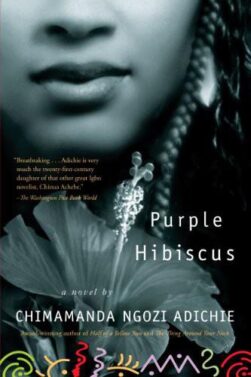
“Purple Hibiscus” is the debut novel of acclaimed Nigerian author Chimamanda Ngozi Adichie, published in 2003. The novel is a coming-of-age story set in post-colonial Nigeria, narrated by fifteen-year-old Kambili Achike. Through Kambili’s eyes, readers witness the complex dynamics of a family dominated by a tyrannical father, the political turmoil of a military regime, and the transformative power of love, faith, and freedom. The novel explores themes of religious hypocrisy, domestic abuse, colonialism’s legacy, political oppression, and the journey toward self-discovery and liberation.
The title itself carries symbolic weight the purple hibiscus represents something rare and precious, a hybrid of freedom that blooms unexpectedly, much like the protagonist’s awakening to a different kind of life beyond her father’s oppressive control.
Part One: Breaking Gods (Chapters 1-4)
Palm Sunday – The Catalyst
The novel opens on Palm Sunday, a day that marks the beginning of the end of the Achike family’s carefully constructed facade. The narrator, Kambili, describes how “things started to fall apart at home” when her brother Jaja refused to take communion. This act of defiance, seemingly small, becomes the catalyst for the unraveling of their family’s rigid structure.
Papa, Eugene Achike, is introduced as a deeply religious man who sits in the front pew of St. Agnes Catholic Church, receives communion with exaggerated piety, and is praised by Father Benedict as an exemplar of Christian virtue. The priest’s sermons frequently reference “Brother Eugene” as a model of how to “let your light shine before men.” Papa’s generosity to the church is legendary he pays for communion wine, ovens for the convent, and a new wing for the hospital. However, this public piety masks a private tyranny.
When Jaja refuses communion, claiming “The wafer gives me bad breath” and that “the priest keeps touching my mouth and it nauseates me,” Papa’s reaction is violent. He flings his leather-bound missal across the room, shattering Mama’s ballet-dancing figurines on the etagere. This moment of violence, witnessed by the entire family, sets the stage for the novel’s exploration of domestic abuse hidden behind a veneer of religious devotion.
The family’s silence in the aftermath is telling. Mama kneels to pick up the broken pieces, and Kambili observes that they speak “more with our spirits than with our lips.” The narrator reflects on how this silence began to lift in Nsukka, at Aunty Ifeoma’s flat, where she saw a purple hibiscus “rare, fragrant with the undertones of freedom.”
Speaking with Our Spirits – Daily Life Under Papa’s Rule
The second chapter introduces the suffocating routines of the Achike household. Kambili and Jaja follow meticulously crafted schedules prepared by Papa, down to the minute. Every aspect of their lives is controlled when they eat, study, sleep, even when they are allowed to spend time with family.
Mama announces she is pregnant, a revelation that brings hope but also fear. Jaja declares, “We will take care of the baby; we will protect him,” indicating that even the children recognize the threat Papa poses to any perceived vulnerability.
During this period, Nigeria experiences another military coup. Papa, as publisher of the Standard newspaper, uses his platform to criticize the new government and advocate for democracy. Ade Coker, his editor, writes critical editorials. The political turmoil mirrors the domestic turmoil, with both spheres characterized by oppressive power structures.
Kambili’s report card reveals she came second in her class a failure in Papa’s eyes. His punishment is characteristically cruel: he shows her a mirror and asks how many heads she has, then asks why she “let” the girl with one head come first. He lectures her about his own difficult upbringing and the sacrifices he made, emphasizing that “God has given you much, he expects much from you. He expects perfection.”
The Baby is Lost
When Mama suggests she might stay in the car during a visit to Father Benedict, Papa insists she accompany them despite her feeling ill. Later, Kambili hears “swift, heavy thuds” on her parents’ bedroom door the sounds of Papa beating Mama. When Mama comes home from the hospital the next day, she announces: “There was an accident, the baby is gone.” Papa had beaten her so severely that she miscarried.
The family’s response is telling: Papa orders sixteen different novenas for Mama’s “forgiveness,” suggesting that Mama somehow deserved punishment. The religious language is weaponized to justify abuse.
First Position and Defiance
Kambili’s first term at school is marked by trauma. The words in her textbooks turn into blood, reflecting her emotional state. She comes first in her class, but her satisfaction is complicated by the knowledge that Papa’s approval is always conditional.
During Christmas break in Abba, the family visits PapaNnukwu, Papa’s father, whom Papa considers a “heathen” because he practices traditional Igbo religion. The visits are limited to fifteen minutes, and the children are forbidden from eating anything in his house. This rejection of PapaNnukwu despite his age and illness reveals Papa’s religious extremism and lack of compassion.
Part Two: Speaking with Our Spirits (Chapters 5-8)
Aunty Ifeoma and Her Children
Aunty Ifeoma, Papa’s widowed sister and a university lecturer, arrives in Abba with her three children: Amaka, fifteen; Obiora, fourteen; and Chima, seven. She represents everything Papa is not spontaneous, questioning, joyful, and free. The contrast between the two households is stark.
When Aunty Ifeoma announces plans to take the children to see the mmuo (masquerades) at the Aro festival, Papa initially objects but eventually allows it. This outing introduces Kambili and Jaja to a world beyond Papa’s control a world of traditional culture, laughter, and unselfconscious joy. PapaNnukwu accompanies them, and Kambili observes how different he seems outside his small compound, wearing shorts Aunty Ifeoma bought him and telling stories with animation.
The visit to Ezi Icheke to watch the mmuo is transformative. The crowds, the masquerades, the energy all contrast with the austere piety of Papa’s household. When an mmuo representing a female spirit passes, Aunty Ifeoma says they can look, but when the powerful agwonatumbe approaches, women must look away. Kambili struggles with the sinfulness of participating in this “heathen” ritual while simultaneously feeling drawn to it.
Christmas Day and Tensions
Christmas Day at the Achike compound is a performance of Papa’s status as “Omelora” The One Who Does for the Community. Villagers stream through the house to receive money, food, and Papa’s blessing. The wives of the umunna cook massive pots of food, and everyone leaves with their share.
Aunty Ifeoma and her family arrive for lunch, and the tension between Papa and his sister is palpable. She challenges him about his treatment of PapaNnukwu, his rigid religiosity, and his control over his children. When she mentions that PapaNnukwu is dying, Papa remains unmoved, insisting that their father should convert before death.
Amaka, Kambili’s cousin, is initially hostile toward her. She mocks Kambili’s privilege, her quietness, her inability to peel yams properly. However, beneath the sarcasm lies a desire to connect. Amaka’s question about why Kambili lowers her voice reveals that she perceives the fear and suppression in her cousin’s life.
The Visit to Nsukka
Papa eventually agrees to let Jaja and Kambili visit Nsukka for five days. This visit becomes the pivotal experience that changes everything. In Aunty Ifeoma’s flat, Kambili discovers a different way of living.
The flat is small, cramped, and modest nothing like the mansion in Enugu. But it is full of life, argument, laughter, and love. Aunty Ifeoma and her children argue openly, laugh loudly, and sing during rosary. Food is shared, not perfectly plated. There is no schedule dictating every moment.
Kambili notices these differences with bewilderment. At dinner, when she doesn’t immediately begin eating after grace, Aunty Ifeoma teases her: “Nne, we have finished praying. We do not say Mass in the name of grace like your father does.” The family’s relationship with religion is different faith is a source of joy, not oppression.
Aunty Ifeoma takes Jaja and Kambili on a tour of the university campus, showing them the statue of the lion with the inscription “To restore the dignity of man.” They see the poor conditions of the junior staff quarters, the damaged buildings, and the signs of government neglect. Aunty Ifeoma’s car runs on fumes, and fuel is scarce a reminder of the country’s economic crisis.
Father Amadi
Father Amadi, a young priest at the university chaplaincy, is introduced during the Nsukka visit. He is unlike any priest Kambili has met young, athletic, musical, and approachable. He plays football with local boys, sings Igbo choruses, and speaks about faith in a way that feels alive rather than oppressive.
Kambili’s reaction to Father Amadi is immediate and intense. She describes his voice as having “the same effect on my ears that Mama working Pears baby oil into my hair had on my scalp.” When he asks if she smiles, she realizes she has forgotten how. His attention makes her feel seen in a way she never has before.
PapaNnukwu’s Illness and Death
Aunty Ifeoma brings PapaNnukwu to Nsukka when he falls ill. Despite the cramped quarters, he is given a mattress in Amaka and Kambili’s room. Doctor Nduoma visits, but the medical center is on strike, and tests cannot be done.
PapaNnukwu’s condition deteriorates. Despite the medication, he dies in his sleep. Aunty Ifeoma’s grief is devastating she screams “Nna m o!” (My father!) in a voice that echoes through the flat. Amaka is equally distraught. Kambili observes the burial preparations with a sense of detachment, still processing her own relationship with PapaNnukwu a man she was taught to view as a heathen but who showed her kindness and asked God to bless her.
Papa arrives to take Jaja and Kambili home. He refuses to participate in a “pagan funeral” but gives money for it. His coldness toward his dead father, his insistence that Aunty Ifeoma should have called a priest, and his inability to grieve reveal the depth of his religious rigidity.
The Aftermath
Back in Enugu, the atmosphere is tense. Jaja asks Papa for the key to his room, a request that Papa interprets as a desire to masturbate. His response reveals his obsession with controlling his children’s bodies and his fear of any independence.
The beating that follows when Papa discovers the painting of PapaNnukwu that Amaka gave to Kambili is the most severe yet. He kicks Kambili repeatedly, breaking a rib and causing internal bleeding. She is hospitalized, and Father Benedict administers extreme unction, indicating that her life was in danger.
Aunty Ifeoma, called to the hospital, confronts Mama: “This cannot go on, nwunye m. When a house is on fire, you run out before the roof collapses on your head.” She insists that Kambili and Jaja come to Nsukka to recuperate. Papa agrees, perhaps because he cannot refuse when his daughter’s life is in danger, or perhaps because he feels guilty.
Part Three: The Pieces of Gods (Chapters 9-15)
Recovery in Nsukka
Kambili’s recovery in Nsukka is both physical and spiritual. She is welcomed by Aunty Ifeoma, Amaka, Obiora, and Chima with genuine affection. The household’s warmth and chaos are healing.
Kambili gradually opens up. She begins to laugh, to run, to play. Father Amadi takes her to the stadium to watch football, and she runs with him when he challenges her to show she loves Jesus. He tells her she has “good legs for running” and encourages her to try out for a role in a play.
Amaka, who was initially hostile, becomes a friend. She lends Kambili her lipstick, teaches her how to peel yams, and introduces her to “culturally conscious” music Fela, Onyeka Onwenu, Osadebe. The companionship between the cousins grows, and Amaka even begins to paint PapaNnukwu from memory, capturing his likeness as a tribute.
Revelation of PapaNnukwu’s Death
The news of PapaNnukwu’s death reaches Nsukka, and Aunty Ifeoma’s grief is compounded by Papa’s refusal to give him a Catholic funeral. Obiora, despite his youth, takes on the role of “man of the house,” supporting his mother and helping with the funeral arrangements. Papa gives money for the funeral, but his coldness remains.
The Riot and Security Search
The university is closed due to student riots over lack of electricity and water. Aunty Ifeoma’s flat is searched by security agents looking for “documents designed to sabotage the peace of the university.” The men are threatening, and their search is more of an intimidation tactic than a genuine investigation.
Aunty Ifeoma is told to “be careful” a warning that her job is in danger. She has been vocal about the university’s problems and has been marked as “disloyal.” Obiora and Amaka argue about whether to leave Nigeria; Obiora thinks they should go to America, while Amaka insists they should stay and fix their country.
Father Amadi’s Departure
Father Amadi announces that he is leaving for missionary work in Germany. Kambili is devastated. She has developed deep feelings for him, and his departure feels like a loss she cannot bear. He tells her, “You are almost sixteen, Kambili. You are beautiful. You will find more love than you will need in a lifetime.” She doesn’t believe him.
Before he leaves, he writes her a letter with his German address. Kambili copies it over and over in her notebook.
Mama’s Secret
Mama arrives in Nsukka, looking disheveled and wearing rubber slippers. She reveals the truth: Papa had broken a small table on her belly, causing a miscarriage. She had been six weeks pregnant and had not yet told Papa.
Aunty Ifeoma urges Mama to leave Papa, but Mama insists, “Where would I go if I leave Eugene’s house?” She lists all the reasons she owes him: he paid school fees for hundreds of people, he never took a second wife, he supported her through miscarriages.
Later, after returning to Enugu, Mama reveals an even darker secret: she has been poisoning Papa’s tea. She had started before the Nsukka visit, using poison from Sisi’s uncle, a witch doctor. When Papa is found dead in his office, the autopsy reveals the poison.
Papa’s Death
Papa’s death is the final unraveling. The family receives the news while in Nsukka, preparing for Aunty Ifeoma’s departure to America. Papa had been found dead at his desk, and the autopsy revealed poison.
Jaja, without waiting to be questioned, tells the police he used rat poison, that he put it in Papa’s tea. He is arrested and taken away.
Mama also confesses, but she is not believed. People think grief has made her mad she walks around with her wrapper loose, her scarf askew, telling anyone who will listen that she killed her husband.
Part Four: Different Silence (Chapter 16)
The Present
Three years have passed. Jaja is still in prison, awaiting trial. Kambili, now nineteen, lives with Mama in what was once Papa’s house. The compound gates are locked; Mama has instructed the gatekeeper to turn away visitors who come to offer condolences.
Kambili visits Jaja in prison regularly. He has been moved to a crowded cell after assaulting a guard. His body is covered with scabs, and his shoulders, which once “bloomed” in Nsukka, have sagged.
The lawyers have finally secured Jaja’s release. The Head of State has died, and the new interim government is releasing prisoners of conscience. Jaja’s name is number four on the list.
Aunty Ifeoma’s Family in America
Aunty Ifeoma and her children now live in America. Their letters are full of longing for home. Amaka writes that “we don’t laugh anymore.” Obiora has a scholarship to a private school. Aunty Ifeoma works two jobs but dreams of returning.
Father Amadi
Father Amadi continues to write to Kambili. She carries his letters with her, not because of “lovey-dovey” sentiments but because they remind her of her worth. He tells her not to seek the “whys” because some things simply have no answer. She writes to him and prays for his safety.
The Visit to Nsukka
Before Jaja’s release, Kambili visits Nsukka. The flat where Aunty Ifeoma lived is occupied by a new family. The university is still in disrepair, the statue of the lion no longer gleaming.
The Final Scene
Kambili and Mama visit Jaja in prison. Mama has brought food in a china plate, as she always does. Jaja eats quickly, mechanically. When Kambili tells him about his release, he shrugs, unable to believe or perhaps unwilling to hope.
As they leave, Mama thanks Kambili one of the few times she has spoken unprompted in three years. Kambili places her arm around Mama’s shoulder and says they will go to Nsukka, then visit Aunty Ifeoma in America, then return to Abba to plant new orange trees and purple hibiscuses and ixora.
She is laughing. The clouds hang low, heavy with rain. “The new rains will come down soon.”
Character Analysis
Kambili Achike
Kambili is the novel’s narrator and protagonist, a fifteen-year-old girl who has been raised in an atmosphere of fear and control. She stutters when she speaks, avoids eye contact, and has internalized her father’s belief that she is “precious” but “stained by failure.”
Her transformation is the heart of the novel. In Nsukka, she learns to laugh, to run, to speak her mind. She discovers her feelings for Father Amadi and, in the process, discovers her own worth. By the end of the novel, she is a young woman who writes to Father Amadi, has mass said for Papa, and can laugh at the memory of Nsukka.
Kambili’s narration is characterized by its sensory detail and emotional precision. She notices the smell of her mother’s deodorant, the texture of yams, the colors of the hibiscuses. This attention to detail reflects her hypervigilance she has been trained to notice everything that might trigger Papa’s anger.
Eugene Achike (Papa)
Papa is one of the most complex characters in African literature. He is simultaneously a hero and a villain, a generous philanthropist and a brutal tyrant. He uses his wealth and influence to fight for democracy in Nigeria, risking his life to publish the truth. At the same time, he terrorizes his family, beating his wife until she miscarries, kicking his daughter until she needs hospitalization.
Papa’s religious fervor is inextricably linked to his abuse. He believes he is doing God’s work, that he is saving his children from sin. His punishments are framed as expressions of love he tells Kambili, “You knew you would be sleeping in the same house as a heathen? So you saw the sin clearly and you walked right into it?”
Papa’s relationship with his father, PapaNnukwu, is central to understanding his character. He rejects his father as a “heathen” and refuses to let him into his house. He gives money but withholds love. The missionaries who raised Papa taught him to despise his own culture, and he has internalized this self-hatred.
Papa’s death at the end of the novel by poison administered by his own wife is both a liberation and a tragedy. Kambili’s feelings are complicated: she offers masses for him, wants to see him in her dreams, but cannot control even the dreams she makes.
Mama (Beatrice Achike)
Mama is the archetypal abused wife silent, submissive, and self-sacrificing. She endures years of physical and emotional abuse, miscarrying multiple times due to Papa’s beatings. She polishes her figurines after each attack, a ritual of survival.
Yet Mama is not simply a victim. She is the one who poisons Papa, the one who takes revenge for all the years of suffering. Her confession “I started putting the poison in his tea before I came to Nsukka” reveals a quiet strength and a determination to protect her children.
In the aftermath, Mama’s guilt and grief manifest as a kind of madness. She walks around with her wrapper loose, tells anyone who will listen that she killed her husband. But she is also the one who refuses to leave the house, who says she will not open the gates for mourners. Her insistence on mourning privately suggests that she is reclaiming her own grief, her own way of saying goodbye.
Jaja Achike
Jaja is Kambili’s older brother and protector. From the beginning, he shows signs of rebellion refusing communion, asking for the key to his room, planting purple hibiscuses. In Nsukka, he blossoms, his shoulders broadening, his confidence growing.
Jaja’s confession to the police “I used rat poison” is a sacrifice. He takes the blame for Mama’s actions, perhaps to protect her, perhaps because he feels he should have done more to protect his family. In prison, he hardens. His eyes become “like the bark of a palm tree, unyielding.”
Aunty Ifeoma
Aunty Ifeoma is the foil to Papa. Where he is rigid, she is flexible; where he is authoritarian, she is democratic; where he is cold, she is warm. She represents the possibility of a different kind of life one that integrates faith with joy, tradition with modernity, discipline with freedom.
As a university lecturer, she is intelligent and outspoken. She challenges the university administration, the government, and her brother. She is also a devoted mother, cooking for her children, tending her garden, creating a home that is full of laughter and love.
Her decision to move to America is bittersweet. She does not want to leave Nigeria, but she has no choice her job is in jeopardy, and she cannot provide for her children. Her letters from America are full of longing for home.
Father Amadi
Father Amadi is a young priest who represents a different kind of religion one that is joyful, embodied, and open. He plays football, sings Igbo choruses, and tells Kambili he sees “Christ in the faces” of the poor boys he coaches.
His relationship with Kambili is complex. He is clearly fond of her, but he is also a priest. When she tells him she loves him, he says, “You are almost sixteen, Kambili. You are beautiful. You will find more love than you will need in a lifetime.” He does not confess his feelings, but he writes to her regularly from Germany.
Amaka
Amaka, Aunty Ifeoma’s daughter, is initially hostile toward Kambili. She mocks her cousin’s privilege, her quietness, her inability to do basic tasks. But beneath the sarcasm lies a desire for connection. As the novel progresses, Amaka becomes Kambili’s friend and ally.
Amaka is artistic, politically conscious, and deeply connected to her Igbo heritage. She refuses to take an English name for her confirmation, arguing that Igbo names “glorify God as much as ‘Paul’ and ‘Peter’ and ‘Simon.'” She paints PapaNnukwu, capturing his likeness as a tribute. She writes letters to the Office of the Head of State, even though she knows they will not be acknowledged.
Obiora
Obiora is Aunty Ifeoma’s fourteen-year-old son. He is intelligent, precocious, and something of a philosopher. He pushes his glasses up his nose, uses words like “microcosm,” and argues about the “political virgin.” He is also the “man of the house,” supporting his mother after PapaNnukwu’s death.
PapaNnukwu
PapaNnukwu is Papa’s father, a traditionalist who practices the Igbo religion. He is described as old, stooped, and covered with age spots. He worships at a small shrine in his compound, asking his chi (personal god) and his ancestors for blessings.
PapaNnukwu is rejected by Papa as a “heathen,” but he is a source of wisdom and love for his grandchildren. He tells them stories, asks God to bless them, and tells them they are “ripe agbogho” (young women). His death in Nsukka is a turning point in the novel, revealing the depth of Papa’s cruelty and the possibility of a different kind of faith.
Ade Coker
Ade Coker is the editor of the Standard, Papa’s newspaper. He is a small, round, laughing man with thick glasses and a playful manner. He writes editorials critical of the government, risking his life to tell the truth.
His death by letter bomb a package from the State House is a turning point in the novel’s political storyline. Kambili imagines “the thick, bluish lenses shattering, the white frames melting into sticky goo.” The government’s brutality is revealed in full.
Themes
Religious Hypocrisy
The novel is a sustained critique of religious hypocrisy. Papa presents himself as a devout Catholic, but his faith is used to justify abuse. He beats his children, causes his wife to miscarry, and rejects his father all in the name of God. The novel suggests that true faith is not about rigid adherence to rules but about love, compassion, and joy.
Domestic Abuse
“Purple Hibiscus” is one of the most powerful depictions of domestic abuse in contemporary literature. The abuse is physical, emotional, and psychological. Papa controls every aspect of his family’s lives their schedules, their relationships, their bodies. The novel shows how abuse is often hidden behind a veneer of respectability; Papa is a public hero, a philanthropist, a defender of democracy.
Colonialism’s Legacy
Papa is a product of colonialism. He was raised by missionaries, taught to reject his own culture, and given an English education. His religious extremism and his rejection of his father are direct consequences of the colonial project, which sought to replace African traditions with European values.
Freedom and Resistance
The novel is a story of resistance. Jaja’s refusal to take communion is the first act of defiance. Kambili’s journey to Nsukka is a journey toward freedom. Aunty Ifeoma’s outspokenness and her decision to leave Nigeria are forms of resistance. Mama’s poisoning of Papa is the ultimate act of rebellion.
Silence and Speech
The novel is filled with silences. Kambili and Jaja speak “with their spirits” rather than with their lips. Mama communicates through her body her beatings, her pregnancies, her miscarriages. The novel is about learning to speak, to find one’s voice. Kambili’s stutter is a symptom of her suppression; when she finally speaks, her words are powerful.
Family and Belonging
The novel explores what it means to belong. For Kambili, family is both a source of love and a source of terror. Nsukka represents an alternative family one based on love rather than fear. The novel suggests that we can choose our families, that love is not determined by blood alone.
Symbolism
The Purple Hibiscus
The purple hibiscus is the novel’s central symbol. It represents rarity, freedom, and beauty. Papa had only red hibiscuses in his garden; the purple ones at Aunty Ifeoma’s represent a different kind of beauty strange, experimental, and free. Jaja brings stalks of purple hibiscus back to Enugu, planting them in Papa’s garden. At the end of the novel, Kambili imagines planting purple hibiscus in Abba.
The Figurines
Mama’s ballet-dancing figurines represent her fragility and her survival. She polishes them after each beating, a ritual that helps her endure. When Papa throws the missal at Jaja and shatters the figurines, the act symbolizes the breaking of Mama’s world and the beginning of a new one.
Food
Food is a recurring symbol in the novel. At Papa’s house, meals are formal and silent. At Aunty Ifeoma’s, they are casual and joyful. The “love sips” of tea that Papa requires his children to drink are a symbol of his controlling love. The food that Mama brings to Jaja in prison is a symbol of her unending devotion.
The Lion Statue
The statue of the lion at the University of Nigeria, with its inscription “To restore the dignity of man,” symbolizes the possibility of a dignified life. However, the statue is neglected, its gleam dulled a comment on the failure of post-colonial Nigeria to fulfill its promise.
Rain
Rain appears throughout the novel as a symbol of cleansing and renewal. At the end, rain clouds gather, promising “new rains” a new beginning for Kambili and her family.
Style and Structure
Narrative Voice
Kambili’s narration is characterized by its sensory detail and emotional precision. She notices everything the smell of the air, the texture of food, the color of hibiscuses. This hyperawareness is a symptom of her trauma; she has learned to notice everything that might trigger Papa’s anger.
Her voice matures over the course of the novel. At the beginning, she is timid and self-deprecating. By the end, she can laugh at the memory of Nsukka and imagine a future filled with love and freedom.
Structure
The novel is structured in three parts: “Breaking Gods,” “Speaking with Our Spirits,” and “The Pieces of Gods,” followed by “Different Silence.” This structure reflects the arc of the novel: the breaking of the old order, the awakening to a different way of life, and the aftermath of liberation.
The novel is not strictly linear. It opens on Palm Sunday, the day everything changes, and then moves backward to explain how the family arrived at this point. This structure creates a sense of inevitability we know from the first page that something has broken, and the rest of the novel explains why and how.
Language
Adichie blends English with Igbo, creating a narrative that feels authentically Nigerian. Papa insists his children speak English in public, but at Aunty Ifeoma’s house, Igbo is spoken freely. The novel’s use of language is political it resists the colonial imposition of English while also acknowledging its role in Nigerian life.
Historical Context
Post-Colonial Nigeria
“Purple Hibiscus” is set in Nigeria in the late 1990s, during the military regime of Sani Abacha (though Abacha is never named in the novel). The novel depicts the political turmoil of the period: coups, military repression, the persecution of journalists, and the economic crisis.
The novel also references the Biafran War (1967-1970), though only obliquely. PapaNnukwu remembers the missionaries, and the abandoned building on Odim hill is a relic of the war.
The Catholic Church in Nigeria
The novel reflects the complex relationship between Catholicism and Igbo culture. Papa represents the extreme end of the spectrum a Catholic who rejects everything traditional. Aunty Ifeoma represents a more integrated faith she is Catholic, but she also respects her father’s traditionalism. The novel asks whether it is possible to be both fully Catholic and fully Igbo.
Conclusion
“Purple Hibiscus” is a novel about the courage to be free. It is the story of a girl who learns to speak, to laugh, to love and in doing so, finds her own worth. It is a critique of religious hypocrisy and domestic abuse, a celebration of Nigerian culture, and a portrait of a nation in crisis.
The novel’s title is a promise. The purple hibiscus is “rare, fragrant with the undertones of freedom, a different kind of freedom from the one the crowds waving green leaves chanted at Government Square after the coup. A freedom to be, to do.” This is the freedom Kambili achieves the freedom to be herself, to love whom she loves, to speak as she wishes, to laugh as loudly as she wants.
In the final scene, Kambili laughs. “Because Nsukka could free something deep inside your belly that would rise up to your throat and come out as a freedom song. As laughter.” The novel ends with a vision of renewal: new orange trees, new purple hibiscuses, new rains. The old gods have broken, but something new is growing.
Works Cited
Adichie, Chimamanda Ngozi. Purple Hibiscus. Algonquin Books, 2003.