
Introduction
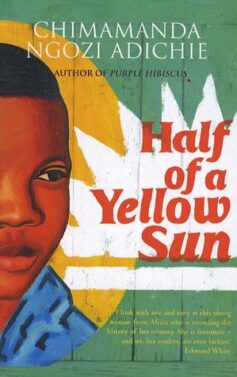
“Half of a Yellow Sun” is Chimamanda Ngozi Adichie’s second novel, published in 2006. The novel is a masterful work of historical fiction that chronicles the Nigeria-Biafra War (1967-1970) through the intertwined lives of several characters. The title refers to the symbol on the flag of the short-lived Republic of Biafra a half of a yellow sun against a background of red, black, and green. The novel explores themes of love, loyalty, betrayal, class, ethnicity, colonialism, and the devastating human cost of war. Adichie weaves together multiple narrative perspectives to create a rich tapestry that illuminates both the personal and political dimensions of this tragic chapter in Nigerian history.
Part One: The Early Sixties
Ugwu’s Arrival and Introduction to University Life
The novel opens with Ugwu, a thirteen-year-old village boy from Opi, arriving at the University of Nsukka to work as a houseboy for Odenigbo, a mathematics lecturer. Ugwu’s aunt, who works as a cleaner at the university, has secured this position for him, and she instructs him on how to behave: “As long as you work well, you will eat well. You will even eat meat every day” (Page 5). Ugwu is overwhelmed by the sights and sounds of the university environment the smooth tarred roads, the painted bungalows, and the running water. His initial encounter with Odenigbo reveals the master’s eccentric nature: he is absorbed in his books, talks to himself, and has unconventional habits.
Odenigbo emerges as a complex character a radical intellectual who challenges colonial narratives and engages in passionate debates with his friends about African politics, socialism, and the future of Nigeria. He tells Ugwu: “There are two answers to the things they will teach you about our land: the real answer and the answer you give in school to pass. You must read books and learn both answers” (Page 16). This instruction reflects Odenigbo’s belief in the importance of education as a tool for liberation while acknowledging the necessity of navigating colonial systems.
Olanna’s Introduction and the Beginning of Her Relationship with Odenigbo
The narrative shifts to Olanna, a beautiful and educated woman from a wealthy Lagos family. She is the daughter of Chief Ozobia, a businessman who has amassed considerable wealth through government contracts. Olanna has just completed her master’s degree in sociology from London University and is traveling to Nsukka to be with Odenigbo. Their relationship began two years earlier in Ibadan when Olanna witnessed Odenigbo confronting a ticket seller who had allowed a white man to skip the queue. She was struck by his courage and moral conviction.
Olanna’s family background is complex. Her parents are wealthy but emotionally distant, and their marriage appears hollow. Her mother is obsessed with appearances and social status, while her father is engaged in corrupt business dealings. Olanna has a twin sister, Kainene, with whom she has a strained relationship. The twins were once close but have drifted apart over the years. Kainene is described as sardonic, pragmatic, and deeply private, while Olanna is more idealistic and emotionally open.
The Introduction of Other Key Characters
The novel introduces several other important characters who form Odenigbo’s social circle:
Okeoma: A poet and lecturer who reads his poetry at Odenigbo’s gatherings. Odenigbo calls him “The voice of our generation!”
Miss Adebayo: A Yoruba woman who engages in heated debates with Odenigbo. She is sharp-tongued and challenges Odenigbo’s tribalist views.
Professor Ezeka: A condescending intellectual who often disagrees with Odenigbo.
Dr. Patel: An Indian lecturer who brings levity to the group.
Richard Churchill: A British writer who has come to Nigeria to study Igbo-Ukwu art. He is shy, uncertain, and eager to belong. He becomes involved with Kainene.
The Introduction of Richard and Kainene
Richard Churchill’s arrival in Nigeria is motivated by his fascination with Igbo-Ukwu art, particularly the roped pot a bronze artifact from the ninth century that he saw in a magazine. He is introduced to Lagos society through Susan Grenville-Pitts, an English woman who becomes his lover and patron. Susan is condescending toward Nigerians and represents the colonial attitude that Richard eventually rejects.
At a cocktail party, Richard meets Kainene, who is immediately different from the other Nigerian women he has encountered. She is sardonic, direct, and unimpressed by his attempts at wit. Despite his sexual dysfunction with Kainene a recurring theme that reflects his insecurity and sense of inadequacy Richard falls deeply in love with her.
Kainene’s relationship with Olanna is strained. When Olanna calls her from Nsukka, Kainene is distant and mocking. Their parents have used Olanna as “sex bait” for Chief Okonji, a cabinet minister, to secure business contracts a fact that Kainene highlights with bitter sarcasm.
Olanna’s Visit to Kano and Mohammed
Olanna travels to Kano to visit her relatives and Mohammed, her former lover. Mohammed is a Hausa man from a prominent family who wanted to marry Olanna but was rejected by his mother because Olanna was Igbo. The visit reveals the ethnic tensions simmering beneath the surface of Nigerian society. Olanna’s uncle, Mbaezi, runs a market stall, and her aunt, Ifeka, sells goods from a kiosk. Their life is modest but warm.
Arize, Olanna’s cousin, is pregnant and excited about her baby. Aunty Ifeka advises Olanna about relationships: “You must never behave as if your life belongs to a man. Do you hear me? Your life belongs to you and you alone” (Page 280). This advice foreshadows Olanna’s eventual response to Odenigbo’s betrayal.
Odenigbo’s Mother and Her Opposition
Odenigbo’s mother, known simply as Mama, comes to visit from the village of Abba. She is deeply suspicious of Olanna, whom she considers a witch who has enchanted her son. Mama confronts Olanna in the kitchen, accusing her of being an “abnormal woman” because she did not suckle her mother’s breasts. She shouts: “Tell them that nobody’s medicine will work on my son. He will not marry an abnormal woman, unless you kill me first. Only over my dead body!” (Page 126).
Mama’s hostility stems from her fear of losing her son to an educated woman from a different social class. She wants Odenigbo to marry a village woman who will be subservient and bear him many children. The confrontation deeply upsets Olanna, who leaves the house and goes to her flat.
The Amala Incident
Mama brings a young woman named Amala with her from the village. Amala is quiet, unassuming, and seemingly obedient. While Olanna is away in Lagos, Mama arranges for Amala to sleep with Odenigbo, who is drunk. Amala becomes pregnant. This betrayal devastates Olanna, who had trusted Odenigbo completely.
When Odenigbo tells Olanna about the pregnancy, she is devastated: “I see how much of a joke you think this is. You think you can do anything and I will stay” (Page 287). She leaves him and returns to her flat, where she struggles with feelings of betrayal and worthlessness.
Part Two: The Late Sixties
The Rise of Ethnic Tensions
The novel now shifts to the political developments that lead to the Nigeria-Biafra War. The first coup of January 1966, led by Major Nzeogwu, was seen by many as an Igbo coup because most of the coup leaders were Igbo and many of the killed politicians were Northerners. This perception led to reprisal killings of Igbo people in the North.
The second coup of July 1966 brought Northern officers to power, and the killing of Igbo officers became widespread. The massacres of Igbo civilians in the North in Kano, Zaria, Maiduguri, and other cities created a refugee crisis as survivors fled to the Eastern Region.
Adichie illustrates these events through the experiences of her characters. Olanna’s relatives in Kano are murdered. She travels to Kano and witnesses the aftermath: her uncle’s body lying in the yard, her aunt’s mutilated corpse, and the head of her cousin’s child in a calabash on the train. These scenes are based on actual events that Adichie researched, and they convey the horror and trauma of the massacres.
The Secession and Birth of Biafra
On May 30, 1967, Colonel Odumegwu Ojukwu declared the independence of the Republic of Biafra. The novel captures the excitement and hope of this moment: “Biafra is born! We will lead Black Africa! We will live in security! Nobody will ever again attack us! Never again!” (Page 205).
However, the secession also brought war. Nigeria, supported by Britain and the Soviet Union, launched a military campaign to crush the rebellion. Biafra, with limited resources and international support, fought desperately to survive.
The Fall of Nsukka and the Refugee Crisis
As the war progresses, the Biafran army is forced to retreat. Nsukka falls, and the university community evacuates. Olanna, Odenigbo, Baby, and Ugwu flee to Abba, Odenigbo’s hometown. From there, they move to Umuahia, where Odenigbo works at the Manpower Directorate.
The refugee crisis is a central theme of the novel. Millions of people are displaced, and starvation becomes a weapon of war. The relief centers, run by organizations like the World Council of Churches and Caritas, struggle to provide food. Ugwu’s dried egg yolk and Olanna’s struggles to find food illustrate the daily reality of hunger.
The Death of Odenigbo’s Mother
Odenigbo’s mother refuses to leave Abba when the town is threatened. She is killed by Nigerian soldiers, and her body is buried by a cousin. Odenigbo’s attempt to return to Abba to find her is thwarted by the occupation, and he returns traumatized. His grief manifests as excessive drinking and emotional withdrawal.
Ugwu’s Conscription and the Atrocities of War
Ugwu is forcibly conscripted into the Biafran army, despite Olanna’s efforts to protect him. He is taken to a training camp where he learns to use the ogbunigwe, a crude land mine made from scrap metal. The conditions are horrific lack of food, brutal training, and constant fear.
Ugwu participates in operations where he kills Nigerian soldiers. His first kill leaves him shaken: “He bent over a lean body. He yanked off the boots. In the pockets, he felt a cold hard kola nut and warm thick blood” (Page 455). The novel does not shy away from the moral complexity of war; Ugwu’s actions are both necessary for survival and deeply traumatic.
The most disturbing scene in Ugwu’s narrative is the gang rape of a bar girl. Ugwu participates after being taunted by the other soldiers: “Who is afraid?” he said disdainfully. “I just like to eat before others, that is all.” He does not look at the girl’s face, or at anything at all, as he moves quickly and feels his own climax, “a self-loathing release” (Page 459). This scene forces the reader to confront the capacity for evil within ordinary people and the ways war dehumanizes both victims and perpetrators.
The Death of Okeoma and the Loss of Hope
Okeoma, the poet who once embodied the hope and idealism of the Biafran cause, is killed in action. His death devastates Olanna and Odenigbo, who had looked to him as a voice of their generation. The novel’s treatment of Okeoma’s death reflects the broader loss of hope as Biafra’s defeat becomes inevitable.
Kainene’s Disappearance
The novel’s central mystery is the disappearance of Kainene. She goes on an “afia attack” trading across enemy lines and never returns. The family searches for her in hospitals, mortuaries, and refugee camps, but no trace is found. Her disappearance is never resolved, and the novel ends with Olanna still hoping for her return.
Kainene’s last full memory is of her stopping the beating of a young soldier. This memory becomes a symbol of her courage and humanity, even as her fate remains unknown. The ambiguity of her disappearance reflects the many unresolved losses of the war.
Part Three: The Early Sixties (Flashback)
This section returns to the period before the war, providing deeper insight into Olanna and Odenigbo’s relationship and the events leading to the war. The flashback structure allows Adichie to show how the seeds of the war were planted long before the first shots were fired.
Odenigbo’s Academic Life and Political Engagement
Odenigbo is shown as a passionate intellectual who believes in the power of ideas to transform society. He hosts gatherings where friends debate politics, philosophy, and culture. His home is a haven for radical thought, and he is respected and sometimes feared for his sharp intellect and unyielding principles.
Olanna’s Struggle with Her Family
Olanna’s relationship with her parents is explored in greater depth. Her mother, in particular, is controlling and manipulative, using Olanna as a tool for social advancement. When Olanna refuses to marry Chief Okonji’s son, her mother is furious. The family’s wealth is built on corruption and exploitation, and Olanna’s rejection of their values creates a rift that never fully heals.
The Twins’ Estrangement
The novel explores the deep bond between Olanna and Kainene, as well as the sources of their estrangement. They were once inseparable, but different life choices and temperaments have driven them apart. Kainene’s sardonic humor and emotional distance are revealed as defense mechanisms, and her eventual willingness to reconnect with Olanna is one of the novel’s most moving developments.
Part Four: The Late Sixties (War and Aftermath)
The Final Days of Biafra
The war’s final months are depicted with unflinching honesty. The Biafran territory shrinks, food supplies dwindle, and hope fades. The characters experience the disintegration of their world the loss of homes, possessions, and loved ones.
The Wedding of Olanna and Odenigbo
Amid the chaos of war, Olanna and Odenigbo marry in a small ceremony. The wedding is a defiant act of hope, a declaration that life will continue despite the surrounding death and destruction. The ceremony is interrupted by an air raid, but the couple survives, and the wedding proceeds.
Ugwu’s Survival and Return
Ugwu is wounded in battle and sent to a hospital, where Richard finds him. His recovery is slow, but he survives. After the war, he returns to Nsukka with Olanna, Odenigbo, and Baby, and begins to write his own account of the war the “Narrative of the Life of a Country” that he had conceived during his convalescence.
Richard’s Journey
Richard’s search for Kainene takes him across the devastated landscape of Biafra. He is changed by the war hardened, sadder, but also more humble. He decides to stay in Nigeria and join the new Institute for African Studies at Nsukka, committing himself to the country that has become his home.
The Aftermath and the Unresolved
The novel ends without resolution. Kainene is still missing, and the characters must learn to live with uncertainty. Olanna finds some peace in her family and in the small rituals of daily life, but she never stops hoping for her sister’s return.
Character Analysis
Ugwu
Ugwu is the novel’s moral center. His journey from illiterate village boy to soldier to writer mirrors the transformation of Nigeria itself. He is intelligent, observant, and deeply loyal. His relationship with Olanna and Odenigbo is one of mutual respect and affection, despite the power imbalance inherent in his position as houseboy.
Ugwu’s capacity for violence demonstrated in his killing of Nigerian soldiers and his participation in the gang rape reveals the corrupting influence of war. Yet his remorse and his determination to write about his experiences suggest that he retains his humanity. His final act writing his own narrative is an assertion of agency and a refusal to let others define his story.
Olanna
Olanna is the novel’s emotional heart. She is beautiful, intelligent, and compassionate, but also vulnerable. Her relationship with Odenigbo is tested by his infidelity, her family’s dysfunction, and the horrors of war. She struggles to maintain her dignity and her hope in the face of overwhelming loss.
Olanna’s journey is one of self-discovery. She learns that her life does not belong to a man, as Aunty Ifeka advised, and she finds the strength to forgive Odenigbo while also holding him accountable. Her decision to raise Baby, Odenigbo’s child with Amala, is an act of extraordinary generosity and love.
Odenigbo
Odenigbo is a complex and contradictory figure. He is brilliant, passionate, and deeply committed to his ideals, but he is also flawed. His infidelity with Amala is a betrayal of Olanna’s trust, and his subsequent drinking and emotional withdrawal reveal his inability to cope with loss.
Despite his flaws, Odenigbo is portrayed with sympathy. His love for Olanna is genuine, and his grief over his mother’s death and his failure to bury her is deeply felt. He is a man of his time shaped by colonialism, educated in the West, and struggling to build a new identity for himself and his country.
Kainene
Kainene is the most enigmatic character in the novel. She is sardonic, independent, and seemingly indifferent to the opinions of others. Her relationship with Richard is marked by his sexual dysfunction and her emotional reserve, yet there is a deep connection between them that neither fully understands.
Kainene’s disappearance is the novel’s central mystery. Her choice to go on afia attack a dangerous trading mission reflects her courage and her commitment to the Biafran cause. Her fate is never revealed, and the ambiguity of her disappearance reflects the many unresolved losses of the war.
Richard Churchill
Richard is an outsider who gradually becomes an insider. His initial fascination with Igbo-Ukwu art is a form of cultural tourism, but his experiences during the war transform him. He witnesses atrocities, falls deeply in love with Kainene, and eventually commits himself to Nigeria as his home.
Richard’s relationship with Kainene is complicated by his sexual difficulties, which reflect his broader sense of inadequacy. His search for Kainene after her disappearance is a testament to his love and his determination to find meaning in loss.
Major Themes
Colonialism and Its Legacy
The novel explores how colonialism shaped Nigeria’s ethnic divisions and political instability. The British policy of indirect rule, which favored the North and created a system of “warrant chiefs” in the East, exacerbated ethnic tensions. The colonial economy, which relied on cash crops and resource extraction, left Nigeria dependent on foreign powers.
Adichie shows how the legacy of colonialism persisted after independence. The Nigerian elite adopted the attitudes and lifestyles of their former colonizers, while the masses remained impoverished. The war itself was shaped by Cold War politics, with Britain and the Soviet Union supporting Nigeria and France supporting Biafra.
Ethnic Identity and Tribalism
The novel examines how ethnic identity was constructed and manipulated for political purposes. The Igbo were portrayed as ambitious and clannish, the Hausa-Fulani as feudal and conservative, and the Yoruba as sycophantic and duplicitous. These stereotypes were used to justify discrimination and violence.
Adichie complicates these stereotypes by showing the diversity within ethnic groups and the ways individuals transcend tribal boundaries. Odenigbo’s friends include Yoruba (Miss Adebayo), Indian (Dr. Patel), and British (Richard) individuals, and their relationships are based on shared ideals rather than ethnicity.
Class and Social Mobility
The novel explores the role of class in Nigerian society. Olanna’s family is wealthy and connected, while Odenigbo comes from a modest background. Ugwu is from a poor village family, and his position as houseboy reflects the rigid class hierarchies of Nigerian society.
However, the war disrupts these hierarchies. Wealthy families lose their possessions, and poor families are forced to flee. The relief centers, where food is distributed regardless of class, create temporary moments of equality. The war also creates opportunities for social mobility some people profit from the chaos, while others lose everything.
Love and Betrayal
The novel’s central relationships Olanna and Odenigbo, Kainene and Richard, Ugwu and Eberechi are tested by the pressures of war. Infidelity, jealousy, and misunderstanding threaten to destroy these relationships, but the characters find ways to forgive and continue.
The novel suggests that love is not about perfection but about persistence. Olanna forgives Odenigbo’s infidelity not because it was acceptable but because she chooses to value their relationship over her pride. Richard’s love for Kainene endures even after her disappearance, and his commitment to her memory gives his life meaning.
War and Trauma
The novel is unflinching in its depiction of the horrors of war. The massacres of Igbo civilians, the starvation of millions, and the deaths of soldiers are presented without sentimentality. The characters’ psychological responses to trauma Olanna’s “Dark Swoops,” Odenigbo’s drinking, Ugwu’s nightmares are portrayed with clinical accuracy.
The novel also explores the moral complexity of war. Ugwu’s killing of Nigerian soldiers and his participation in the gang rape are presented as both understandable (in the context of survival) and morally reprehensible. The novel refuses to offer easy answers or to divide its characters into heroes and villains.
Storytelling and Memory
The novel is deeply concerned with who gets to tell the story of the war. Ugwu’s decision to write his own narrative, Richard’s abandoned book, and Olanna’s memories are all attempts to make sense of the past.
Adichie’s decision to write the novel itself is a political act a refusal to let the history of Biafra be forgotten or misrepresented. The novel’s dedication to the author’s grandfathers, who did not survive the war, and her grandmothers, who did, is a personal acknowledgment of the war’s continuing impact on Nigerian families.
Historical Context
The Nigeria-Biafra War was one of the most devastating conflicts in post-colonial African history. The war resulted from the political, economic, and ethnic tensions that had been building since Nigeria’s independence in 1960. The Igbo, who were the dominant ethnic group in the Eastern Region, felt increasingly marginalized and threatened by the Northern-dominated federal government.
The immediate trigger for the war was the January 1966 coup, which was perceived as an Igbo attempt to seize power. The counter-coup of July 1966 brought Northern officers to power, and the massacres of Igbo civilians began shortly thereafter. Between 30,000 and 50,000 Igbo were killed in the North, and millions fled to the Eastern Region.
On May 30, 1967, Lieutenant Colonel Odumegwu Ojukwu declared the independence of the Republic of Biafra. The Nigerian government, under General Yakubu Gowon, responded with a military campaign to crush the rebellion. The war lasted three years and resulted in an estimated one to three million deaths, mostly from starvation and disease.
The international community was largely indifferent to the suffering of Biafrans. Britain and the Soviet Union supported Nigeria, while France provided limited support to Biafra. The United States remained neutral, and many other countries refused to recognize Biafra’s independence.
The war ended in January 1970 with Biafra’s surrender. General Gowon declared that there would be “no victor, no vanquished” and initiated a program of reconciliation and reconstruction. However, the scars of the war remain, and the Igbo continue to face discrimination and marginalization in Nigerian society.
Literary Analysis
Narrative Structure
The novel’s structure moving between the early sixties and the late sixties creates a sense of foreboding. The reader knows what is coming, and the early sections are colored by the knowledge of the tragedy that will follow. This structure also allows Adichie to show how the war was not an aberration but the culmination of trends that had been developing for years.
The novel’s multiple perspectives Ugwu, Olanna, and Richard allow Adichie to explore the war from different angles. Ugwu’s perspective is that of a poor, uneducated boy who rises to become a soldier and a writer. Olanna’s perspective is that of an educated woman from a wealthy family who becomes a refugee. Richard’s perspective is that of a foreigner who gradually becomes an insider.
Prose Style
Adichie’s prose is elegant and precise. She has a gift for metaphor and imagery, and her descriptions of people and places are vivid and evocative. She also has a keen ear for dialogue, capturing the rhythms of Igbo-English and the distinctive voices of her characters.
One of the novel’s most striking features is its treatment of language. The characters speak in a mix of English and Igbo, reflecting the linguistic complexity of post-colonial Nigeria. Adichie does not translate the Igbo passages, which creates a sense of authenticity but also requires the reader to accept that not everything will be understood.
Symbolism
The half of a yellow sun is the novel’s central symbol. It represents the hope and promise of Biafra, as well as the tragedy of its defeat. The symbol appears throughout the novel, on flags, on clothing, and in the title itself.
The roped pot the Igbo-Ukwu bronze artifact that fascinates Richard symbolizes the sophistication and beauty of pre-colonial African culture. It represents the greatness that Nigeria could have achieved if it had not been divided by ethnic conflict and colonial manipulation.
The calabash containing the child’s head symbolizes the horror of the massacres. It is a powerful image of death and trauma that haunts Olanna and the reader long after it is described.
Conclusion
“Half of a Yellow Sun” is a masterpiece of historical fiction. It brings to life one of the most tragic episodes in African history while also telling a deeply human story about love, loyalty, and survival. Adichie’s achievement is to make the past present to show how the events of the Nigeria-Biafra War continue to shape Nigeria and the world today.
The novel’s title, with its reference to the flag of Biafra, is both an homage to the lost nation and a symbol of hope. The half of a yellow sun is incomplete a reminder that the promise of Biafra was never fully realized. But it is also half of a sun, not half of a moon a reminder that light persists even in darkness. The novel ends with Ugwu writing the dedication “For Master, my good man” a tribute to the relationships that sustained people through the war and that continue to sustain them in its aftermath.
The novel’s final message is one of resilience. Despite everything the massacres, the starvation, the deaths life continues. The characters build new lives, write new stories, and hold on to the hope that one day, the full sun will rise.