
Overview
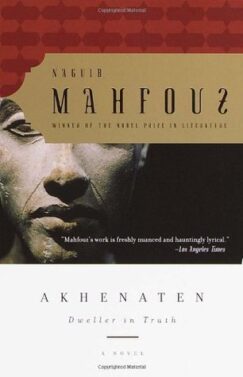
Published in 1985 and translated into English in 1998 by Tagreid Abu-Hassabo, Akhenaten, Dweller in Truth is a historical novel by Nobel laureate Naguib Mahfouz. The novel is structured as a series of testimonies from various individuals who knew Akhenaten, the controversial 18th Dynasty pharaoh who attempted to revolutionize Egyptian religion by introducing monotheistic worship of the Aten (the sun disk). The narrative is framed as a young man’s quest for truth, collecting conflicting accounts years after Akhenaten’s death.
The Framing Narrative
The novel begins with Meriamun, a young man from Sais, traveling with his father by ship. They pass the abandoned city of Akhetaten (Amarna), the “heretic’s city,” which appears lifeless and cursed. Meriamun becomes fascinated by the city and its history, particularly the story of Akhenaten and Nefertiti. His father, a man of learning and wisdom, gives him letters of introduction to various figures who knew Akhenaten. Meriamun sets out to interview these witnesses, seeking to record an impartial history free of bias. His father advises him: “Be like history, impartial and open to every witness. Then deliver a truth that is free of bias for those who wish to contemplate it.”
The Testimonies
1. The High Priest of Amun
The High Priest presents the most hostile account of Akhenaten. He describes Akhenaten as:
- A “heretic,” “effeminate,” and “grotesque”
- A man of questionable birth who destroyed Egypt
- A weak, feminine creature who resented strong men, priests, and deities
- Someone who conceived of a god similar to himself weak and feminine
- A madman who neglected his duties while the empire crumbled
The High Priest traces the origins of the crisis to Queen Tiye, Akhenaten’s mother, whom he accuses of political ambition. He claims Tiye promoted Aten worship to curb the power of Amun’s priests. He describes Akhenaten’s religious experience as madness and portrays Nefertiti as an ambitious woman who bore six daughters through adulterous affairs. He accuses Akhenaten of erasing his father’s name from monuments and of effectively killing him after death. The High Priest describes the confrontation between himself and the young king, where Akhenaten declared: “There is no god but the One and Only God.” He organized opposition to Akhenaten, including having Toto the chanter priest infiltrate the palace as a spy. He describes the exodus to Akhetaten, the confiscation of temple properties, and the eventual abandonment of the king by his own men. He concludes that Akhenaten died “disappointed in his god and hopeless of the hereafter.”
2. Ay (The Sage)
Ay, Nefertiti’s father and Akhenaten’s former tutor, presents a more nuanced but still critical view. He describes:
- Akhenaten as an extraordinarily intelligent child with “the wisdom of a man”
- His early religious questioning and rejection of Amun
- His mystical experience by the Nile where he heard the voice of the One God
- His physical weakness contrasted with spiritual strength
Ay recounts how he was appointed to educate the young prince and witnessed his intellectual and spiritual development. He describes Akhenaten’s growing disdain for the priests of Amun, whom the prince viewed as corrupt exploiters of the poor. Ay also reveals the political dimensions of Akhenaten’s marriage to Nefertiti how it elevated his family to royalty. He admits that he declared faith in the new god partly out of ambition and partly because he believed in freedom of worship. Ay describes the building of Akhetaten as a magnificent achievement, but acknowledges the growing crisis: corruption among officials, rebellion in the provinces, and attacks on the empire’s borders. He participated in the delegation that asked Akhenaten to either allow freedom of worship or abdicate. Ay’s testimony reveals his own complex position he loved Akhenaten but also abandoned him, and he cannot rid his heart of “his love, nor can I stop admiring him.”
3. Haremhab (The Chief of Security)
Haremhab, Akhenaten’s childhood friend and chief of security, offers a perspective from someone who loved the king personally but despised his policies. He describes:
- Akhenaten as physically weak and feminine but possessing an “amazing ability to capture people’s hearts”
- Their unlikely friendship despite being opposites
- Akhenaten’s horror at violence and military training
- The king’s religious devotion and mystical experiences
Haremhab describes the growing crisis and his own role in the delegation that confronted Akhenaten. He advised the king to grant freedom of worship and defend the empire, but Akhenaten refused. Haremhab admits he sometimes wished to kill Akhenaten “out of love and loyalty” to save Egypt from destruction. He eventually left Akhetaten with the others, believing this was the only way to protect the king from harm. Regarding Nefertiti’s departure, he suggests she left to save herself but remained in the city because the priests considered her equally culpable. Haremhab refuses to discuss his feelings upon hearing of Akhenaten’s death, saying only: “I have said all I have to say.”
4. Bek (The Sculptor)
Bek, the royal sculptor, provides the most sympathetic account of Akhenaten. He describes:
- Their friendship from childhood
- Akhenaten’s profound spirituality and love of truth
- His artistic vision and rejection of traditional artistic conventions
- The king’s kindness and compassion
Bek recounts how Akhenaten taught him both religion and art, saying: “Do not let the teachings of the dead shackle your hands when you work. Let your stone be a harbor for truth.” He describes Akhenaten as someone who “lived for the truth, and because of the truth he died.” Bek reveals intimate details, including that Akhenaten carved a sculpture of Nefertiti and, when she left him, removed its left eye “to express his disappointment, but left the rest of it intact as a token of eternal love.” Bek describes the king’s unwavering faith even as everyone abandoned him: “Evil can never overcome. What we are witnessing is only a fleeting moment.” He believes Akhenaten was murdered, not died of natural illness, and describes his own life as now purposeless: “Here I am living without purpose or a trace of happiness, waiting for death to take me.”
5. Tadukhipa (The Mitannian Princess)
Tadukhipa, daughter of King Tushratta of Mitanni and part of Amenhotep III’s harem, inherited by Akhenaten, presents a bitterly hostile account. She describes:
- Akhenaten as “hideous” and “effeminate”
- His neglect of the harem
- His supposed impotence
- His unnatural relationship with his mother
She recounts an encounter where Akhenaten visited her chamber but left without consummating the relationship, saying “Love is my only duty.” Tadukhipa repeats scandalous rumors: that Nefertiti’s six daughters were fathered by other men, that Akhenaten had sexual relations with his mother, and that Nefertiti was a “trained whore.” She describes the court as filled with hypocrites and the king as “a strange creature, neither man nor woman, driven by shame and stigma to destroy himself and the country.”
6. Toto (The Chief Epistoler)
Toto, who served as a spy for the High Priest of Amun within Akhenaten’s court, offers a hostile but politically astute account. He describes:
- Akhenaten as a “mouse” who “fancied himself a lion”
- The king’s weakness and jealousy driving his religious policies
- The corruption of the officials who flocked to the new religion for power
Toto admits to plotting Akhenaten’s assassination and resorting to sorcery against him. He describes the king’s mystical trances as “obscene mockery” and claims none of Akhenaten’s men truly believed in his god. He portrays Nefertiti as ambitious and faithless, suggesting she only pretended to believe in the new religion to maintain power.
7. Tey (Nefertiti’s Stepmother)
Tey, Ay’s wife and Nefertiti’s stepmother, offers a more sympathetic view of Nefertiti. She describes:
- Nefertiti as intelligent, passionate, and spiritually inclined from a young age
- Her genuine belief in Akhenaten’s god
- The loving marriage between Akhenaten and Nefertiti
Tey defends Nefertiti’s faith and describes her as “a great queen in every way.” She expresses bewilderment at Nefertiti’s departure from Akhenaten, suggesting: “Nefertiti had so dreaded seeing the king fall that she preferred, in a moment of desperation, to flee. Yet I am certain that she left with the intention of returning to him.” Tey believes Akhenaten was murdered: “I’m sure they killed him and made out he had died a natural death.”
8. Mutnedjmet (Nefertiti’s Sister)
Mutnedjmet, Nefertiti’s younger sister, presents a bitterly jealous and hostile account. She describes:
- Nefertiti as an attention-seeker who “whip up storms from trivial arguments”
- Her sister’s faith as insincere
- Akhenaten as “hideous and sickly”
Mutnedjmet claims Nefertiti married Akhenaten for power and gratified her lust with other men. She repeats the rumor of Akhenaten’s incestuous relationship with his mother. She describes her own role as a secret intermediary between the priests’ camp and Akhenaten’s men, working to undermine the king. She places more blame on Nefertiti than on Akhenaten: “I place more blame on Nefertiti, for she is not lacking in reason. But she wanted only to nurse her ambition and cultivate more power.”
9. Meri-Ra (The High Priest of the One God)
Meri-Ra, Akhenaten’s closest spiritual companion and the high priest of the One God, provides the most devoted and mystical account. He describes:
- Their shared spiritual seeking from boyhood
- Akhenaten’s profound religious experience
- The king’s unwavering faith and love
Meri-Ra recounts Akhenaten’s revelation: “I heard a voice sweeter than the scent of flowers: ‘Fill thy soul with my breath. Renounce what I have not granted thee. I am the Creator, I am the stream from which life flows. I am love, peace, and joy.'” He describes Akhenaten as possessing “a power that no one had guessed at,” with courage exceeding that of warriors. Meri-Ra insists that Akhenaten “did not and will not die. For he has found the eternal truth. The day will come when he will be victorious.” He gives Meriamun a scroll of Akhenaten’s teachings, suggesting the young man’s quest was divinely guided.
10. Mae (The Commander of Armed Forces)
Mae, the military commander, offers a contemptuous view of Akhenaten. He describes:
- The king as a “vile, low-born man” who humiliated Egypt
- The loss of military honor and the empire’s security
- The king’s weakness of mind and body
Mae was prepared to attack Akhetaten with force but was overruled by the High Priest’s preference for negotiation. He expresses frustration that he was not allowed to destroy the heretic and his followers. He dismisses Nefertiti as “a beautiful woman created to be a whore” and claims her competence as queen was illusory.
11. Maho (The Chief of Police)
Maho, a simple man from a farming village who became chief of police, offers one of the most genuinely affectionate accounts. He describes:
- His awe at being noticed by the crown prince
- Akhenaten’s kindness and compassion
- The king’s policy of love rather than punishment
Maho recounts how Akhenaten appointed him chief of police and instructed: “Let your weapon be like an ornament. Discipline people with love… Remember, what love cannot cure, fear will not correct.” He describes the king’s daily life of prayer and his accessibility to common people. Maho tells of foiling an assassination attempt, killing the assassin with an arrow. He was forced to leave Akhenaten and was not permitted to say goodbye. He believes the king was murdered and has lost faith: “I no longer believe in any god.”
12. Nakht (The Minister of the Chamber)
Nakht, a nobleman and minister, offers a balanced but critical view. He describes:
- Akhenaten as intelligent but unconcerned with practical governance
- The king’s mystical ambitions
- The growing crisis that led to the empire’s collapse
Nakht admits he declared faith in the new religion out of pragmatism, believing he could better influence events from within. He describes Akhenaten as “not mad and… not a fool though he was not normal either.” He places significant blame on Ay, suggesting Ay contrived to use Akhenaten’s weaknesses to advance his own family’s power. Nakht concludes: “This is a story of innocence, of deception, and infinite grief.”
13. Bento (The Physician)
Bento, Akhenaten’s personal physician, offers a compassionate medical perspective. He describes:
- Akhenaten’s physical frailty from childhood
- The death of his brother Tuthmosis
- The king’s spiritual depth and physical weakness
Bento recounts how the sickly Akhenaten survived while his stronger brother died, and how this affected the young prince. He describes Akhenaten’s early questions about death and his growing spiritual intensity. Bento declares his faith in Akhenaten’s god but also maintains belief in Thoth and other deities. He refuses the High Priest’s implicit request to kill the king: “My profession does not condone treachery.” Regarding the rumors of incest, Bento says: “I always dismissed it as malicious fabrication.” He describes Akhenaten as “a visionary, promising a paradise irreconcilable with human nature.”
14. Nefertiti (The Queen)
Nefertiti’s testimony is the novel’s emotional climax. She reveals:
- Her genuine faith in Akhenaten’s god from before their marriage
- Her growing love for Akhenaten as a husband and man
- The political pressures from Queen Tiye
- Her decision to leave Akhenaten
Nefertiti describes her first meeting with Akhenaten at the Sed festival: “I saw beyond his strange features and feeble body a spirit that was singled out by God to receive his divine love.” She recounts Queen Tiye’s interview and the queen’s demand for “unconditional loyalty.” She describes her growing love for Akhenaten during his absence on the empire tour: “I realized that, without him, I was not happy… I loved him, not only as my spiritual companion, but as husband and lover.”
Nefertiti defends her faith and her husband’s vision. She describes the building of Akhetaten as a dream of love and truth. She recounts the death of her daughter Meketaten as a devastating blow. She explains her decision to leave Akhenaten: “It occurred to me that if I left him he might falter and take the advice of his men. He would be convinced that I had betrayed him, but at least his life would be saved.” She remained in Akhetaten, believing she and Akhenaten would be reunited. She says of his death: “I did not believe a word he said. My beloved did not fall ill and die. They must have killed him.”
Character Analysis
Akhenaten
Akhenaten emerges as the novel’s central enigma. Each witness presents a different version of him:
- To the High Priest: a mad heretic and destroyer of Egypt
- To Ay: a brilliant but impractical visionary
- To Haremhab: a beloved friend whose policies were disastrous
- To Bek: a saintly artist and spiritual teacher
- To Tadukhipa: a grotesque, impotent pervert
- To Toto: a weak, deceptive madman
- To Tey: a noble, truthful, compassionate man
- To Mutnedjmet: a hideous, insane heretic
- To Meri-Ra: a divine messenger and true prophet
- To Mae: a vile, low-born destroyer of military honor
- To Maho: a loving, compassionate teacher of peace
- To Nakht: an enigma, neither mad nor sane
- To Bento: a visionary too good for human nature
- To Nefertiti: a beloved husband and spiritual guide
The novel deliberately refuses to resolve these contradictions. Akhenaten remains a figure who cannot be captured by any single perspective he is all of these things and none of them. What emerges most clearly is the profound impact he had on everyone who knew him, whether through love or hatred.
Nefertiti
Nefertiti is the novel’s other central figure. Like Akhenaten, she appears differently to each witness:
- To the High Priest: an ambitious, lustful woman
- To Ay: a wise and capable daughter
- To Haremhab: a mystery, perhaps a true believer, perhaps an opportunist
- To Bek: a beloved queen who inexplicably abandoned her husband
- To Tadukhipa: a jealous, promiscuous whore
- To Toto: a power-hungry manipulator
- To Tey: a great queen and loving stepdaughter
- To Mutnedjmet: an attention-seeking, insincere heretic
- To Meri-Ra: a fellow believer
- To Mae: a beautiful whore
- To Maho: “beauty and brilliance combined”
- To Bento: a great queen
- In her own words: a woman who loved her husband but left him to save his life
Nefertiti’s own testimony, placed at the novel’s end, serves as a counterpoint to all the hostile accounts. She reveals herself as a woman of genuine faith and deep love, whose final act of leaving her husband was an act of desperate love, not betrayal.
The Narrator: Meriamun
Meriamun is the novel’s framing device a young man who seeks truth for its own sake. His father’s advice sets the novel’s ethical framework: “Be like history, impartial and open to every witness.” Meriamun’s journey reveals that truth is not a single narrative but a mosaic of perspectives, each shaped by the witness’s own biases, desires, and limitations. At the end, Meriamun admits he has kept two things from his father: “my growing fondness for the hymns of the One God, and my profound love for the beautiful Nefertiti.” This suggests that his quest for truth has transformed him he has become a believer and fallen in love with the woman he came to interview.
Major Themes
1. The Nature of Truth
The novel’s central theme is the impossibility of objective truth in history. Each witness presents a coherent version of events, but they contradict each other on fundamental points. The novel suggests that truth is not a single narrative but a complex, multifaceted reality that can only be approached through multiple perspectives. As the sage Qaqimna says (quoted by Meriamun): “Pass no judgment upon a matter until you have heard all testimonies.”
2. Religion and Power
The conflict between Akhenaten and the priests of Amun is both religious and political. The novel explores how religion can be used as a tool for political power, and how genuine spiritual experience can be corrupted by institutional interests. The High Priest of Amun represents the conservative religious establishment, defending its wealth and power in the name of tradition. Akhenaten represents a radical challenge to this establishment, but his revolution is ultimately defeated by the same political forces he sought to transcend.
3. Love vs. Power
The novel contrasts Akhenaten’s philosophy of love with the realpolitik of his opponents. Akhenaten believes that “love is the only law, peace the ultimate end, and joy the gratitude offered to the creator.” His enemies believe that power military, political, religious is the only reality. The novel explores whether love can truly govern human affairs, or whether it is inevitably defeated by the forces of self-interest and ambition.
4. The Burden of Vision
Akhenaten is a visionary whose vision is incompatible with the world as it is. He sees himself as an instrument of God, called to transform Egypt and the world. But his vision is too radical, too demanding, and ultimately too impractical. The novel asks whether the visionary is a saint or a madman, and suggests that the answer may depend entirely on perspective. Bento says: “He was a visionary, promising a paradise irreconcilable with human nature. He confronted people with their mediocrity and provoked their deepest fears.”
5. Betrayal and Loyalty
The novel is filled with betrayals. Akhenaten’s men abandon him. Nefertiti leaves him. His own mother, Queen Tiye, fails to protect him. The priests conspire against him. Yet there is also loyalty Meri-Ra, Bek, Maho, and ultimately Nefertiti remain faithful in their hearts. The novel explores the fine line between loyalty and betrayal, and the ways in which love can coexist with abandonment.
6. The Role of Women in Power
The novel presents several powerful women: Queen Tiye, Nefertiti, and even Tadukhipa and Mutnedjmet in their own ways. These women navigate a patriarchal world, using their intelligence, beauty, and relationships to achieve power and influence. The novel explores the double standards applied to women in power Nefertiti is accused of promiscuity and ambition in ways that Akhenaten is not, even though both are equally committed to their vision.
7. Memory and History
The novel is concerned with how history is written and remembered. Each witness is aware that they are contributing to the historical record. The High Priest says: “The truth, however, must be recorded.” Ay says: “Let the final word be that of Osiris.” The novel suggests that history is not a record of facts but a contest of narratives, and that the victors in this case, the priests of Amun and their allies write the history that survives.
Historical Context
The novel is based on the historical figure of Akhenaten (originally Amenhotep IV), who ruled Egypt from approximately 1353-1336 BCE. He is known for:
- Introducing the worship of Aten, the sun disk, as the supreme deity
- Building a new capital at Akhetaten (modern Amarna)
- Abandoning traditional Egyptian polytheism
- Neglecting foreign affairs and military campaigns
- His marriage to Nefertiti
- His probable son Tutankhamun (by a minor wife, Kiya, according to most historians)
The historical Akhenaten remains a controversial figure. Some scholars view him as a visionary who anticipated monotheism; others see him as a deluded fanatic who destroyed Egypt’s traditional religion and empire. Mahfouz’s novel reflects this ambiguity, presenting multiple perspectives without resolving them.
Literary Techniques
1. Multiple Perspectives
The novel uses a technique similar to Rashomon the same events are narrated by different witnesses, each with their own biases and interpretations. This technique emphasizes the subjectivity of truth and the impossibility of a single, objective account.
2. Framing Narrative
The story is framed by Meriamun’s journey, which provides a unifying thread and a clear purpose for the multiple testimonies. The framing narrative also allows Mahfouz to comment on the nature of history and the quest for truth.
3. Unreliable Narrators
Every witness in the novel is an unreliable narrator. Each has their own agenda, their own grievances, their own reasons for presenting events as they do. The High Priest wants to justify his opposition to Akhenaten. Ay wants to justify his abandonment of the king. Tadukhipa wants to justify her contempt. Nefertiti wants to justify her love. The novel forces the reader to evaluate each testimony critically, weighing it against the others.
4. Symbolism
The novel is rich in symbolism:
- Akhetaten (the city of light) represents Akhenaten’s vision of a perfect world
- The abandoned city represents the failure of that vision
- The sun (Aten) represents the universal, life-giving force that Akhenaten worshipped
- The darkness of the temples represents the old religion’s secrecy and corruption
- Nefertiti’s beauty represents the allure and danger of power
5. Poetic Language
The novel is written in a lyrical, poetic style that reflects Mahfouz’s background in Arabic literature. The hymns to the Aten that punctuate the narrative are particularly beautiful, expressing the mystical dimension of Akhenaten’s faith.
Critical Analysis
The Novel as Political Allegory
Some critics have read Akhenaten, Dweller in Truth as a political allegory. Akhenaten’s struggle against the priests of Amun can be seen as a metaphor for the struggle between secular and religious authority in modern Egypt. The novel’s exploration of how religious institutions accumulate power and wealth, and how they resist challenges to their authority, resonates with contemporary debates about the role of religion in politics.
The Novel as Meditation on Leadership
The novel can also be read as a meditation on the nature of leadership. Akhenaten is a leader who is ahead of his time a visionary whose ideals are noble but whose methods are impractical. His failure raises questions about the relationship between vision and power, between ideals and reality. Can a leader who is not willing to use force achieve anything in a world governed by force? Is compromise always necessary? The novel does not provide easy answers.
The Novel as Love Story
At its heart, the novel is also a love story the love between Akhenaten and Nefertiti. Despite the rumors and accusations, Nefertiti’s own testimony reveals a deep and genuine love. Her decision to leave him, presented as an act of desperation to save his life, is one of the novel’s most tragic moments. The novel suggests that love can survive even betrayal, and that the bond between two people can transcend misunderstanding and separation.
Conclusion
Akhenaten, Dweller in Truth is a masterful work of historical fiction that uses multiple perspectives to explore the nature of truth, the relationship between religion and power, and the tragedy of a visionary who is destroyed by the world he seeks to transform. The novel’s refusal to provide a definitive answer its insistence on the multiplicity of truth is its greatest strength. Like Meriamun, the reader is left to weigh the testimonies, to judge the witnesses, and to decide for themselves what the truth about Akhenaten might be.
The novel’s final image is of Meriamun returning to Sais, carrying with him two secrets his growing faith in Akhenaten’s god and his profound love for Nefertiti. This suggests that the quest for truth is never merely intellectual; it transforms the seeker in ways that cannot be predicted or controlled. The truth, Mahfouz suggests, is not something we possess but something that possesses us.
In the end, Akhenaten remains what he was in life an enigma, a contradiction, a figure who cannot be reduced to any single narrative. He is the heretic and the saint, the madman and the visionary, the destroyer and the creator. And perhaps that is the truth: that truth itself is a mosaic, and no single piece can capture the whole.