
Introduction
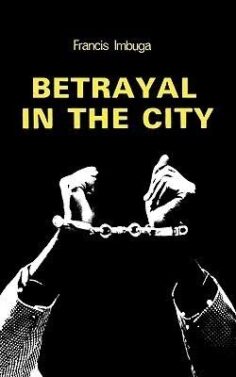
“Betrayal in the City” is a powerful political drama written by Kenyan playwright Francis Imbuga, first published in 1976. The play stands as one of the most significant works of East African theatre, offering a searing critique of post-independence African governance, military dictatorship, and the betrayal of the common people by those who claim to serve them. Set in the fictional African nation of Kafira, the play explores themes of oppression, resistance, sacrifice, and the moral compromises made by ordinary citizens living under authoritarian rule.
The play is structured in two acts with multiple scenes, moving between the grave of a murdered student, a prison cell, a modest urban home, and the corridors of power. Through its complex characters and layered narrative, Imbuga presents a multifaceted examination of what happens when a nation’s leaders betray the ideals of independence and turn against their own people.
This analysis will provide a comprehensive summary of the play, examine its major characters, explore its themes and symbolism, discuss its historical context, and evaluate its literary significance.
Summary
Act One, Scene One: The Desecrated Grave
The play opens at dawn in a desolate setting a lonely grave surrounded by dry thorny branches. A wooden bowl containing a few silver coins sits at the centre of the grave, and a visible crack runs across it. This is the grave of Adika, the son of Doga and Nina, who was killed in the city during a student demonstration.
Doga and Nina arrive at the grave to prepare for the traditional shaving ceremony a ritual meant to honour the dead. However, they discover that the grave has been desecrated. The crack in the earth and the smell of petrol indicate that someone has tried to burn or exhume the body. Doga recognizes this as the work of political enemies who want to erase evidence of Adika’s murder and silence his spirit.
The couple’s other son, Jusper, was supposed to guard the grave overnight but was absent during the desecration. Jusper, who has been mentally unstable since his brother’s death, arrives dressed in a red academic gown, behaving erratically. He speaks in riddles, mimicking gunfire, and claims to have killed someone and thrown the body in a river. His parents are confused and worried about his mental state.
Doga reveals the circumstances of Adika’s death: four bullets were fired during a student demonstration, and four bullet wounds were found in Adika’s chest. Two weeks after the burial, the sub-chief’s brother, Chagaga, was dismissed from his job, and rumors suggest he claimed self-defence in the killing.
Jere and Mulili, two soldiers, arrive with orders to cancel the ceremony. Mulili is drunk and aggressive, while Jere shows some sympathy for the family but insists he is only following orders. Doga recognizes Jere as the son of Kaleka, a man he was circumcised with a bond that should make them like brothers.
Jere reveals shocking news: Jusper has killed Chagaga, the sub-chief’s brother. Jusper had gone to the rally, dressed in a white shirt, and publicly confessed to the murder. The crowd stoned him until he fell, and he was taken into custody. Jere and Mulili were sent to guard the grave.
Doga gives Jere his pocket Bible, hoping it will open his eyes to the suffering of his people. Jere, moved by conscience, declares he will announce that the ceremony is on, despite Mulili’s objections. When Mulili refuses to help, Jere shoots at him (deliberately missing), and Mulili flees. Jere kneels at the grave in prayer, dropping a coin into the bowl.
Act One, Scene Two: The Prison Cell
The scene shifts to a prison cell where Mosese wa Tonga sits with his back to the audience. Jere is pushed into the cell by an Askari (guard). The Askari is cynical and mocking, revealing the dehumanizing nature of the prison system.
Mosese is a former lecturer at Kafira University who was arrested on fabricated drug charges after speaking out at Adika’s funeral. He was charged with possessing one kilogramme of opium a drug planted on him by a man named Nicodemus, which was also Mosese’s former name. He changed his name to Mosese wa Tonga, meaning “remember the past,” the day after his arrest.
Jere and Mosese gradually open up to each other. Jere reveals that he was a soldier and religious knowledge teacher who became disillusioned when sent to restore “peace and order” in his own sub-location. He was arrested after acting out the role of Pilate in a prison cell theatrical performance caning a fellow prisoner who played Jesus and then being beaten by guards who misunderstood the theatrical nature of the act.
Mosese explains his philosophy of silence as a weapon and his refusal to collaborate with the system. He reveals that his sister Regina visits him twice a month, and that soldiers beat her until she lost hearing in one ear, forcing her to give evidence against him.
The Askari returns with tea for Mosese (not Jere, because Jere doesn’t belong to his tribe). He hints at a mysterious opportunity for Mosese a chance for release if he cooperates with a plan to have prisoners perform a play for a visiting head of state. Mosese initially refuses, seeing it as betrayal of his principles.
Mosese experiences a vivid hallucination or dream sequence in which he seems to be giving a press conference or interview, accepting a post, and talking about forgiveness and the future. He shakes hands with invisible well-wishers and enters an imaginary car before returning to his mat. Jere observes this and delivers a powerful line: “When the madness of an entire nation disturbs a solitary mind, it is not enough to say the man is mad.”
Act One, Scene Three: Regina’s Home
The scene moves to a small room where Regina, Mosese’s sister, is getting ready. Jusper enters playfully, wearing his red academic gown. He is now out of prison, having been released due to his mental state and the intervention of influential people.
Regina is frustrated with Jusper’s erratic behavior and his insistence on wearing the academic gown in public. She reveals that their parents were found dead in their hut murdered in exchange for Jusper’s release. This adds another layer of tragedy to the story.
Jusper speaks passionately about justice, revolution, and the need to avenge Adika’s death. He reveals that students want a photograph of the dead student printed in newspapers with the word “THANKS” above it a modest demand that authorities refuse.
Regina urges caution, warning that speaking out only leads to imprisonment or death. She reveals that a state visit may be happening, and that prisoners might be released to mark the occasion. This gives her hope for Mosese’s release.
Tumbo, the landlord and a government official, arrives. He is a complex character corrupt and opportunistic, yet capable of genuine insight. He reveals that he has arranged for Regina to meet with Boss (the President) to plead for Mosese’s release. He also offers Jusper a commission to write a play for the visiting head of state, promising payment and recognition.
Tumbo reveals that Mulili, Boss’s cousin, is on the entertainment committee and is corrupt and dangerous. He also admits that the playwriting competition is rigged Jusper is declared the winner before any competition takes place. The prize money is actually government money allocated for the visit, and Jusper must write a play that highlights “progress” and “achievement.”
Jusper accepts the commission but secretly plans to use the play to expose the truth about the regime. He sees it as an opportunity to reach the visiting head of state and perhaps the nation.
Act Two, Scene One: The Entertainment Committee
The committee meets to plan the visitor’s entertainment. Kabito, a committee member, is asleep when Nicodemo arrives. Kabito is bitter about losing a university milk tender to Mulili through corruption. He considers Mulili an army dropout and second-rate farmer who has no business being on the committee.
Tumbo arrives and tries to maintain order. Mulili arrives late, boasting about how he used his connection to Boss to reverse the cancellation of his tender. The committee discusses plans: school children lining the airport road, traditional dances, and the play performed by prisoners.
Kabito objects to various proposals and clashes with Mulili, who accuses him of being a “primary kid.” The meeting descends into chaos, and Tumbo calls for a one-hour break.
Act Two, Scene Two: Outside Boss’s Palace
Boss sits outside his palace, pulling out grey hairs while looking in a mirror a symbol of his vanity and fear of aging. Mulili arrives to report that Kabito has been speaking against Boss, claiming Boss has money in foreign accounts and tried to force himself on Regina.
Boss becomes enraged and orders Mulili to silence Kabito. Mulili, an “old hand” at such tasks, understands this as an order to kill.
Act Two, Scene Three: The Aftermath
Jusper confronts Tumbo about Kabito’s death. The official story is that Kabito died in a drunk driving accident, but everyone knows he was murdered for speaking out. Jusper is shaken and wants to withdraw from the play, but Tumbo warns him of the consequences.
Jusper reveals that Regina was locked up in the palace cell for complaining about Boss’s advances she had to escape by jumping from a ten-foot-high window. This adds another layer of horror to Boss’s tyranny.
Tumbo, Nicodemo, and Mulili discuss Kabito’s death. Mulili lies about the circumstances, claiming Kabito’s body smelled of whisky. They agree to observe a minute of silence and move on.
Act Two, Scene Four: The Final Rehearsal
The scene is set for the final rehearsal of Jusper’s play. Tumbo and Jusper discuss the arrangements nervously. Tumbo warns Jusper that Boss is unpredictable and dangerous. Jusper reveals that Mosese has cooperated fully and knows all his lines.
Boss arrives to watch the rehearsal. He reveals that he was once an actor and understands the theatre. He questions Jusper about the play’s title “Betrayal in the City” and its content. Jusper describes a play about an army cadet who is promoted beyond his abilities, accidentally shoots a colleague, and is revealed to have no real connections.
Boss is intrigued but also suspicious. He insists on seeing the full-dress rehearsal with props, including guns. The guards bring their guns, which Jusper cleverly uses for the play.
The play-within-a-play begins. Mosese and Jere act as soldiers arguing about the specifications of different guns. Boss plays the role of the chief of staff. The tension builds as the actors move closer to Boss.
Suddenly, Jere points his gun at Boss, and Jusper shouts, “Shoot now!” Boss is taken hostage. Mulili tries to escape, but Mosese forces him to sit down. Jusper takes control, aiming at Mulili and eventually shooting him.
Jere offers himself as a sacrifice, but Boss refuses to shoot. Jusper demands the gun and kills Mulili, declaring, “I did it for Kafira. I did it for all of you people.”
The scene transforms into a tableau mirroring the opening graveside scene. Mulili’s body takes the place of the grave. Doga and Nina’s ghosts appear, repeating their movements from the first scene, suggesting that the cycle of death and mourning continues.
Character Analysis
Doga
Doga is the patriarch of the family, a traditional elder who believes in the importance of ritual and tradition. He is grief-stricken by his son’s death but maintains his dignity and sense of duty. He insists on performing the shaving ceremony despite the desecration of the grave, believing that failing to honour the dead would anger the spirits.
Doga represents the older generation’s wisdom and resilience. He recognizes the political nature of his son’s death and the desecration of the grave, understanding that the same forces that killed Adika are trying to erase his memory. His gift of the Bible to Jere is a gesture of hope he wants Jere to understand the suffering of his people and perhaps find a moral compass.
Doga’s character embodies the tension between tradition and political reality. He knows that the sub-chief is corrupt and that appealing to traditional authorities may be futile, yet he clings to the rituals that give his life meaning. His final appearance as a ghost suggests that even death does not end the struggle for justice.
Nina
Nina is Doga’s wife and the mother of Adika and Jusper. She is a figure of maternal grief, oscillating between despair and hope. She is terrified of what has happened to her family and fears for Jusper’s mental state.
Nina represents the suffering of ordinary people under oppressive regimes. She has lost one son to state violence, watched another descend into madness, and must now endure the desecration of her son’s grave. Her willingness to strip naked and show her “poor naked bones” to Jere and Mulili is a powerful act of defiance she has nothing left to lose and will shame those who have taken everything from her.
Jusper Wendo
Jusper is the most complex character in the play. He is a university student, a philosophy major, and a playwright. His brother’s murder and the subsequent events have unhinged him, leading to erratic behavior that authorities dismiss as madness.
However, Jusper’s “madness” is a conscious strategy. He uses his apparent insanity to speak truth to power, to behave in ways that would be dangerous for a “sane” person. His red academic gown is a costume that allows him to act out against the regime while appearing harmless.
Jusper’s killing of Chagaga is an act of vengeance for his brother’s death, but it is also a political act. He confesses publicly, knowing that he will be punished, but his mental state and family connections eventually secure his release. His parents’ murder in retaliation for his release adds another layer to his motivation.
As the playwright of “Betrayal in the City,” Jusper becomes the vehicle for Imbuga’s own critique of the regime. The play-within-a-play structure allows Jusper to present a subversive narrative while appearing to comply with the authorities’ demands. His final act killing Mulili is both a personal revenge and a symbolic act of resistance.
Jusper represents the revolutionary impulse, the willingness to sacrifice everything for justice. He is willing to die for his beliefs, as he demonstrates when he asks Boss to shoot him. His final line “I did it for Kafira” elevates his act from personal vengeance to patriotic duty.
Mosese wa Tonga
Mosese is a former lecturer at Kafira University, arrested on fabricated drug charges after speaking out at Adika’s funeral. He is a man of principle who has been broken by his experiences but refuses to betray his ideals.
Mosese’s philosophy of silence is a response to the futility of speech in a dictatorship. He has seen words lose their meaning “rehabilitation,” “nationalisation,” “africanisation” and has chosen silence as a form of resistance. However, his silence is not passive; it is a weapon, a way of refusing to participate in his own oppression.
Mosese’s hallucination/dream sequence reveals his inner conflict. He imagines being released, giving interviews, accepting a post, and talking about forgiveness. This fantasy is both a temptation and a warning it shows what he could have if he cooperated, but also what he would become.
His decision to participate in the play is a turning point. He recognizes that the play is an opportunity to speak to the nation, to reach the visiting head of state, and perhaps to effect change. His performance as a soldier who argues about gun specifications is a metaphor for the absurdity of military rule.
Mosese’s name change is significant. He was originally named Nicodemus, but he chose “Mosese wa Tonga” (remember the past) to remind himself and others of the history that the regime wants to erase. His sister Regina is his only remaining family, and his concern for her safety is a constant theme.
Jere Kaleka
Jere is a soldier who becomes disillusioned with the regime after witnessing its brutality. He is the son of Doga’s circumcision mate, making him and Jusper like brothers in the traditional sense.
Jere’s journey from soldier to rebel is gradual. He begins by following orders, even when those orders are unjust. He guards the desecrated grave, knowing that his superiors are responsible for the desecration. He informs Doga and Nina of their son’s murder and Jusper’s arrest, even though this is not strictly his duty.
Jere’s turning point comes when he reads the Bible Doga gives him. He recognizes the suffering of his people and decides to act. He announces that the ceremony will proceed, defying Mulili’s orders. He shoots at Mulili (deliberately missing) and then kneels at the grave in prayer.
In prison, Jere befriends Mosese and learns from him. He begins to understand the nature of the regime and the necessity of resistance. His arrest for “rioting in a public cell” is a fabrication he was simply performing a play but it gives him time to reflect.
In the final scene, Jere is the one who points the gun at Boss, initiating the hostage situation. He offers himself as a sacrifice, willing to die for the cause. He is not as radical as Jusper he doesn’t kill anyone but he is committed to the struggle.
Mulili
Mulili is Boss’s cousin and a former army officer who has been rewarded with a large farm for his services to the nation. He is corrupt, brutal, and stupid a dangerous combination.
Mulili represents the worst aspects of the regime. He uses his connection to Boss to win tenders and eliminate rivals. He is responsible for the desecration of Adika’s grave he is the “stray clansman” Doga mentions, the one who tried to burn the body to rid himself of the ghost.
Mulili’s murder of Kabito is described as a “fatal accident,” but everyone knows it was an assassination. He is the instrument of Boss’s tyranny, carrying out the dirty work that keeps the regime in power.
In the play-within-a-play, Mulili plays himself a corrupt official who tries to escape when the revolution begins. His death at Jusper’s hands is the climax of the play, the moment when the oppressed finally strike back.
Boss
Boss is the President of Kafira, a dictator who rules through fear and violence. He is vain, paranoid, and cruel, but also capable of charm and wit.
Boss’s vanity is symbolized by his obsession with grey hair he pulls them out because “a leader should not grow grey: people begin to lose confidence in you.” His paranoia is evident in his reaction to Kabito’s alleged remarks he immediately orders his death, without any investigation or trial.
Boss’s cruelty is demonstrated by his treatment of his wife, whom he locks up in the palace cell for complaining about his advances toward Regina. His treatment of the students sending three hundred more expatriate personnel just to spite them shows his willingness to use state resources for petty revenge.
However, Boss is not a one-dimensional villain. He reveals that he was once a good actor, that he understands theatre, and that he respects Jusper’s intelligence. He is capable of recognizing talent and even of self-awareness he knows that his guards hate him but are afraid to say so.
Boss’s final humiliation being held at gunpoint by his own prisoners is a reversal of power that symbolizes the possibility of revolution. However, his survival (he is not killed) suggests that the struggle is not over.
Regina
Regina is Mosese’s sister and Jusper’s girlfriend. She is a woman caught between her love for her brother and her fear of the regime.
Regina’s visit to Boss to plead for Mosese’s release is an act of courage, but it also puts her in danger. Boss attempts to seduce her, and when she rejects him, he locks her up. Her escape from the palace cell jumping from a ten-foot-high window is a testament to her determination.
Regina represents the women who suffer under dictatorship. She has lost her parents, her brother is in prison, and she is subjected to sexual harassment by the most powerful man in the country. Yet she survives, and her survival is a form of resistance.
Tumbo
Tumbo is the landlord and a government official. He is corrupt and opportunistic he accepts bribes, rigs the playwriting competition, and serves as Boss’s “right-hand man.” However, he is also capable of genuine insight and even compassion.
Tumbo’s relationship with Regina is complex. He arranges for her to meet Boss, knowing that this may be dangerous. He commissions Jusper to write the play, knowing that Jusper is a subversive. He warns Jusper about the dangers of speaking out, yet he also seems to admire Jusper’s courage.
Tumbo represents the compromised intellectual the person who knows what is wrong but lacks the courage to act. His final fate is left ambiguous he is not killed, but his future under the regime is uncertain.
Kabito
Kabito is a committee member who loses a tender to Mulili through corruption. He is vocal in his criticism of Mulili and the regime, which leads to his murder.
Kabito’s death is a turning point in the play. It shows that even committee members people with some status and connection are not safe from the regime’s violence. His death galvanizes Jusper and others, pushing them toward action.
Nicodemo
Nicodemo is another committee member. He is less vocal than Kabito but equally critical of the regime. He is the one who planted the drugs on Mosese the name “Nicodemus” is a reference to the biblical figure who visited Jesus at night, a secret disciple.
Nicodemo’s role in the play is ambiguous. He is complicit in the regime’s crimes, yet he also suffers under it. His fate is left uncertain.
The Askari
The Askari (guard) is a minor but important character. He represents the ordinary people who serve the regime, often without fully understanding what they are serving.
The Askari is cynical and mocking, but he is also capable of small acts of kindness he brings Mosese tea, even though Jere gets nothing. He is proud of his “education” (he did pure physics up to O-level) but uses it to justify torture and brainwashing.
The Askari’s comment that “I have once killed a man in this very cell” reveals the casual brutality of the regime. He is not a monster he is an ordinary man who has been taught to do monstrous things.
Themes and Symbolism
Betrayal
The title of the play, “Betrayal in the City,” refers to multiple levels of betrayal. The most obvious is the betrayal of the people by their leaders Boss and his regime have betrayed the ideals of independence, using state power for personal enrichment and political repression. The city, which should be a place of opportunity and progress, has become a site of violence and corruption.
But there are other betrayals as well. Mosese feels betrayed by his sister Regina when she plans to plead with Boss for his release he sees this as capitulation to the regime. Jusper feels betrayed by the university students who sacked him as Organising Secretary for his willingness to compromise. Regina feels betrayed by Tumbo, who arranged her meeting with Boss but failed to protect her. And ultimately, the characters betray themselves their ideals, their principles, their humanity in order to survive.
Madness and Sanity
The play constantly blurs the line between madness and sanity. Jusper is considered mad, yet he is the one who sees the truth most clearly. Mosese’s hallucination is a form of madness, yet it reveals profound truths about the human condition. The Askari is considered sane, yet he participates in a system that is fundamentally insane.
Jere’s line “When the madness of an entire nation disturbs a solitary mind, it is not enough to say the man is mad” is the key to understanding this theme. In a society that is itself mad where killing students, desecrating graves, and torturing dissidents are normal the person who refuses to participate may appear mad. But it is the society that is mad, not the individual.
Silence and Speech
Mosese’s philosophy of silence is a central theme. He argues that words have lost their meaning under the regime “rehabilitation, nationalisation, africanisation” and that silence is a form of resistance. But Jere and Jusper argue that silence is not enough, that one must speak out, even at the risk of death.
The play itself is an act of speech it breaks the silence that the regime imposes. The play-within-a-play is a way of speaking truth to power, of using the regime’s own platform to expose its crimes. Jusper’s final act killing Mulili is a form of speech, a declaration that the oppressed will not remain silent forever.
Sacrifice
Sacrifice is a recurring theme. Adika sacrificed his life for the truth. Jusper is willing to sacrifice himself for revenge. Jere offers himself as a sacrifice. Mosese sacrifices his freedom for his principles.
The play suggests that sacrifice is necessary for change. The old order cannot be overthrown without cost. But the play also questions whether sacrifice is enough whether the death of one person can change a system that is built on death.
The Past and the Future
Mosese’s name “remember the past” is a reminder that history matters. The regime wants to erase the past, to make people forget the crimes it has committed. The desecration of Adika’s grave is an attempt to erase the past, to destroy the evidence of state violence.
But the past cannot be erased. Doga and Nina’s ghosts appear at the end of the play, reminding the audience that the dead are not forgotten. The cycle of violence and mourning continues, but so does the struggle for justice.
Corruption
Corruption is pervasive in Kafira. Mulili wins tenders through his connection to Boss. Tumbo rigs the playwriting competition. The sub-chief’s brother is dismissed but faces no consequences for murder. The regime itself is a vast system of corruption, with Boss keeping money in foreign accounts while his people suffer.
The play suggests that corruption is not just a matter of individual greed it is a system that rewards loyalty over competence, connections over merit, and silence over truth. To fight corruption is to fight the entire system.
Violence and Power
Violence is the foundation of Boss’s power. He kills Kabito for speaking out. He locks up his wife for complaining. He sends soldiers to beat up Regina. He orders the desecration of Adika’s grave. The regime maintains power through fear, and fear is maintained through violence.
But the play also shows that violence can be resisted. Jusper kills Mulili. Jere points a gun at Boss. The students demonstrate in the streets. The people are not passive victims they are agents of change, even when that change comes at a terrible cost.
Theatre and Politics
The play-within-a-play structure is central to the play’s meaning. Jusper uses the commission to write a play for the visiting head of state as an opportunity to stage a subversive performance. The play that he writes “Betrayal in the City” is a mirror image of the larger play we are watching.
This structure suggests that politics is itself a form of theatre Boss stages elaborate ceremonies to impress visitors, the committee plans entertainment to showcase “progress,” and the regime uses propaganda to create an illusion of normalcy. Jusper’s play exposes the reality behind the illusion.
The theatre is also a space of freedom. In the play-within-a-play, the actors can say things they could not say in real life. They can point guns at the President. They can kill the villain. The theatre allows the audience to imagine a different world, a world where justice is possible.
Historical and Political Context
Kenya Under Kenyatta and Moi
“Betrayal in the City” was first performed in 1975, during the presidency of Jomo Kenyatta. Kenya had gained independence in 1963, but the promise of independence land, freedom, prosperity had not been fulfilled for most Kenyans. The regime was increasingly authoritarian, using detention without trial, torture, and political assassination to silence dissent.
The play was written just before Kenyatta’s death in 1978, and it reflects the anxieties and frustrations of that period. The character of Boss is a composite figure he resembles Kenyatta in some ways (the “father of the nation” who becomes a dictator) but also anticipates Daniel arap Moi, who succeeded Kenyatta and ruled Kenya for twenty-four years.
The play was banned in Kenya for many years because of its political content. It was seen as a threat to national security, a critique of the ruling party, and an incitement to rebellion. The ban itself is a testament to the play’s power it said something that the regime did not want to hear.
Post-Colonial African Theatre
Imbuga was part of a generation of African playwrights who used theatre as a tool for political critique. Writers like Wole Soyinka (Nigeria), Ngugi wa Thiong’o (Kenya), and Athol Fugard (South Africa) used drama to explore the contradictions of post-colonial society.
“Betrayal in the City” is particularly influenced by Soyinka’s work, especially “The Interpreters” and “Madmen and Specialists.” Like Soyinka, Imbuga uses absurdist techniques, fragmented narrative, and symbolism to convey the insanity of political dictatorship.
The play also draws on traditional African theatre the use of the chorus, the integration of music and dance, the ritualistic elements. The graveside ceremony, the shaving ritual, the appearance of ghosts all of these are rooted in African cultural practices.
The Figure of the Dictator
Boss is a classic example of the African dictator a figure that appears throughout post-colonial literature. He is charismatic, paranoid, cruel, and vain. He surrounds himself with sycophants (Mulili, Tumbo) and eliminates anyone who threatens his power (Kabito, Adika).
The play suggests that dictatorship is not just a matter of individual evil it is a system that corrupts everyone who participates in it. Even well-meaning people like Jere and Tumbo are compromised by their involvement in the regime. The only way out is to resist, even at the cost of one’s life.
Symbolism and Imagery
The Grave
The grave is the central symbol of the play. It represents death, memory, and the struggle for justice. The crack in the grave symbolizes the attempt to erase the past to destroy the evidence of state violence. The coins in the bowl represent the blood money paid to silence the family.
The desecration of the grave is a political act it is an attempt to destroy Adika’s spirit, to prevent him from becoming a martyr. But the attempt fails. Adika’s spirit lives on in Jusper, who avenges his brother’s death.
The Red Academic Gown
Jusper’s red academic gown is a symbol of his student status and his madness. Red is the color of blood, of revolution, of sacrifice. The gown marks him as an intellectual, but also as a clown a figure who can speak truth to power without being taken seriously.
When Jusper wears the gown in public, he is making a statement. He is saying that the university is a site of resistance, that students are the conscience of the nation. The authorities see the gown as a provocation it marks him as a troublemaker, a subversive.
The Bible
Doga gives Jere his pocket Bible as a symbol of hope. The Bible represents truth, justice, and the possibility of redemption. Jere, a former religious knowledge teacher, understands the Bible’s message that the powerful will be brought low, that the meek will inherit the earth.
But the Bible is also a site of conflict. Jere is arrested for acting out the story of Pilate and Jesus a story about the abuse of power, the sacrifice of the innocent, and the possibility of resurrection. The guards who beat Jere and take away his Bible do not understand the story they are trying to suppress.
The Guns
The guns in the play are symbols of state power and revolutionary violence. The guards’ guns are used to intimidate, to control, to kill. But in the play-within-a-play, the guns are turned against the state Jere points his gun at Boss, and Jusper uses a gun to kill Mulili.
The guns are also symbols of masculinity and militarism. Mulili’s identity as a “professional soldier” is based on his relationship to guns. Jere’s identity as a soldier is challenged when he begins to question the use of violence. The play suggests that guns are not inherently evil it depends on who is using them and for what purpose.
The Play-within-a-Play
The play-within-a-play is a device that allows Imbuga to comment on the relationship between theatre and politics. The play that Jusper writes is a mirror image of the larger play it tells the story of a corrupt regime, a naive cadet, and a revolutionary uprising.
The play-within-a-play also allows the characters to say things they could not say in real life. When Jere points his gun at Boss, he is not just acting he is making a political statement. When Jusper kills Mulili, he is not just performing he is carrying out a revolutionary act.
Ghosts
The appearance of Doga and Nina’s ghosts at the end of the play is a powerful symbol. It suggests that the dead are not forgotten, that the struggle continues beyond death. The ghosts repeat the movements of the first scene, suggesting that the cycle of violence and mourning is eternal.
But the ghosts also represent hope. They are the ancestors, the spirits of the past, who watch over the living and demand justice. Their presence at the end of the play suggests that the revolution is not just a political act it is a spiritual one, a return to the values of the ancestors.
Language and Style
Language and Power
The play explores the relationship between language and power. Boss uses language to control he issues orders, makes speeches, and creates propaganda. The Askari uses language to intimidate he mocks the prisoners, threatens them, and asserts his authority.
But language can also be a tool of resistance. Jusper uses language to subvert he speaks in riddles, makes jokes, and uses the play to expose the truth. Mosese uses silence as a weapon by refusing to speak, he refuses to participate in his own oppression.
The play also explores the corruption of language under dictatorship. Words like “rehabilitation,” “nationalisation,” and “africanisation” have lost their meaning they are used to justify oppression, not to describe reality. Mosese’s question “What is africanisation in your mother tongue?” exposes the emptiness of official language.
Humor and Satire
Despite its serious themes, “Betrayal in the City” is full of humor and satire. Mulili’s broken English, his constant references to “tenders” and “potatoes,” and his absurd self-importance are comic. Boss’s vanity, his obsession with grey hair, and his theatrical posturing are satirical.
The humor serves a serious purpose. It exposes the absurdity of dictatorship the way that petty officials become tyrants, the way that ordinary people are crushed by the whims of the powerful. By making us laugh at Mulili and Boss, Imbuga makes us recognize them as human and therefore as capable of being overthrown.
Dramatic Irony
The play is full of dramatic irony. The audience knows that Jusper is planning to use the play to expose the regime, but Boss does not. The audience knows that Mosese is innocent, but the Askari does not. The audience knows that Mulili is a murderer, but Boss treats him as a loyal cousin.
This irony creates tension and suspense. We watch the characters move toward a climax that they cannot foresee but we can. The final scene, in which the prisoners turn the play into a revolution, is the payoff of all the irony that has come before.
Conclusion
“Betrayal in the City” is a powerful indictment of post-colonial African dictatorship. Through its complex characters, layered narrative, and rich symbolism, the play exposes the betrayal of the people by their leaders, the corruption of language and institutions, and the possibility of resistance.
The play is not without hope. The final scene, in which the prisoners turn the play into a revolution, suggests that change is possible. But the cost is high Jusper kills Mulili, Jere points a gun at Boss, and the cycle of violence continues. The ghosts of Doga and Nina remind us that the struggle is not just political but spiritual, that the dead are watching, and that justice must be done.
Francis Imbuga’s play remains relevant today, not just in Kenya but throughout Africa and beyond. It speaks to anyone who has lived under a regime that betrays its people, anyone who has struggled for justice, and anyone who believes that theatre can be a force for change.
The play’s title “Betrayal in the City” is a warning. The city, which should be a place of opportunity and progress, has become a site of betrayal. The leaders have betrayed the people. The intellectuals have betrayed their principles. The soldiers have betrayed their duty. Only the mad, the imprisoned, and the dead remain true to the cause of justice.
But the play also suggests that betrayal is not the end of the story. The final tableau, in which the graveside scene is replayed with Mulili’s body in place of the grave, is a reminder that the cycle continues. The struggle for justice is eternal, and each generation must take up the fight.
“Betrayal in the City” is a masterpiece of African theatre, a work that combines political critique, psychological insight, and theatrical innovation. It is a play that demands to be seen, not just read a play that uses the stage to create a world that is both specific to its time and place and universal in its themes. It is a play that, in the words of Jere, reminds us that “when the madness of an entire nation disturbs a solitary mind, it is not enough to say the man is mad.”