
Introduction
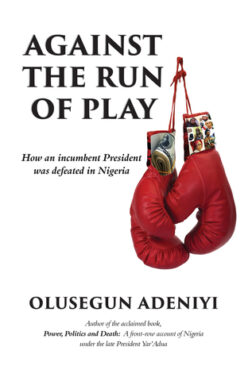
“Against the Run of Play: How an Incumbent President Was Defeated in Nigeria” is a meticulously researched and compellingly written book by Olusegun Adeniyi, a veteran Nigerian journalist and author. Published in 2017 by Kachifo Limited under its Prestige imprint, the book provides an unprecedented, insider’s account of one of the most significant political events in Nigeria’s democratic history: the defeat of an incumbent President, Dr. Goodluck Ebele Jonathan, in the 2015 presidential election by Major General Muhammadu Buhari (retd.) of the All Progressives Congress (APC).
The title itself captures the essence of the narrative the defeat of an incumbent Nigerian president was historically unprecedented and considered virtually impossible in Nigerian political circles, hence the “against the run of play” metaphor drawn from football (soccer). The book not only documents the defeat itself but also explores the factors, personalities, and circumstances that made this seemingly impossible outcome a reality. Adeniyi, who previously authored the acclaimed book “Power, Politics and Death: A Front-Row Account of Nigeria Under the Late President Yar’Adua,” brings his characteristic depth, access to key players, and journalistic rigor to this work.
Structure and Approach
The book is organized into twelve chapters, plus a foreword by Dr. Chidi Amuta, acknowledgments, and a postscript. Adeniyi’s methodology involves extensive interviews with virtually all the key actors in the drama he recounts former presidents, governors, party officials, security chiefs, ministers, and the principal figures themselves: former President Goodluck Jonathan, President Muhammadu Buhari, and former Lagos State Governor Bola Ahmed Tinubu.
The narrative is chronological, beginning with the circumstances surrounding Jonathan’s ascension to power in 2010 and the contentious zoning debate within the Peoples Democratic Party (PDP) that preceded the 2011 election. It then progresses through the various political developments, decisions, and miscalculations that culminated in the 2015 election and its aftermath.
Foreword by Dr. Chidi Amuta
Dr. Chidi Amuta’s foreword sets the stage for the book, contextualizing its significance within Nigerian political history and the broader African democratic landscape. He describes Adeniyi as “arguably the foremost and most credible chronicler of Nigeria’s contemporary political history and evolution,” noting that the author approaches this “necessary national assignment from the perspective of an active journalist, not that of a professional academic historian.”
Amuta highlights the historical significance of the 2015 election, emphasizing that “the moment at issue is the precarious one when an entrenched political party was defeated in a presidential election after 16 unbroken years in power.” He particularly praises Jonathan’s concession as an act of heroism, noting that “in a continent where leaders have cultivated perpetual tenures that sometimes last decades or even life times,” the peaceful transfer of power was of immense significance.
The foreword also touches on the timing of the book’s publication, coinciding with President Buhari’s extended medical vacation in London, drawing uncomfortable parallels with the late President Yar’Adua’s similar circumstances. Amuta quotes cultural philosopher Walter Benjamin: “Every epoch not only dreams the next…it bears its end within itself, and reveals it by a ruse.”
Chapter One: 2011 and the Hard Bargain
This chapter establishes the foundational context for Jonathan’s political trajectory. It begins with a dramatic scene at the First Lady’s Conference Room within the Presidential Villa, where the PDP leadership convened to discuss Jonathan’s intention to contest the 2011 presidential primaries. This was against the backdrop of an unwritten zoning agreement that the vacuum left by President Umaru Musa Yar’Adua’s death in May 2010 could only be filled by another northerner.
The chapter introduces key figures in the drama, including PDP National Chairman Dr. Okwesilieze Nwodo, Chief Ombo Isokrari, former Governor Samuel Ogbemudia, Chief Emmanuel Iwuanyanwu, Alhaji Adamu Ciroma, and Secretary to the Government of the Federation Alhaji Mahmud Yayale Ahmed. It details the heated debate between those who argued Jonathan had a constitutional right to contest and those who insisted on the zoning principle that would have reserved the presidential ticket for a northern candidate.
Adeniyi reveals the historical context of the PDP’s zoning arrangement, tracing it back to a 1998 meeting at the house of Prof. Jerry Gana, where the party resolved to rotate power between North and South. The author quotes Nwodo extensively, explaining how the party had previously enforced zoning by returning Alhaji Abubakar Rimi’s nomination check in 1999.
The chapter also explores the American perspective on Jonathan’s intentions, citing WikiLeaks dispatches from Ambassador Robin Renée Sanders indicating that Jonathan initially said he “does not anticipate standing for elections in 2011” but would consider it “if they want me to run.”
A significant revelation is the one-term deal. At a meeting in December 2010, with PDP governors clamoring, Jonathan agreed to spend only one term. This was publicly confirmed when Governor Ibrahim Shema of Katsina State read a statement on behalf of the PDP Governors Forum: “The Governors also recognize the Yar’Adua/Jonathan ticket and therefore hereby support and endorse President Goodluck Ebele Jonathan (GCFR) to contest the 2011 election as the PDP presidential candidate for a period of four years only.”
The chapter also details Atiku Abubakar’s challenge to Jonathan in the PDP primaries, with Atiku launching blistering attacks on Jonathan’s competence and character. Despite this, Jonathan won the primaries and went on to win the 2011 presidential election, defeating Buhari, Nuhu Ribadu, and Ibrahim Shekarau. However, the results revealed a sharply divided nation, with Jonathan losing all the North-East and North-West states.
Chapter Two: The Seeds of Rebellion
This chapter examines how Jonathan’s own actions and those of his close associates particularly his wife, Dame Patience Jonathan created enemies within his own party and set the stage for his eventual defeat.
Adeniyi opens with a dramatic scene: Speaker Aminu Waziri Tambuwal receiving a phone call from Dame Patience Jonathan, who berates him for allegedly plotting against her husband’s government. This personal animosity is traced back to the 2011 National Assembly leadership contest, where Tambuwal and Emeka Ihedioha defied the presidency’s preferred candidates to emerge as Speaker and Deputy Speaker respectively.
The chapter details how the First Lady’s interference in the selection process particularly her support for Mulikat Akande-Adeola as Speaker created unnecessary conflict. It also describes how the presidency’s heavy-handed response, including deploying security agencies to intimidate Tambuwal and Ihedioha, only strengthened their resolve and created a permanent rift.
Adeniyi explores similar patterns of conflict with other key figures, including Bayelsa State Governor Timipre Sylva and Rivers State Governor Rotimi Amaechi. Sylva’s removal from office through the PDP National Working Committee and subsequent persecution by the EFCC are detailed, with Sylva’s open letter to Jonathan lamenting “the totally unjust way, manner, reason… people were used to remove me from office and the wave of state persecution.”
The Amaechi saga receives extensive treatment, with the author quoting Amaechi’s explanation: “I am happy President Jonathan told you about my problem with his wife but he apparently did not tell you the whole story. The question you should ask yourself is, why should a Governor have problem with the wife of the President? The simple answer is that I could not surrender my mandate to a woman in Abuja, even if such a person was wife of the President.”
The chapter reveals the interconnected nature of these conflicts: Amaechi’s opposition to the management of the Federation Account, the loss of oil wells to neighboring states, and his role as Nigeria Governors Forum Chairman all contributed to his estrangement from the presidency. The author notes that “in overplaying their hand on many levels, Jonathan’s apparatchiks did not realise that they were strengthening the opposition.”
The chapter also documents the rapid turnover of PDP national chairmen six in five years under Jonathan and the various controversies surrounding them, particularly the Nwodo affair involving an Enugu High Court injunction and the eventual finding of judicial misconduct against Justice Reuben Onuorah.
Chapter Three: The Road to Opposition Merger
This chapter chronicles the tortuous path toward the formation of the All Progressives Congress (APC), the coalition that would ultimately unseat the PDP.
Adeniyi begins with a historical survey of failed opposition alliances in Nigeria, from the First Republic’s NCNC-AG alliance through various attempts in the Second Republic. He notes that “given the character of the Nigerian politician, could such an idea really work?” and that “not many people believed in the feasibility of such an option.”
The chapter then traces Buhari’s political journey through the ANPP, including the dramatic 2003 convention where John Nwodo and other aspirants withdrew in protest over the lack of transparency. It details Buhari’s decision to leave the ANPP in 2010 and form the Congress for Progressive Change (CPC), with the letter to the party explaining “fundamental and irreconcilable ideological differences.”
The failed 2011 alliance between the CPC and the ACN receives detailed attention, with conflicting accounts from various participants. Tinubu’s version emphasizes the CPC’s pre-emptive announcement of Pastor Tunde Bakare as Buhari’s running mate, which he says “roiled the waters and severely complicated matters.” Buba Galadima, the CPC’s founding National Secretary, corroborates Tinubu’s account, revealing that “without any consultation, Buhari in his typical impulsive manner announced the name of Pastor Bakare, who we had rejected in the committee because we felt he would not be an electoral asset.”
Aminu Bello Masari offers a different perspective, arguing that the problem was primarily about timing: “Despite the realization that the only way the PDP could be defeated was to have a coalition of opposition parties working together, we left the talk for such a platform till practically on the eve of submission of candidates’ list to INEC.”
The chapter then describes the post-2011 efforts to revive the merger talks, including the role of the late Emir of Borgu, Haliru Dantoro, who “became the father of the merger.” Tinubu’s account of the Emir’s intervention is particularly revealing: “Without the late Emir of Borgu, there was no way I would go to Kaduna. Dantoro had earlier invited both Buhari and myself to his daughter’s wedding in Borgu where we had our first exploratory talk.”
The El-Rufai Committee’s memo, “The ACN-CPC Merger: Preliminary Roadmap,” dated 30th June 2012, provides crucial insight into the strategic thinking behind the merger. The memo projected that “an initial ACN-CPC merger will galvanize other sceptical opposition parties to join, encourage many unhappy PDP members to pitch their tent with us, and mobilize a frustrated citizenry to send the PDP packing at federal and state levels.”
The chapter details the merger negotiations, including the delicate issue of what the new party would be called. Ogbonnaya Onu’s book is quoted extensively, explaining how each merging party contributed to the APC acronym: “In accepting the name, All Progressives Congress (APC), the Action Congress of Nigeria (ACN) was satisfied that it contributed ‘Congress’. The All Nigeria Peoples Party (ANPP) was happy that it contributed ‘All’. Even though ‘All’ had only three letters, it was the leading word in the new name. The Congress for Progressive Change (CPC) felt satisfied that it contributed ‘Progressives’. Also, the All Progressives Grand Alliance (APGA) was satisfied that it contributed ‘All Progressives.'”
The APC was formally registered by INEC on 31st July 2013, and the chapter concludes with Oby Ezekwesili’s warning at the party’s national summit: “Regardless of what anyone may promise about ‘change’, it cannot be confidently accepted by citizens who watch in utter dismay the migratory dance by politicians moving from one party to another seeking where their personal benefits are best guaranteed.”
Chapter Four: Revolt of the PDP Governors
This chapter focuses on the internal revolt within the PDP that saw several governors leave the party to join the APC, a development that proved crucial to Jonathan’s defeat.
The narrative centers on the Nigerian Governors Forum (NGF) chairmanship election of 2013, which became a proxy battle between Jonathan and Amaechi. Adeniyi provides detailed background on the NGF’s evolution from an informal club to a more structured body, including the various leadership changes that had occurred over the years.
The author reveals the extent of the presidency’s involvement in trying to prevent Amaechi’s re-election, quoting Okauru’s conversation with Tony Anenih: “Sir, why don’t you ask Amaechi to nominate another governor since you feel this strongly about the issue? We have tried to do that but the silly boy nominated Kwakwanso. The President would rather Amaechi continue than have that one (Kwakwanso) become the NGF Chairman.”
The election itself is described in detail: Amaechi defeated Jonah David Jang by 19 votes to 16, with Isa Yuguda’s withdrawal from the Northern Governors Forum providing insight into the betrayal that many northern governors felt.
The chapter then traces the aftermath of the NGF election, including the PDP’s attempts to remove Amaechi through the courts and the ensuing political crisis in Rivers State. It also describes the formation of the G-7 group of governors within the PDP, which eventually led to five of them Amaechi, Murtala Nyako, Magatakarda Wamakko, Rabiu Kwankwaso, and Aliyu Wamakko leaving the party for the APC.
Amaechi’s explanation for joining the APC is particularly significant: “There were those who wanted to be president. There were also those who felt we should form a different political party. My point was that such an idea would not hurt Jonathan because at the end of the day, we would just be playing into his hands by splitting the votes. There was no way a new party would win so I felt that rather than waste our time and energy, it was better to join what was at that period a growing opposition party in the APC. I was the one who pushed them in the direction of Buhari who in any case I actually liked for his discipline and stance on corruption.”
Chapter Five: The Perception of Corruption
This chapter examines the various corruption scandals that plagued the Jonathan administration and contributed significantly to his defeat.
Adeniyi begins with Jonathan’s infamous “I don’t give a damn” statement regarding the public declaration of his assets, made during a presidential media chat in June 2012. The author notes that “that phrase – ‘I don’t give a damn about it’ – became the highlight of the session while the manner in which he reacted revealed a surprisingly erratic temperament.”
The chapter details the WikiLeaks revelations, including the damaging cable stating that “in September 2006, the Economic and Financial Crimes Commission (EFCC) seized USD 13.5 million from Dame Patience Jonathan at an airport. Reports indicated the money was laundered through an associate; Jonathan managed to distance himself from the deal.”
The fuel subsidy scandal receives extensive treatment, with the author detailing the Aig-Imoukhuede Committee’s findings. The committee’s report revealed staggering fraud, including the use of dead vessels for import transactions, companies without any experience in the oil sector receiving import allocations, and billions of naira in questionable subsidy claims.
The report’s findings are quoted extensively: “A dead vessel named MT LOUISIANA GETTY, which had been changed to PHILIP LOUISIANA since 1975 before she eventually died as duly reported by Lloyd’s List Intelligence, was used to conclude PMS import transaction in 2010 and 2011; The name of another dead vessel, KRITI AKITI, which had been changed since 17th April, 2010 before she was decommissioned and eventually died on 6th July, 2010 was also used for PMS import transactions in 2011.”
The chapter also covers the Pension Reform Task Team scandal involving Abdulrasheed Maina, the Stella Oduah bulletproof cars scandal, and the Nigerian Immigration Service recruitment tragedy that claimed 16 lives. The Maina scandal is particularly notable for the Senate’s unprecedented confrontation with the executive, with Senate President David Mark warning that “the executive has to choose between the Senate and Maina.”
The state pardon granted to Diepreye Alamieyeseigha, the former Bayelsa State governor convicted of corruption, is described as particularly damaging, especially given the international dimension involving the United States government’s condemnation.
The chapter concludes with the Sanusi Lamido Sanusi letter to Jonathan alerting him to $48.9 billion that could not be properly accounted for by the NNPC, and Sanusi’s subsequent suspension. The author notes that “it was a scandal that dealt perhaps the biggest corruption blow to the Jonathan administration, and from which it never recovered.”
Chapter Six: Of Boko Haram and Chibok Girls
This chapter addresses the security challenges that plagued the Jonathan administration, particularly the Boko Haram insurgency and the abduction of the Chibok girls.
Adeniyi begins with a dramatic scene at the Presidential Villa, where Governor Kashim Shettima of Borno was summoned to discuss the Chibok abduction. The author describes Jonathan’s palpable anger and the belligerent posture of those in the room, quoting Shettima: “Not only did he agree to the idea of a one-on-one meeting, President Jonathan actually held me by the hand as he led me into his office. But the moment we entered, all the others at the meeting also followed. At that point, I saw a leader who was helpless.”
The chapter details Shettima’s earlier warning about the military’s inability to defeat Boko Haram, which drew Jonathan’s threat to withdraw the army from Borno State for a month. The governor’s perspective is given extensive coverage: “I am an eternal optimist but I am also a realist. Given the present state of affairs, it is absolutely impossible for us to defeat Boko Haram.”
The Chibok abduction itself is described, including the advance warnings that were ignored and the military’s failed response. The author quotes Hon. Yaga Yarakawa, the Chairman of Chibok Local Government, who recalls: “I recall that the DPO called me that their ammunitions were exhausted and that they had to retreat. By then, the few soldiers that put up some resistance had already retreated in the face of superior firepower.”
The chapter also documents the First Lady’s infamous “Diaris God o!” outburst and her claim that “no child is missing in Borno State,” which only compounded the administration’s credibility problems. The author notes that “the opposition didn’t have to do much to shape the narrative against the Jonathan administration.”
The international response to the Chibok abduction, including the #BringBackOurGirls campaign and the involvement of Michelle Obama, is covered, as is the Paris summit convened by President Francois Hollande. The chapter concludes with the military’s various claims about knowing the location of the girls and the eventual admission by Chief of Defence Staff Alex Badeh that the military lacked the equipment and motivation to fight Boko Haram effectively.
Chapter Seven: The Intrigues Within APC
This chapter details the internal dynamics of the APC, particularly the contentious issue of Buhari’s running mate for the 2015 election.
Adeniyi describes the December 2014 meetings in Lagos where APC governors gathered to discuss the presidential primary and the running mate question. The author reveals that Buhari had told some governors about his “long-standing commitment to Tinubu that they would run together,” which caused significant concern among party stakeholders.
The chapter then provides a detailed history of Buhari’s political career, including the formation of the CPC and the 2011 campaign. The author quotes Buhari’s 2011 concession that “this is the third and last one for me, since after it I will not present myself again for election into the Office of the President,” and his subsequent reversal a year later.
The chapter explores the conflicting accounts of the 2011 alliance failure, with Masari, Tinubu, and El-Rufai offering different perspectives. El-Rufai’s account is particularly detailed: “The ACN leadership doublecrossed Buhari and the CPC in the negotiations preceding the 2011 presidential election.”
The jostling for the VP position is described in detail, including Buhari’s visit to Atiku (who warned against a Muslim-Muslim ticket) and his meeting with Tinubu. The author reveals that when Buhari asked Tinubu to nominate three persons, “the South-West leader sent only one name: that of his former Attorney General and Commissioner of Justice, Prof. Yemi Osinbajo.”
Tinubu’s reflections on the episode are given extensive coverage, including his statement: “I told him that I would give him only one name that would not be mine, although I personally believed a Muslim-Muslim ticket could ensure victory. I backed out because I did not want to be depicted as causing a problem.”
The chapter also details the various attacks on Tinubu’s potential candidacy, including those from Tom Ikimi and others who used religion as an argument against a Muslim-Muslim ticket. Fani-Kayode’s warning is quoted: “The biggest mistake that the APC can make is to field a Muslim/Muslim ticket for the 2015 presidential elections. Such a mistake would spell the death-knell of the party.”
Chapter Eight: The Obasanjo Revolt
This chapter examines the dramatic falling out between Jonathan and former President Olusegun Obasanjo, who had been instrumental in Jonathan’s rise to power.
Adeniyi describes the January 2015 meeting at Obasanjo’s Abeokuta residence, where Jonathan brought Pastor Enoch Adeboye and Bishop David Oyedepo as witnesses. Obasanjo’s account is given in detail: “I told him in the presence of his witnesses that I was not going to support him for a second-term and I gave my reasons. Aside the issue of zoning on which he was reneging, his stewardship up to that point had also shown very clearly that he was not up to the job.”
The chapter traces the deterioration of the Obasanjo-Jonathan relationship, from Obasanjo’s resignation as PDP Board of Trustees Chairman in April 2012 to his various public criticisms of the administration. The author quotes Obasanjo’s 2013 open letter, “Before It Is Too Late,” extensively, including the passage: “For you to allow yourself to be ‘possessed’, so to say, to the exclusion of most of the rest of Nigerians as an ‘Ijaw man’ is a mistake that should never have been allowed to happen.”
Obasanjo’s motivations are explored, with the former president explaining his position: “I didn’t join them in supporting Buhari, I joined in opposing Jonathan so Buhari was just a beneficiary of my opposition to Jonathan since my position was AOBJ: Any Option But Jonathan.”
The chapter also details Obasanjo’s criticism of Jonathan’s handling of the Boko Haram insurgency, including his statement that “Jonathan and his people turned Boko Haram into an industry for making money. Rather than seek for solution, Boko Haram became an ATM machine for taking money out of the treasury.”
The author provides context for Obasanjo’s own political journey, including his selection of Yar’Adua as his successor and his subsequent role in Jonathan’s ascension. Obasanjo’s explanation for supporting Jonathan in 2011 is revealing: “I saw the emergence of Jonathan as an opportunity to solve the problem of minority agitation. The three majority ethnic groups in Nigeria can always sort themselves out but not so for the minority.”
The chapter concludes with Obasanjo’s continued attacks on the Jonathan administration in the weeks before the election, including his accusation that Jonathan was “trying to play Gbagbo” and his warning that the president feared prosecution if Buhari won.
Chapter Nine: A Litany of Unforced Errors
This chapter catalogs the various missteps and miscalculations that contributed to Jonathan’s defeat, many of which were self-inflicted.
Adeniyi begins with the Mbaka saga, describing how the fiery Catholic priest initially supported Jonathan but turned against him after the First Lady refused to give him her phone number. The author quotes Mbaka’s New Year’s Eve sermon: “We need change. NEPA is not working because of corruption. The privatization of public companies has not yielded any fruit because of corruption. Nigerians are sick and tired of wasting innocent lives without government doing enough to stop the destruction.”
The chapter details other gaffes, including Jonathan’s failure to attend important events (the Commonwealth meeting in Perth and the AU summit in Addis Ababa), the ill-fated renaming of the University of Lagos, and the national conference that alienated northern leaders.
The Morocco diplomatic incident is given extensive coverage, with the author describing how a purported phone call between Jonathan and King Mohammed VI became an international embarrassment. The Moroccan foreign ministry’s statement is quoted: “The request by Nigerian authorities for a phone conversation between HM King Mohammed VI and Nigerian President was refused by the Monarch who deemed it inappropriate on grounds of the upcoming elections in Nigeria.”
Nigeria’s abstention from the UN Security Council vote on Palestinian statehood is also examined, with the author noting that “it was seen by majority of Muslims in Nigeria as a betrayal and helped to drive a wedge between supporters of the President in the North.”
The chapter also covers the Ombatse crisis in Nasarawa State, where 90 police officers were killed, and the controversial statement by the SSS Director General that he forgave the killers. Buhari’s reaction is quoted: “The SSS boss or whoever that said he has left everything to God has no right to do that.”
The author also examines Jonathan’s management of the PDP, including the rapid turnover of national chairmen and the controversial emergence of Bamanga Tukur as chairman despite losing the North-East zonal congress. The chapter concludes with Babangida Aliyu’s assessment of how the PDP unraveled.
Chapter Ten: Election Postponed…
This chapter details the events surrounding the postponement of the 2015 election from February 14 to March 28.
Adeniyi begins with the Council of State meeting of February 5, 2015, where the decision to postpone was debated. The author describes the conflicting interpretations given by Governor Rochas Okorocha (APC) and Governor Olusegun Mimiko (PDP) after the meeting, reflecting the political tensions surrounding the issue.
The chapter provides detailed background on the security concerns raised by National Security Adviser Sambo Dasuki and the service chiefs, as well as the concerns about PVC distribution. The author notes that “it was very obvious to us that collection of PVCs was very high in the North-West and North-East, zones that could be considered the catchment area of the APC because of Buhari, while the collection was very low in the South-South and South-East which was the home base of Jonathan.”
The debate at the Council of State meeting is described in detail, with Fashola arguing against postponement and Imoke and Akpabio arguing for it. The author quotes Jega’s presentation on INEC’s readiness and the card reader technology.
The chapter also explores the alternative option considered by some within the administration: invoking Section 135(3) of the Constitution to extend Jonathan’s tenure due to the war against Boko Haram. The author notes that “Jonathan knew that succumbing to such an idea would be politically suicidal for him and he rejected it outright.”
The six-week postponement period is described, including the military’s efforts to degrade Boko Haram and the political maneuvering that continued. Tinubu’s perspective is given: “The thinking was that by postponing the election, they would stretch us financially since one of their main calculations for winning was to use money.”
The chapter also covers the various attempts to remove Jega and the controversy over the card readers, as well as the health rumors surrounding Buhari and Governor Fayose’s controversial advert.
Chapter Eleven: The Ballot and the Day After
This chapter provides a detailed account of the election itself and its immediate aftermath.
Adeniyi describes the final weeks of the campaign, including the roles played by the wives of the two main candidates. Dame Patience Jonathan’s description of Buhari as “brain-dead” is quoted, as is Aisha Buhari’s effective response: “The wife of the President is supposed to be a mother to all Nigerians, regardless of political affiliation. So, for her to say northerners are Almajiris who beg for alms is sad.”
The various peace initiatives are described, including the Council of the Wise, the Kofi Annan/Emeka Anyaoku intervention, and the National Peace Committee chaired by General Abdulsalami Abubakar. The author provides a detailed account of the peace accord signed by Jonathan and Buhari, including the dramatic circumstances surrounding the Sheraton Hotel meeting.
The election day itself is described, including the card reader glitches that affected Jonathan and his wife, the hacking of the INEC website, and the extension of voting in 300 polling units. The author notes that “there were also reports of electoral violence emanating mainly from Rivers State.”
The collation of results is described in detail, including the dramatic confrontation between Godsday Orubebe and Jega. The author quotes Orubebe’s outburst: “We are not going to take it. We are not going to take it,” and Jega’s calm response.
The chapter concludes with Jonathan’s historic concession call to Buhari and the final declaration of results. The author notes that “it was the first time in history that an African nation had experienced such a magnanimous act of statesmanship.”
Chapter Twelve: A Web of Conspiracies?
This chapter examines the various conspiracy theories surrounding Jonathan’s defeat, including the role of international actors and internal betrayal.
Adeniyi begins with the March 2014 visit of twelve northern governors to the United States, where they met with senior Obama administration officials. Babangida Aliyu’s assessment is quoted: “I have no proof of course, but I think the idea was to ascertain what the disposition of the North would be to the idea of another term for President Jonathan. That was my reading of the situation. I believe it was all about the 2015 election for which the Americans had resolved not to support Jonathan.”
Jonathan’s own perspective is given extensive coverage, including his claims about American opposition: “President Barack Obama and his officials made it very clear to me by their actions that they wanted a change of government in Nigeria and were ready to do anything to achieve that purpose. They even brought some naval ships into the Gulf of Guinea in the days preceding the election.”
The chapter details the American refusal to sell arms to Nigeria due to human rights concerns, the Nigerian government’s decision to halt US training of its soldiers, and the various diplomatic pressures that Jonathan claims were applied.
Jonathan’s defense of his record on corruption is also presented, including his explanation for not publicly declaring his assets: “I remember I told the late President Yar’Adua that it was wrong to declare our assets publicly and I explained why. I told him that the drafters of the law knew what they were doing when they wrote the provisions the way they did.”
The former president’s reflections on the Boko Haram insurgency and the Chibok abduction are also included, with Jonathan maintaining that “the allegation that I didn’t care was false.”
The chapter concludes with various perspectives on why Jonathan lost, including David Mark’s observation that “President Jonathan was a bit tentative, almost as if he wasn’t certain about running,” and Babangida Aliyu’s account of the one-term agreement and its breach.
The Postscript
Adeniyi’s postscript offers a reflective analysis of the 2015 election and its significance. He describes Jonathan as “an ambitious man with enormous capacity for concealing his hand” who “successfully managed two critical transitions in Nigeria’s political history.”
The author argues that “Jonathan chose to be a minority president; suffering from a psychology of perennial embattlement by spending most of his period in office as a hostage to power.” He lists the various missteps that contributed to Jonathan’s defeat, from the Speaker contest to the Chibok “Waka-Come” theatrics.
On the election itself, Adeniyi concludes: “while the 2015 presidential election was not perfect, the conduct was much better than the previous ones because of the use of the card reader. And the results reflected the popular will. Therefore, all factors considered, Jonathan was not rigged out. He was defeated.”
The postscript also examines the broader pattern of Nigerian leadership, noting that “many Nigerian leaders almost always arrive their duty posts more by accident (and luck) than by any conscious dream nurtured by ideas or ideals.” The author calls for a more rigorous process of selecting leaders, including public debates and health scrutiny.
The book concludes with a powerful statement: “regardless of whether the expectations of Nigerians who voted ‘Change’ are met or not, the enduring value of the 2015 elections cannot be wished away: an incumbent president can be defeated, even in Nigeria. That is an important lesson for the current incumbent and a lasting victory for the Nigerian people.”
Character Analysis
Goodluck Ebele Jonathan
Jonathan emerges as a complex figure in Adeniyi’s narrative well-meaning but politically naive, personally decent but professionally indecisive. The author portrays him as a leader who was overwhelmed by the office and surrounded by advisers who insulated him from reality.
Jonathan’s own words reveal much about his perspective. His statement that “I don’t give a damn” about public asset declaration shows a stubborn streak and a failure to appreciate public sentiment. His explanation for not fighting corruption more aggressively “majority of Nigerians, especially those with access to the media, love hypocrisy” reveals a certain defensiveness and perhaps a sense of victimhood.
The author’s assessment is that Jonathan “gave ample ammunition to the opposition to define him in a manner that left many to conclude that he was ill-suited for the job of President and Commander-in-Chief.”
Muhammadu Buhari
Buhari is portrayed as a persistent, somewhat inflexible figure whose political journey was marked by repeated failures before eventual success. The author notes his “militaristic disposition” and his difficulty in adapting to democratic politics, as evidenced by his handling of the 2003 ANPP convention and the 2011 CPC-ACN negotiations.
Buhari’s refusal to engage extensively with the media during the 2015 campaign is noted, as is his reliance on surrogates to make promises on his behalf. The author quotes the observation that Buhari “cumulatively spoke for less than two hours” during the entire campaign.
The postscript raises questions about Buhari’s preparedness for office and his health challenges, drawing parallels with the Yar’Adua situation.
Bola Ahmed Tinubu
Tinubu emerges as the strategic mastermind behind the opposition merger, a skilled political operator who was crucial to Buhari’s victory. The author describes him as “perhaps Nigeria’s most capable and versatile politician, strategist and policy maker.”
Tinubu’s own account of the merger negotiations reveals his tactical approach, including his insistence on the VP slot for the ACN and his eventual decision to nominate only Osinbajo when asked for three names.
The author also documents the personal attacks on Tinubu, particularly those based on religion, and Tinubu’s statement that “those who exploit religion should be wary. For there really is a God and He does not like it when you play with His people or use His name to do the opposite of what He intends.”
Dame Patience Jonathan
The First Lady emerges as a significant negative force in the narrative, her interventions often creating problems for her husband. The author describes her phone call to Tambuwal, her interference in the Speaker selection, and her various gaffes that damaged the administration’s image.
The Mbaka episode is particularly illustrative her refusal to give the priest her phone number, combined with the breaking of the anointed oil bottle, turned a potential supporter into an enemy.
Her “Diaris God o!” outburst and her claim that “no child is missing in Borno State” are presented as particularly damaging moments.
Olusegun Obasanjo
Obasanjo appears as a kingmaker whose support was crucial to Jonathan’s rise and whose opposition was equally crucial to his fall. The author documents Obasanjo’s gradual disillusionment with Jonathan, from his resignation as BoT Chairman to his public criticisms and eventually his active opposition.
Obasanjo’s own explanation “I didn’t join them in supporting Buhari, I joined in opposing Jonathan” reveals his determination to prevent Jonathan’s re-election.
Rotimi Amaechi
Amaechi’s journey from Jonathan supporter to key opposition figure is one of the most detailed subplots in the book. His explanations for the rift the electricity distribution request, the Soku oil wells, the NGF chairmanship reveal a pattern of perceived betrayal by the presidency.
His decision to join the APC and support Buhari is presented as a strategic calculation: “There was no way a new party would win so I felt that rather than waste our time and energy, it was better to join what was at that period a growing opposition party in the APC.”
Aminu Tambuwal
Tambuwal’s defiance of the presidency in the Speaker election and his subsequent treatment are presented as a key moment in the erosion of Jonathan’s support. The author notes that “since the PDP was pushing Tambuwal away, the opposition began to embrace him.”
David Mark
Mark emerges as a loyal but increasingly concerned ally of Jonathan, warning him about the northern conspiracy and the false projections being made by his advisers. His statement that “I could see the conspiracy and gang-up building up in the North against the aspiration of Jonathan but my voice was drowned out by those who took it for granted that a sitting president, and one from the PDP, could not lose” is particularly poignant.
Themes and Analysis
The Failure of Zoning and the One-Term Agreement
The zoning controversy and the disputed one-term agreement form a recurring theme throughout the book. The author shows how Jonathan’s decision to run in 2011 despite the zoning arrangement created lasting resentment in the North, and how his subsequent decision to seek re-election in 2015 violated the understanding that had allowed his initial candidacy.
The conflicting accounts of the one-term agreement Jonathan’s claim that he was misinterpreted versus the accounts of Obasanjo, Suswam, and Aliyu highlight the ambiguity and mistrust that characterized Nigerian political agreements.
The Role of Ethnicity and Religion
Adeniyi explores how ethnicity and religion shaped the 2015 election, from the Muslim-Muslim ticket debate to the regional voting patterns. The author notes that “in Nigeria, political parties change and increase in number every election season. The acronyms that distinguish them are ideologically empty.”
The northern governors’ visit to the United States and their concerns about Jonathan’s Ijaw identity are presented as evidence of the ethnic calculations that influenced political alignments.
The Power of Incumbency and Its Limits
The book challenges the conventional wisdom that incumbency in Nigeria guarantees re-election. The author documents how Jonathan’s control of state resources, the security apparatus, and the ruling party machinery were insufficient to overcome the coalition arrayed against him.
At the same time, the author acknowledges that incumbency did provide significant advantages, including the ability to postpone the election and the resources to mount a vigorous campaign.
The Importance of Perception
A recurring theme is the gap between reality and perception in Nigerian politics. The author shows how Jonathan’s failures real and perceived were amplified by the opposition and the media, while his achievements were downplayed or ignored.
The author also notes the role of social media in shaping perceptions, particularly the #BringBackOurGirls campaign and the various memes and hashtags that mocked the First Lady.
The Role of International Actors
Adeniyi examines the role of the international community, particularly the United States and the United Kingdom, in the 2015 election. Jonathan’s claims that the Obama administration actively worked against him are presented alongside evidence of American concerns about corruption and human rights abuses.
The author also notes the international pressure that helped ensure a peaceful transfer of power, including the various statements and interventions by foreign governments and organizations.
The Failure of Institutions
The book highlights the weakness of Nigerian political institutions the parties, the electoral commission, the judiciary, and the security forces. The author shows how these institutions were manipulated by powerful individuals, often with damaging consequences for the country.
The PDP’s rapid turnover of national chairmen and the various court cases surrounding party leadership are presented as evidence of institutional weakness.
Conclusion
“Against the Run of Play” is a masterful work of political journalism that provides unprecedented insight into one of the most significant events in Nigerian political history. Adeniyi’s access to the key players, his careful documentation of events, and his balanced analysis make this an essential read for anyone interested in Nigerian politics and democratic transitions.
The book’s enduring value lies not only in its account of how Jonathan was defeated but also in its lessons for the future. As the author notes, “an incumbent president can be defeated, even in Nigeria.” This is a powerful statement about the possibilities of democracy, even in challenging circumstances.
At the same time, the book raises uncomfortable questions about the nature of Nigerian politics the role of ethnicity and religion, the weakness of institutions, the prevalence of corruption, and the difficulty of governance in a complex, multi-ethnic society. These questions remain relevant today, as Nigeria continues to grapple with many of the same challenges.
The postscript, written as Buhari approached his second year in office, hints at the disappointment that many Nigerians would come to feel with the new administration. The author’s observation that “the failings of the past seem to be repeating themselves in bigger proportions today” was prescient, and the book’s critique of Nigerian leadership the tendency for leaders to emerge “more by accident (and luck) than by any conscious dream nurtured by ideas or ideals” remains as relevant as ever.
Ultimately, “Against the Run of Play” is a testament to the power of journalism to document, analyze, and illuminate the most important moments in a nation’s life. It is a fitting addition to Adeniyi’s body of work and a valuable contribution to the understanding of Nigerian democracy.