
Listen to the Book Summary Below
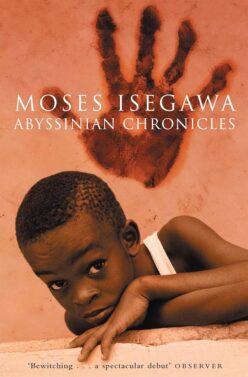
Moses Isegawa’s Abyssinian Chronicles is a sprawling, multi-generational epic that charts the turbulent history of modern Uganda through the eyes of its narrator, Mugezi. The novel is structured into seven “books,” spanning from the early 1970s to the late 20th century, juxtaposing the intimate domestic dramas of Mugezi’s family with the violent political upheavals of the Idi Amin and Milton Obote regimes.
Book One: Village Days (1971)
The narrative begins with a reflection on Mugezi’s father, Serenity (also known as Sere or Mpanama), and the childhood traumas that shaped his “wooden expression” and emotional detachment. Abandoned by his mother at age three, Serenity spent his youth accosting tall women in the hope that his mother had returned. He was eventually “cured” of this obsession by a woman who rudely pushed him away, causing him to coil into an “inner cocoon” of indifference. Serenity’s nickname, Mpanama, was a village slur referring to hydrocele, which he mistakenly thought the village Fiddler carried in his trousers as “breasts between his legs”.
Mugezi describes his Grandpa, a Catholic sub-county chief who lost his power to a Protestant rival in a religiously sectarian conflict. As Grandpa’s influence shrivelled, his large homestead once filled with wives, relatives, and hangers-on became a “howling lacuna” filled only by nostalgia and the stories of Uncle Kawayida, a charismatic meter reader and fantastic storyteller. The family was further marked by Serenity’s sisters: Tiida (“Miss Sunlight Soap”), an elegant woman who married a medical assistant masquerading as a doctor, and Nakatu, who eventually converted to Islam to marry Hajj Ali after her first marriage failed.
The core of the family drama involves Serenity’s marriage to Padlock (real name Nakkazi, also called Sr. Peter). Padlock was a former nun who had been disrobed after a violent “flash” in which she severely beat several children. Serenity chose her over Grandpa’s preferred matches, viewing her petite frame and self-contained will as a ticket to freedom from his father’s shadow. Their wedding was a clash of cultures: Padlock’s prudish Catholic upbringing vs. the lewd pelvic thrusts of the village dancers. The marriage was consummated under the supervision of Padlock’s aunt, Nakibuka, who would later become Serenity’s mistress.
Mugezi was born during a massive storm that flooded the aqueducts. Left in the village with Grandma while his parents moved to the city, Mugezi became a “midwife’s mascot-cum-assistant,” gaining early exposure to the vulnerabilities of adults. This era ended violently in 1971 when General Idi Amin seized power in a coup. That same night, Grandma’s house burned down in a mysterious fire, and she died shortly after.
Book Two: The City
Mugezi moves to Kampala to join his parents in a large Indian bungalow called the “pagoda”. Here, he enters a domestic dictatorship presided over by Padlock, the “enforcer”. Mugezi is assigned the role of the family “shitman,” responsible for waking his siblings (the “shitters”), supervising their toilet needs on newsprint, and washing mountains of diapers.
This period is defined by Mugezi’s growing rebellion against Padlock’s draconian discipline. He develops a friendship with their neighbor, Lusanani, the young third wife of Hajj Gimbi. He also observes the arrival of Loverboy (Mbaziira), a young man who provides Padlock with the compliments she craves.
A pivotal moment occurs during the “red-ink incident,” when Mugezi notices Padlock bleeding through her clothes a sign of the premature menopause and hemorrhages that would plague her later years. When he mentions it, she knocks him unconscious, reinforcing the silence required in their “domestic dictatorship”. In retaliation for a severe beating by Serenity over a chipped headboard, Mugezi writes a fake love letter from Loverboy to Padlock, sowing deep discord in his parents’ marriage. Serenity uses the chaos as an excuse to start an affair with Padlock’s aunt, Nakibuka. Mugezi later sabotages Padlock by stealing her sewing machine bobbin, an essential tool in her dressmaking business. To escape his parents’ home, he feigns a sexual encounter with Lusanani, prompting them to send him away to his Aunt Lwandeka before eventually packing him off to the seminary.
Book Three: Amin, the Godfather
This section contextualizes the family’s struggle within the broader ruin of Uganda under Amin. Grandpa views the state as a “powder keg” built on the “treacherous sands of inequality”. Amin’s 1972 order expelling all Indians within ninety days is a central event. Serenity, who harbored a lifelong fear of Indian shopkeepers, views their departure as a “childhood fantasy” come true, yet he is also sobered by the sight of their helpessness as they are forced to leave.
Serenity funds a prestigious pilgrimage to Rome and the Holy Land by selling a fraudulent delivery note for five thousand rolls of cloth on the black market. In Rome, he finds himself fascinated by the “holy armadillo” (the Pope) and the legend of Romulus and Remus. Padlock, too, eventually makes the pilgrimage, viewing herself as a “mighty buffalo” of faith in a lake of sand (the clouds). However, back in the village, Grandpa’s predictions of “explosions” begin to manifest as natural disasters and escalating state violence.
Book Four: Seminary Years
At the seminary, Mugezi finds a new form of autocracy defined by brainwashing and schizophrenia. He survives the initial bullying of the “Bushmen” by recruiting Lwendo, a shaggy bruiser, as his bodyguard. Mugezi eventually blackmails Lwendo after catching him having sex with Sr. Bison in the food store.
Mugezi wages a “guerrilla war” against the tyrannical priests. He smears the car of the disciplinary master, Fr. Mindi, with excrement. Later, he vandalizes the glossy boat “Agatha,” the pride of the new bursar, Fr. Gilles Lageau (the “Red Indian”). He is aided in these acts by the night watchman Dorobo, who is revealed to be the “Fisherman” a secret power saboteur who had been framing the village bullies for his own subversions. Mugezi eventually leaves the seminary by forging his own expulsion letter and academic recommendations.
Book Five: Nineteen Seventy-Nine
The 1979 war to oust Idi Amin brings total chaos. Mugezi lives with Aunt Lwandeka, whose history of arrest and torture involving a snake is revealed. Lwandeka is a secret operative for the National Reform Movement (NRM) guerrillas, using the money from Mugezi’s burgeoning liquor business to fund the struggle.
The fall of Kampala is marked by massive looting and public executions of Amin’s collaborators. Grandpa, who had left the village just before the city fell, goes missing. Mugezi eventually finds Grandpa’s body lying facedown in the shadow of the Owino Market office. The family’s suffering continues as Aunt Kasawo is gang-raped by seven Tanzanian “liberators”. She later seeks spiritual and psychological healing through the “Vicar General,” a prominent Catholic witch doctor. Mugezi himself is violated by the “Infernal Trinity” three soldier women who assault him at a fake roadblock.
Book Six: Triangular Revelations
In the 1980s, Mugezi attends Makerere University but is forced into Social Sciences instead of Law. To survive, he runs Boom-boom Brewery, a highly lucrative illegal liquor operation. During this time, the Luwero Triangle war rages between the Obote II government and the guerrillas.
Mugezi enters a profound relationship with Jo Nakabiri, a teacher who fled the Triangle. Their romance is shattered when they discover they are half-siblings Jo is Serenity’s first child, born of his pre-marital relationship with Kasiko.
Lwendo returns as an army officer and recruits Mugezi into a scheme to embezzle and sell government rehabilitation supplies (iron sheets, blankets, cement) meant for the war-torn Triangle. They are eventually caught by the “Padre,” an ex-priest who banishes Lwendo to the dangerous northern front.
The era is also defined by the arrival of Slim (AIDS), which devastates the family. Uncle Kawayida, who had prospered as a poultry farmer and lover of three sisters, dies in his chicken pen after his family is decimated by the disease. Aunt Lwandeka marries her long-time contact, the Brigadier, only to die of the plague shortly after.
Book Seven: Ghettoblaster
Exhausted by the tragedies in Uganda, Mugezi moves to the Netherlands under the sponsorship of an aid organization, Action II. He quickly becomes disgusted with the “necrophilic exploitation” of the aid industry and flees to the Amsterdam ghetto (Bijlmermeer).
The “despots” meet their bizarre ends in Uganda: Padlock is gored and trampled by a wounded buffalo in the forest, and Serenity is eaten by a colossal crocodile while searching for his missing wife by the lake. In Amsterdam, Mugezi buys a fake British passport under the name John Kato. He finds work as a cemetery gardener and “disinterrer,” finding a strange spiritual peace in the literal excavation of the past. He enters a difficult relationship with a Dutch woman, Magdelein de Meer, but it eventually fails due to cultural friction and her “monitoring” of his life. The novel concludes with Mugezi at Amsterdam’s Central Station, finally finding his “foothold” on a global hilltop, ready to strike out as his own man.