
Listen to this Book Summary Below
Playback speed:
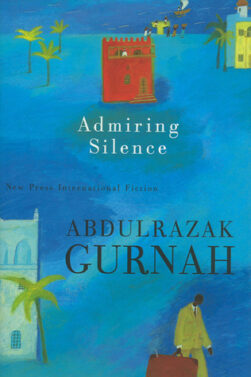
Abdulrazak Gurnah’s Admiring Silence is a profound and intricate narrative exploring themes of identity, displacement, the weight of history, and the transformative (and often deceptive) power of storytelling. The novel follows an unnamed narrator, a forty-two-year-old teacher from Zanzibar who has lived in England for twenty years, as he navigates a life built on a foundation of carefully constructed silences and fabrications. The story is structured around his physical and psychological journey back to his homeland and the subsequent collapse of his domestic life in England.
The Condition in England: A Life of Disquiet
The narrative begins with a physical manifestation of the narrator’s internal state: a persistent, “cockroachy” pain in his chest that reeks of “loneliness and terror”. Living in London with his partner, Emma, and their seventeen-year-old daughter, Amelia, the narrator occupies a space of “agitated content”. His health crisis prompts a visit to a young, “impossibly empirical” doctor who, despite the narrator’s Indian Ocean origins, delivers a racialized diagnosis: “Afro-Caribbean people have dickey hearts”. This diagnosis, which the narrator accepts with a “stoical gulp and an inward sneer,” serves as a metaphor for the way he is consistently misperceived and pigeonholed by the culture that surrounds him.
The narrator’s relationship with Emma is defined by intellectual banter and a shared “anti-bourgeois” stance. Emma is an academic obsessed with the “shape of narratives,” and the narrator has spent two decades feeding her curiosity with embellished stories of his past to “adorn” his alienness. He tells her stories of an orderly, noble family and a mythical “Uncle Abbas” who stowed away to England stories that are intended to repay her interest and make their lives seem “noble and ordered”. However, this storytelling is also a defensive mechanism, a way to “construct a history closer to my choice than the one I have been lumbered with”.
In contrast, his relationship with Amelia is marked by a “hurtful impudence”. To Amelia, the narrator is often a “failure,” a perception he tries to counter with a “feeble and futile” sarcasm. This domestic tension is exacerbated by Emma’s parents, Mr. and Mrs. Willoughby, who embody a polite, “mannerled” arrogance. Mr. Willoughby, in particular, is “hungry for Empire stories,” which the narrator obligingly provides, reinforcing Mr. Willoughby’s conviction that “blockhead” American ideas about democracy ruined the lost Empire.
The Fabrication of History and the Call to Return
The narrator’s life in England is sustained by a “culture of grievance” and a sense of being “uniquely victimized by history”. He reflects on the “Triumph of the West” and the way his own people are viewed as “barbarians” or “beasts” in the gentle stories of Europe. Yet, he acknowledges his own part in this performance, acting “as well and as silently as Pocahontas,” the noble native curiosity who died in an English swamp.
The catalyst for the novel’s second act is a letter from his mother in his homeland (Zanzibar). A change in government has resulted in an amnesty for those who left the country illegally. The narrator decides to return for a visit, a prospect that fills him with “all kinds of terror” because he knows the world he left twenty years ago has been transformed by “chaotic and malevolent rule”. He also hides a crucial detail from the letter: his mother has arranged for him to marry a woman named Safiya Hilali, a “companion” for his life as a “ghoul in a ruined house”.
The Return Home: Confronting the Ruins
The narrator’s flight back to Africa brings him into contact with Ira, a systems designer from Nairobi who also lives in England. Their conversation mirrors his own experience of “disappointed love” for England a sense of being “always on the edges of everything”. Upon arriving at the airport, the narrator is greeted by his half-brother Akbar and half-sister Halima. The reunion is a visceral shock; the “humid fumes of decomposing vegetation” and the shoddy, ruined state of the once-familiar town signify the decay of the post-independence state.
Returning to the family home above his stepfather’s shop, the narrator is confronted with the harsh reality of “postcolonial reality”: blocked toilets, a lack of running water, and severe shortages of basic goods like sugar and salt. His stepfather, Hashim Abubakar, once a “pillar of the community,” is now a frail, “hollow” man who survives on valium and the memories of his own youth as a sailor and smuggler.
The narrator begins a series of late-night conversations with his mother that dismantle the narrative he has told himself and Emma for twenty years. He learns the truth about his biological father, Abbas: he was a teacher who “hated himself” for his dependence and fled the island “like a thief or a killer” just before the narrator was born. Hashim was not a noble uncle but a creditor who had forgiven the narrator’s grandfather’s debts in exchange for his mother’s hand in marriage. This revelation reframes his entire childhood as a guest in a home where he felt like an “orphan he [Hashim] had accepted responsibility for”.
Political Performances and the Marriage Ambush
While his family life is a theater of silent rebukes and “wounding possibilities,” the public sphere is a theater of absurd political performances. The narrator meets Amur Malik, a Permanent Secretary who attempts to recruit him for a “translation project” funded by “Scandinavian cultural foundations”. The project’s goal to translate the “great thoughts” of Europe (Shakespeare, Marx, Hemingway) into the local tongue strikes the narrator as a “liturgical” exercise in hypocrisy.
The narrator is also summoned to meet the Prime Minister, an old schoolmate who hectors him about his “patriotic duty” to return and rebuild the country. The Prime Minister’s nightly television appearances, full of “unsmiling insincerity” and promises of “funding from the donors,” contrast sharply with the reality of his crumbling authority. The narrator realizes that these leaders are merely “organs of consumption,” more interested in gossip and maintaining their “plump arses” than in the actual welfare of the nation.
The domestic “ambush” culminates in a meeting with Safiya, the woman his mother wants him to marry. Safiya is a medical student who views marriage to the narrator as a “ticket” to an education in England. The narrator is struck by her beauty and her “habit of submission,” which mirrors his own, but he is also “horrified” by her youth and the “beastly plebeian hubris” of the entire arrangement.
The Confession and the Return to Silence
Driven by guilt and a desperate longing for Emma, the narrator finally breaks his silence. He confesses to his family that he has lived with Emma for twenty years and has a seventeen-year-old daughter, Amelia. The reaction is one of “frothing spite” and “disappointed disgust”. His mother disowns him, seeing his life in England as a betrayal of “God, home, culture, history”. Akbar accuses him of bringing “shame on both families” through his “dishonourable” silence.
The narrator’s departure from his homeland is “frantic,” a desperate escape from the “anguished confab” of his family and the “blocked, stinking toilets” of the nation. He returns to England expecting a “passionate late-night orgy of forgiveness,” but instead, he finds that his life with Emma has also collapsed.
Emma tells him that she has “someone else” and that her feeling for him has changed from a “fanged love” into an “unbearable” dread of his return. She describes their life together as a “narrative which had refused closure” and leaves him, taking the “memory of life” with her. Shortly after, Amelia also leaves, despising the narrator’s “blunderings through life” and his “contemptible” dependence on alcohol and grief.
Conclusion: The Coda of Plumbing
The novel ends with the narrator in a state of total isolation, “weeping at my loss and my buggered heart and my shattered life”. He becomes obsessed with “plumbing” the literal and metaphorical act of “getting to the bottom of the blocked toilets” and understanding “what clogs up the works”. He views his history as a “stinking tomb full of writhing lies and dead stories” and considers finding his biological father, Abbas, to ask him if the flight was “worth it”.
Ultimately, Admiring Silence is a meditation on the fact that “you can’t change the story while you are in it”. The narrator is left as a “ghoul in a ruined house,” a man who has “lost himself” and “lost his people,” caught between a homeland that disowns him and an England that has finally spurned him. The silence he once admired is now a “fragile” and terrifying state, a “water of oblivion” in which he must find a way to live.