
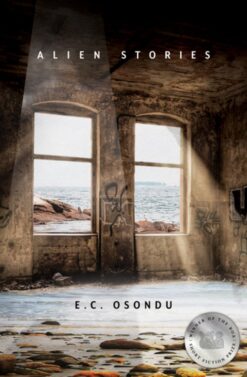
Alien Stories (2021) is a short story collection by Nigerian-American author E.C. Osondu, published by BOA Editions as part of their American Reader Series. The collection won the Short Fiction Prize and explores themes of immigration, diaspora, otherness, and the immigrant experience through the lens of science fiction and speculative fiction. The book uses aliens as metaphors for immigrants, foreigners, and outsiders, examining how societies treat those perceived as “other.”
Story Summaries
1. “Alien Enactors”
Setting: A theme park called “The Ranch” where performers enact different continents for guests.
Plot: The narrator is an African enactor who receives high “Instaratings” (performance ratings) for his performances of Africa. He wears dashikis, tells folktales with talking animals, and creates an “authentic” African experience for tourists including burning banana leaves to simulate “the smell of Africa.” His colleague Ling, who enacts China, is failing. Her ratings are abysmal, and she’s accused of blaming clients rather than taking responsibility. Despite the narrator’s attempts to help her, Ling is eventually fired her “fire has gone out” (her profile shows a black spot). The story critiques how cultures are commodified and performed for tourists, and how corporate structures demand constant performance and self-criticism.
Key Themes: Cultural commodification, performance of identity, workplace surveillance, the pressure to conform, the treatment of “difficult” employees.
2. “Memory Store”
Plot: A Nigerian immigrant discovers Memory Stores in America where people can sell their memories for money. He visits one and sells a cherished memory of running home from school to tell his grandmother he came first in his class. The memory is extracted and he receives a payment card. He uses the money to buy a giant television and later a refrigerator. When he returns to sell another memory about his last day before leaving for America he again receives payment. He buys a new fridge. On the anniversary of his grandmother’s death, he tries to remember her face but cannot. The memory of her has been completely erased sold and gone forever.
Key Themes: The cost of assimilation, the erosion of identity, consumerism, the irreplaceability of cultural memory, the immigrant’s loss of connection to home.
3. “How to Raise an Alien Baby”
Plot: A satirical instructional guide on raising an alien baby. Rules include: maintain a well-manicured lawn (for the mother ship’s arrival), no satellite dishes or TV antennas (to prevent the alien from communicating with its home planet), avoid sci-fi movies (which portray aliens negatively), don’t play hide-and-seek (you’ll never find them) or follow-the-leader (they’ll follow forever). The guide notes that alien babies are self-cleaning, never break rules, and don’t need discipline. The story ends with the alien baby returning to its mother planet, leaving the human parent waving goodbye.
Key Themes: Parenting, assimilation, the fear of the outsider, the impossibility of truly understanding another culture, the pain of letting go.
4. “Visitors”
Plot: A curmudgeonly narrator recounts how his do-gooder wife volunteers to host an alien family that has moved to their small village. The villagers are suspicious of the newcomers why would anyone choose to live there? The narrator’s wife is known for taking in strays, including an ungrateful cat named Old Moocher. When the alien family visits, the narrator is initially skeptical but warms to them. He learns the alien father is from Africa, and they bond over football. The alien couple’s son has been sick, and they share a harrowing story of American healthcare how a foreign doctor finally diagnosed an ear infection after the hospital refused to treat him properly. The story ends with the narrator holding the alien baby, feeling tenderness.
Key Themes: Hospitality, xenophobia, the immigrant experience, healthcare inequality, the common humanity beneath surface differences, the transformative power of kindness.
5. “Feast”
Plot: A village holds an annual “Alien Feast Day” where an alien is sacrificed. Children ask questions about the ritual what color alien will it be? Why do they do it? The alien is allowed to eat whatever it wants before being hanged. The story describes the hanging in ritualistic, repetitive language. After the sacrifice, the entire village feasts and sleeps soundly. The story implies this is a long-standing tradition, a sacrifice to ensure the community’s prosperity.
Key Themes: Ritual sacrifice, scapegoating, collective violence, the way communities justify brutality, the innocence of children witnessing violence.
6. “Mark”
Plot: A boy’s grandmother tells him stories about the Red Planet. In one story, the Red Planet was once close to Earth and edible people could cut pieces and they’d taste like whatever they desired. But when people got greedy and cut more than they could eat, the planet receded. Another story tells of Enenebejolu, the most beautiful girl on Earth, who rejected all suitors. The ugly men of the Red Planet pooled their best body parts to create one handsome man who wooed her. She married him and went to the Red Planet, where he returned the borrowed parts, leaving him ugly. She tried to escape, and his nails left a groove on her back which is why humans have spines. The grandmother eventually dies, and the narrator, now in New England, looks at a red sky and remembers her stories.
Key Themes: Oral tradition, the power of myth, loss of cultural heritage, the grandmother as a link to the past, the immigrant’s nostalgia.
7. “Tatuala”
Plot: A spaceship lands in a Nigerian village. The alien inside looks like a short military man and communicates telepathically. He asks permission to leave his ship while he travels home for parts. The villagers agree. After the ship lands, the village experiences unprecedented good fortune: the school wins competitions, a trader buys a pickup truck, a sick man is cured by washing in water from the ship. People begin making sacrifices to the ship. Then disaster strikes a fire destroys the farms, followed by two days of torrential rain. The Elders decide the ship must go. They try to ignore it, and vegetation eventually covers it.
Key Themes: Colonial encounter, the misinterpretation of technology as magic, the cycle of hope and disappointment, the scapegoating of the outsider, the resilience of traditional communities.
8. “Sacrifice”
Plot: Every year, an alien spaceship comes to a village and takes one young person. This is a treaty: one young person per year, or the aliens will destroy them all. When Makodi a woman who suffered through two barren marriages before finally having her son Obiajulu finds a palm frond on her doorstep (the sign that her household has been chosen), she protests loudly. On the day the ship arrives, she dresses herself and her son in their best clothes and climbs aboard with him. The aliens push them both out. The ship leaves empty. The villagers fear retaliation, but the ship never returns.
Key Themes: Sacrifice, maternal love, resistance to unjust systems, the power of one person to break a cycle, the possibility of change.
9. “Light”
Plot: Bukwu, the most quarrelsome woman in her village, is struck by a beam of blue light from space while farming. Afterward, she becomes a completely different person calm, quiet, and peaceful. She stops quarreling with her husband, quits her dancing group, leaves her job at the bakery (and her suspected lover, Lucky the baker), and speaks in koans. The villagers are confused and disturbed by the change. Eventually, Bukwu begins waking early to go to her farm, saying her “light is fading” and she must wait for the light to touch her again.
Key Themes: Transformation, spiritual awakening, the incomprehensibility of change to outsiders, the community’s resistance to difference, the search for meaning.
10. “Traveler”
Plot: A Nigerian immigrant on a train is joined by an elderly American man named William. William talks about his boring life same town, same school, same factory job for decades and contrasts it with the “interesting” lives of immigrants. He tells the story of his Thai restaurant-owning friend from Laos who escaped a communist prison, was betrayed by the girl he loved, and eventually made it to America. The narrator reflects on the irony: William sees his own stable life as boring, while the immigrant sees it as a privilege. When the narrator returns from the bathroom, William has disappeared without saying goodbye. The conductor announces “Boston South Station,” but the narrator hears “Neptune Space Station.”
Key Themes: The immigrant experience, the American Dream, the value of stability, the invisibility of privilege, the feeling of being alien.
11. “Debriefing”
Plot: A guide for new immigrants to America, written as advice from someone about to be deported. Topics include: don’t buy a car, avoid parties with fellow immigrants, avoid American women seeking revenge on immigrant men, avoid con artists, travel by train not bus (to avoid immigration raids), go to immigrant churches not American ones, don’t go to school (get a nursing certificate instead), hire a white Jewish lawyer not an African one, go to baseball games, eat healthy, dress preppy, take accent reduction classes, and buy a lottery ticket every Friday.
Key Themes: The immigrant experience, survival strategies, assimilation, the exploitation of immigrants, the irony of advice from someone who failed.
12. “#1” through “#12” (List Story)
Plot: A numbered list of observations about aliens. Each entry reflects common human prejudices and assumptions about immigrants and outsiders: aliens have large heads and speak strangely; their skin is an unsettling green; they’re scientifically advanced but lack fashion sense; they must have cured cancer; they don’t have families like humans; they don’t have democracy; they haven’t evolved like humans; they let humans unname their planet; they might not exist at all.
Key Themes: Xenophobia, projection, the human tendency to judge based on appearance, cultural imperialism, the irony of human self-regard.
13. Untitled Story (Spinning)
Plot: A boy and his sister discover they can spin in their backyard and transport to another world. There, they play with silent friends who provide real guns, mechanical birds to shoot, building materials, and bulldozers. The children build and destroy, never questioning where their playmates’ parents are or why there are no animals. One day, their playmates ask them to build tree sculptures from steel. The children work on the trunks, then branches, then leaves. They try to leave but cannot spin anymore. Their mother’s voice fades as they are trapped in the other world, making leaves forever.
Key Themes: Childhood imagination, the loss of innocence, addiction (to the other world), the consequences of escapism, the pull of a fantasy world that traps you.
14. “Who Is in the Garden?”
Plot: An unemployed man is berated by his wife for running the generator to watch a football match. His life is one of constant belittlement his wife mocks him, his mother-in-law despises him, neighbors pity him. One day, he looks into his backyard garden and sees something extraordinary: a glowing object of unknown origin. The news spreads. His mother-in-law arrives singing hymns and praising him. Money people come offering loans and investment advice. The couple throws a lavish party. At the end, they kneel before the glowing thing in their garden, worshipping it.
Key Themes: The transformative power of fortune, the fickleness of social status, the worship of wealth, the emptiness of material success, the mysterious object as a metaphor for sudden wealth or opportunity.
15. “On the Lost Tribes of the Black World”
Plot: A scholarly essay about the Konga, a lost African civilization that communicated entirely through drums. The Konga were egalitarian men and women had equal drums. They had no thieves, no gossips, no liars. They buried their dead upright with their drums. The Silent Drum That Must Never Be Beaten was their most sacred object. Eventually, the younger generation questioned why they had mouths if they couldn’t speak. They demanded to use their tongues. The Elders gave in, and the Konga lost their innocence.
Key Themes: Lost civilizations, the myth of the noble savage, the tension between tradition and change, the relationship between communication and community, the inevitability of loss.
16. “Love Affair”
Plot: Finda, a young Liberian immigrant, is preparing to leave Providence for Delaware to care for her ailing grandmother. She wants one last night with her girlfriend Shay. To earn money, she agrees to accompany Kim Dior to a hotel where an older Guatemalan man pays them to undress. When he asks for more, Finda refuses. She gets $70. She buys weed and Hennessy, planning to share with Shay. But Shay is out with Jamil her “cousin” who may be more. Finda throws the Hennessy off a bridge and walks home.
Key Themes: Queer identity, the immigrant experience, transactional sex, betrayal, the intersection of race and sexuality, the search for belonging.
17. “The Home Companion”
Plot: A satirical instruction manual for a “Home Companion” a device that improves your life. John, a lonely bachelor, installs one. The Home Companion encourages him to cook healthy meals, read classic novels, listen to public radio, drink wine, and appreciate classical music. John’s life improves dramatically. He stops dating and finds fulfillment in the Home Companion’s guidance. The story implies the Home Companion is a metaphor for self-improvement culture, therapy, or perhaps a replacement for human connection.
Key Themes: Loneliness, self-improvement culture, the commodification of companionship, the fear of intimacy, the seduction of easy solutions.
18. “All Our Earthly Possessions”
Plot: A collective narrative (“we”) describing a group of migrants preparing to cross a border. They carry hopes, prayers, phone numbers, memories, and stories. They dream of jobs, money, and returning home in triumph. They have nightmares of drowning but never speak of them. They share dreams of a beautiful future. The story ends with their hope intact, despite the uncertainty ahead.
Key Themes: Migration, hope, solidarity, the immigrant experience, the power of dreams, the collective nature of the journey.
Character Analysis
The Narrator (Alien Enactors)
A conformist who has learned to navigate the corporate structure of the Ranch. He is successful but complicit in the commodification of his own culture. His attempts to help Ling are half-hearted he is more concerned with maintaining his own position than with genuine solidarity.
Ling (Alien Enactors)
A tragic figure who cannot adapt to the demands of the Ranch. She is honest about her difficulties, which makes her vulnerable. Her “fire going out” represents the consequences of failing to perform in a system that demands constant self-improvement and self-criticism.
The Immigrant (Memory Store)
A man who sells his most precious memories for material comfort. He is pragmatic but ultimately hollow he has gained the world but lost his soul. His inability to remember his grandmother’s face is the ultimate cost of assimilation.
The Grandmother (Mark)
A keeper of oral tradition, a link to the past. Her stories about the Red Planet are creation myths, moral tales, and cultural memory all at once. Her death represents the loss of that connection for the narrator, who is now adrift in New England.
Bukwu (Light)
A woman transformed by an encounter with the unknown. Her change from quarrelsome to peaceful is disturbing to her community, which cannot accept that someone can change so fundamentally. She represents the possibility of spiritual transformation and the community’s resistance to it.
Makodi (Sacrifice)
A mother who refuses to accept the sacrifice of her son. Her act of climbing onto the spaceship with him breaks the cycle of sacrifice. She represents maternal love as a force that can challenge even the most entrenched systems.
The Unemployed Man (Who Is in the Garden?)
A man whose life is defined by his failure to provide. His discovery of the glowing object in his garden transforms his social status, but the story suggests that his worth is still determined by external factors his wife, his mother-in-law, the money people. The object is never explained, leaving open the question of whether it is a blessing or a curse.
Finda (Love Affair)
A young queer immigrant caught between her grandmother’s traditional values and her own identity. Her relationship with Shay is complicated by race, class, and the transactional nature of survival. Her decision to throw away the Hennessy represents a refusal to participate in her own exploitation.
William (Traveler)
An elderly white American who sees his own life as boring and immigrants’ lives as interesting. He represents the obliviousness of privilege he cannot see that his stability is a luxury that many immigrants sacrifice everything for.
Thematic Analysis
1. Alien as Metaphor for Immigrant
The central conceit of the collection is the equation of aliens with immigrants. The aliens in these stories are not extraterrestrials in the traditional science fiction sense they are stand-ins for foreigners, refugees, and outsiders. Their “alienness” is their difference: they look different, speak differently, have different customs, and are often treated with suspicion by the host community.
In “Visitors,” the alien family is from Africa. In “Alien Enactors,” the narrator performs “Africa” for tourists. In “Debriefing,” the advice is for new immigrants. The collection consistently uses the language of extraterrestrial encounter to explore the realities of immigration.
2. The Commodification of Culture
“Alien Enactors” is the most explicit exploration of this theme. The Ranch is a theme park where cultures are performed for paying guests. The narrator’s “Africa” is a collection of stereotypes dashikis, folktales, proverbs about villages raising children. He admits that he never heard the proverb in Africa, but “the guests lapped it up.” The story critiques the way cultures are reduced to consumable experiences.
3. Memory and Loss
“Memory Store” is the most direct treatment of this theme. The immigrant sells his memories for money, and they are gone forever. The story asks: what is the cost of assimilation? What do we lose when we trade our past for a future?
The theme recurs throughout the collection. The grandmother’s stories in “Mark” are a form of memory that cannot be sold. The narrator of “Traveler” cannot forget his accent or his origins, no matter how hard he tries.
4. The Ethics of Hospitality
“Visitors” explores the ethics of welcoming the stranger. The narrator’s wife is a do-gooder who takes in strays cats, aliens, anyone in need. The narrator is initially resistant but eventually warms to the alien family. The story suggests that hospitality is not just about welcoming the stranger but about recognizing the stranger’s humanity.
In “Sacrifice,” the village has a treaty with the aliens that requires the sacrifice of one young person per year. Makodi’s refusal to accept this arrangement breaks the cycle. The story asks: when is it right to refuse hospitality? When does hospitality become complicity in violence?
5. The Power of Storytelling
The collection is deeply concerned with storytelling as a mode of survival and resistance. The grandmother in “Mark” tells stories about the Red Planet that are creation myths, moral tales, and cultural memory. The narrator of “Alien Enactors” tells African folktales to tourists. The migrants in “All Our Earthly Possessions” carry stories with them.
Storytelling is also a form of resistance. The Konga in “On the Lost Tribes of the Black World” communicate through drums. When they begin to speak with their mouths, they lose their innocence and their community. The story suggests that the way we communicate shapes who we are.
6. The Immigrant’s Paradox
The immigrant is caught between two worlds. In “Traveler,” William sees the immigrant’s life as “interesting,” while the immigrant sees William’s life as a privilege he can never have. In “Memory Store,” the immigrant gains material comfort but loses his memories. In “Debriefing,” the advice comes from someone who is about to be deported suggesting that even the most successful immigrants can be expelled.
The collection explores the paradox of the immigrant: the desire to belong and the fear of losing oneself in the process.
Style and Structure
1. Satire
Osondu uses satire extensively. “How to Raise an Alien Baby” is a parody of parenting manuals. “Debriefing” is a parody of immigration guides. “The Home Companion” is a parody of self-improvement culture. The satirical voice allows Osondu to critique social norms while maintaining a humorous tone.
2. Oral Tradition
The collection is deeply influenced by African oral tradition. The grandmother’s stories in “Mark” are told in the style of folk tales. The narrator of “Alien Enactors” tells folktales. The collective “we” in “All Our Earthly Possessions” is a form of communal storytelling.
3. Science Fiction as Social Critique
Osondu uses science fiction tropes aliens, spaceships, memory stores, home companions as vehicles for social critique. The aliens are not the point; they are a lens through which to examine human behavior. This is a common strategy in speculative fiction, but Osondu’s use of it is particularly effective because the aliens are never described in detail. They are whatever the reader imagines them to be which makes them a blank screen for the projection of human prejudices.
4. Narrative Voice
The collection uses a variety of narrative voices: first-person narrators (“Alien Enactors,” “Memory Store,” “Mark,” “Traveler”), collective narrators (“All Our Earthly Possessions”), instructional voices (“How to Raise an Alien Baby,” “Debriefing,” “The Home Companion”), and the numbered list (“#1” through “#12”). This variety keeps the collection fresh and allows Osondu to explore different aspects of the immigrant experience.
5. Repetition and Ritual
“Feast” uses repetition to describe the hanging: “The alien was led to the stage. The rope was fastened around the alien’s neck. The lever was pulled. The neck snapped. The alien was dead.” The repetition mirrors the ritualistic nature of the event, emphasizing its inevitability and its horror.
Historical and Cultural Context
1. Nigerian Civil War and Its Aftermath
Osondu was born in Nigeria, and the collection reflects the legacy of the Nigerian Civil War (1967-1970) and its aftermath. The theme of displacement and loss is central to many of the stories. The narrator of “All Our Earthly Possessions” is part of a group of migrants who are leaving their homes behind.
2. The African Diaspora
The collection is deeply concerned with the African diaspora the dispersal of Africans and their descendants throughout the world. The characters in these stories are often immigrants, refugees, or exiles. They are navigating the complexities of life in a new country while carrying the weight of their past.
3. American Immigration Policy
“Debriefing” is a satirical take on American immigration policy. The advice offered avoid buses, hire a white lawyer, take accent reduction classes reflects the real challenges faced by immigrants in America. The story is both funny and heartbreaking, as it shows how immigrants must navigate a system that is often hostile to them.
4. The Immigrant Experience in Rhode Island
Osondu lives in Rhode Island and teaches at Providence College. Many of the stories are set in Rhode Island or New England. “Love Affair” is set in Providence and references specific locations like Olney, the Woonasquatucket River, and Manton Avenue. This grounding in a specific place gives the collection a sense of authenticity.
Literary Influences
1. African Oral Tradition
Osondu’s use of proverbs, folk tales, and the figure of the grandmother are all drawn from African oral tradition. The grandmother in “Mark” is a classic figure in African literature the keeper of stories who passes on cultural memory to the next generation.
2. Science Fiction
Osondu draws on science fiction tropes aliens, spaceships, memory stores, home companions but uses them for social critique rather than for their own sake. This is a tradition that goes back to writers like Octavia Butler and Samuel Delany, who used science fiction to explore race, gender, and identity.
3. Postcolonial Literature
The collection is deeply influenced by postcolonial literature the literature of countries that were once colonized by European powers. The theme of cultural commodification in “Alien Enactors” is a postcolonial theme, as is the theme of language and communication in “On the Lost Tribes of the Black World.”
4. Satire
Osondu’s satire is reminiscent of writers like Jonathan Swift and George Orwell. “How to Raise an Alien Baby” is a satire of parenting manuals, but it is also a satire of the way immigrants are expected to assimilate. “Debriefing” is a satire of immigration guides, but it is also a satire of the American Dream.
Critical Reception
Alien Stories won the Short Fiction Prize and was well-received by critics. Reviewers praised Osondu’s imaginative use of science fiction tropes to explore the immigrant experience. The collection was noted for its humor, its humanity, and its sharp social critique.
Conclusion
Alien Stories is a collection that uses the language of science fiction to explore the realities of immigration, diaspora, and otherness. The aliens in these stories are not extraterrestrials they are immigrants, refugees, and outsiders. By using science fiction as a lens, Osondu allows us to see the immigrant experience with fresh eyes. The collection is funny, heartbreaking, and deeply humane. It is a vital contribution to contemporary literature about immigration and identity.
The stories in this collection are united by a concern with the ethics of hospitality how we treat the stranger in our midst. Some stories show hospitality extended (“Visitors”), some show hospitality refused (“Feast”), and some show hospitality as a form of violence (“Sacrifice”). The collection asks: what does it mean to welcome the stranger? What are the limits of hospitality? And what happens when we fail to welcome the stranger?
Osondu’s answer, if he has one, is that we must learn to see the alien in ourselves. The immigrant is not the other the immigrant is us. We are all aliens in some sense, all strangers in a strange land. The collection is a plea for empathy, for understanding, and for the recognition of our common humanity.