About My Mother by Tahar Ben Jelloun

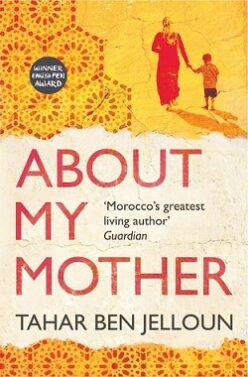
Book cover for About My Mother by Tahar Ben Jelloun, with orange decorative borders and a man walking with a child on a sunlit path

Tahar Ben Jelloun’s About My Mother is a profound, semi-autobiographical meditation on the slow decline of a matriarch, the nature of memory, and the intricate bonds of filial love within the context of Moroccan tradition. The narrative, translated from the French by Ros Schwartz and Lulu Norman, alternates between the narrator’s present-day observations of his dying mother in Tangier (c. 2000–2002) and the hallucinatory recollections of her youth and three marriages in Fez. The Present: A House of Shadows and Forgetting The story opens with the narrator observing his mother, Lalla Fatma, who has become “a frail little thing with a faltering memory”. She is confined to her home in Tangier, cared for by a paid companion named Keltum and occasionally a nurse named Zineb or Rhimou. Lalla Fatma’s reality is fractured; she frequently summons relatives who have been dead for decades, talking to them as if they are standing by her bedside. She is convinced she is still in Fez, the city of her birth, and often believes the year is 1944 rather than 2000. The narrator provides a visceral account of her physical deterioration. She has become incontinent and “soils herself,” leading to a loss of dignity that …
Read more

A Palace in the Old Village by Tahar Ben Jelloun

Tahar Ben Jelloun’s A Palace in the Old Village is a haunting, lyrical exploration of the immigrant experience, the psychological toll of retirement, and the unbridgeable chasm between a traditional past and a modern, assimilated future. The novel follows Mohammed, a Moroccan immigrant who has spent forty years as a meticulous and conscientious worker in a French automobile plant in Yvelines. As he reaches the end of his professional life, he is forced to confront the “nothingness” that threatens to consume him a state he refers to as “’tirement”. The Weight of “’tirement” and the Factory Life For Mohammed, work was not merely a means of earning a living; it was a “straight line” that provided a rhythm to his existence and protected him from the “ravine of the absurd”. He was a “model worker,” never late, never absent unless bedridden by flu, and obsessed with the conscientious care of the assembly line. He believed that the factory’s success depended on his specific, obsessive care, and the prospect of stopping was not a liberation but a “curse” and an “invisible, two-faced enemy”. Mohammed perceives retirement as the “introduction to death,” a “trap” and a “diabolical invention” that strips a man …

Read more