
Listen to the Book Summary Below
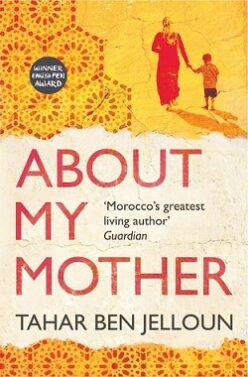
Tahar Ben Jelloun’s About My Mother is a profound, semi-autobiographical meditation on the slow decline of a matriarch, the nature of memory, and the intricate bonds of filial love within the context of Moroccan tradition. The narrative, translated from the French by Ros Schwartz and Lulu Norman, alternates between the narrator’s present-day observations of his dying mother in Tangier (c. 2000–2002) and the hallucinatory recollections of her youth and three marriages in Fez.
The Present: A House of Shadows and Forgetting
The story opens with the narrator observing his mother, Lalla Fatma, who has become “a frail little thing with a faltering memory”. She is confined to her home in Tangier, cared for by a paid companion named Keltum and occasionally a nurse named Zineb or Rhimou. Lalla Fatma’s reality is fractured; she frequently summons relatives who have been dead for decades, talking to them as if they are standing by her bedside. She is convinced she is still in Fez, the city of her birth, and often believes the year is 1944 rather than 2000.
The narrator provides a visceral account of her physical deterioration. She has become incontinent and “soils herself,” leading to a loss of dignity that prevents her from performing her daily prayers because she feels “unclean”. She refuses to wear the pads Keltum buys for her, tearing them off and flinging them under the bed. Her mind “lies scattered over the damp floor,” and she repeatedly asks the narrator the same questions, such as how many children he has, which he answers in the same even tone each time to avoid upsetting her.
A central figure in this domestic drama is Keltum, whom the narrator describes as “hard, cynical and grasping”. Lalla Fatma is afraid of Keltum, sensing the woman’s “wicked thoughts” and fearing that Keltum might spank her or withhold her medication if left alone. Despite this, Lalla Fatma acknowledges that Keltum is the only one who cleans up the “stuff that leaks out” of her, a task she would never ask of her sons. Over time, the relationship between the two women becomes a complex “pact” of dependency and friendship, with Keltum becoming indispensable for the mother’s daily survival.
The Past: The Traditions of Fez
As Lalla Fatma’s present-day awareness fades, she retreats into the “damp folds of the past”. Her memories focus heavily on the Fez medina and the rigid social codes of her upbringing. She recalls being “noticed at the hammam,” where mothers traditionally chose wives for their sons. At age fifteen, she was married off to a man from a Chorfa family (descendants of the Prophet). She describes herself at the time as a child who “still played with dolls,” yet she was told by her mother that the Prophet’s favorite wife, Aisha, was married at twelve.
The narrator vividly reconstructs his mother’s wedding night, a “long night, an interminable night” where she was adorned in heavy jewelry and makeup, waiting in the dakhchoucha (bridal chamber). She was initiated by a negafa (wedding attendant) who gave her practical, albeit harsh, advice on how to submit to her husband, an absolute stranger. The “blood on the white seroual” was the required proof of her virginity and her family’s honor.
Her first marriage was tragically short. Her husband, whom she describes as “strong and handsome,” was carried off by a typhus epidemic just before their daughter, Touria, was born. A widow at sixteen, she returned to her parents’ house, convinced she was a “harbinger of doom” or a victim of the evil eye.
The Three Marriages
The book details Lalla Fatma’s three distinct marital lives, which she often confuses in her delirium:
- The First Husband: A young man from a fine family in Fez who died of typhus.
- Sidi Abdelkrim: A wealthy, much older man who already had a sick wife and four grown children. He treated Lalla Fatma like a “princess” and a “gazelle,” forbidding her from working in the kitchen. She had a son, Abdel Aziz, with him before Abdelkrim died of old age.
- The Narrator’s Father (Si Hassan): A spice merchant who was a close friend of her uncle, Sidi Abdesslam. Si Hassan was “neither happy nor satisfied” with his first wife because she was barren. He married Lalla Fatma on the condition that he would divorce his first wife once Lalla Fatma became pregnant.
The narrator’s relationship with his father is portrayed as complex. Si Hassan was a “thrifty” man, often “stingy” due to his unsuccessful business ventures, which made him bitter and jealous of others’ wealth. He was a man of “irony” and “sarcasm” who often teased his wife for being uneducated and illiterate. Lalla Fatma reveals to the narrator that she was “never happy” with him and that “the sun never shone” during their marriage. However, she remained a “servant” to him, kissing his hand out of respect for tradition, even though his tongue “hurt more than his hands”.
Themes of Culture and Filial Piety
A significant portion of the book is dedicated to the narrator’s reflections on Moroccan values versus Western modernity. He contrasts his mother’s condition with that of his friend Roland’s mother, Zilli, who lives in Lausanne, Switzerland. While Zilli is independent, plays bridge, and travels the world at ninety, Lalla Fatma has spent her entire life “in kitchens and washhouses” without ever learning to read or write.
The narrator is deeply critical of the Western practice of “parking” elderly parents in nursing homes or hospices, which he views as “dumping grounds”. In Morocco, he explains, there is an “almost religious reverence for our parents,” and to refuse a parent’s blessing is the “most severe humiliation”. He maintains a sense of filial love that is “irrational” and “selfless,” even when faced with his mother’s “emotional blackmail” and increasing senility.
The Ritual of Death
Lalla Fatma is obsessed with her own funeral. She frequently demands that the narrator promise to arrange a “sumptuous” and “lavish” reception. She wants the house repainted, new tablecloths bought, and the “best tolba” (Qur’anic chanters) hired so she does not “blush in her grave”. This obsession is not out of fear of death which she views as “a right that God bestows” but out of a desire for a dignified exit that reflects her lifelong hospitality and social standing.
She has a profound horror of the “fridge” (the morgue), a trauma stemming from the night her husband died and his body was kept in a “glacial chamber”. Her greatest wish is to “die in your [her children’s] lifetime” and to be surrounded by them at the moment of her passing.
The Final Decline and “Mokhtar”
As the novel nears its conclusion, Lalla Fatma’s hallucinations become more intense. She begins to believe she has had a new baby, whom she names Mokhtar, confusing a nurse’s child with a son she lost in infancy decades ago. She attempts to breastfeed this imaginary child and refuses to give him back to his real mother.
Her physical state continues to deteriorate until she is “no longer able to speak” and her face takes on a “strange pallor”. The narrator describes the house as being “sealed by an irreparable absence” even before she is gone. Lalla Fatma finally passes away on February 4, 2002.
Conclusion: The Absence
In the aftermath of her death, the narrator reflects on the immense absence that fills the house. The objects she once cherished the “bow-legged table,” the “wheelchair,” the “rags used for cleaning” suddenly become “useless” and “ugly”. Keltum and Rhimou gather their belongings and leave, with Keltum’s departure marked by a final, “nasty” demand for “compensation” beyond her farewell gift.
The book ends with the narrator’s realization that his mother is not in the grave he chose for her next to his father in Tangier. Instead, he carries her memory inside him, picturing her “young and beautiful” on the terraces of Fez, perpetually happy, and waiting to be complimented on the clean plates at the end of a meal she has cooked for her family.