
Listen to this Book Summary Below
Playback speed:
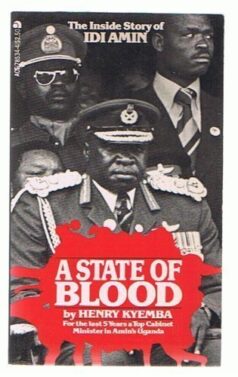
Henry Kyemba’s A State of Blood: The Inside Story of Idi Amin provides a chilling, first-hand account of the terror that gripped Uganda from 1971 to 1977. As a high-ranking official who served as Idi Amin’s Principal Private Secretary, Cabinet Secretary, and Minister of Health, Kyemba writes with the unique authority of a man who worked intimately with a leader he describes as Africa’s most ruthless killer. The book serves not only as a memoir of survival but as a document of horror intended to reveal the truth to a world that often dismissed Amin as a mere clown.
The Roots of the Tyrant and the Rise to Power
The narrative begins by establishing the context of Uganda’s immediate past, which Kyemba believe offered Amin the opportunity to assert his remarkable but dangerous personality. Amin, a member of the Kakwa tribe from the far northwestern part of Uganda, rose through the ranks of the King’s African Rifles as a private to become a sergeant, renowned for his physical size and boxing prowess rather than his education, which was nearly non-existent. Under Uganda’s first Prime Minister, Milton Obote, Amin was promoted to Army Commander, becoming indispensable as Obote relied increasingly on the military to quell civilian unrest and move against political rivals like the Kabaka of Buganda.
Kyemba describes the erosion of democracy in Uganda starting from independence in 1962, noting that Obote himself set the stage for military dictatorship by suspending the constitution and ruling through force. It was during this period that Amin began to show his talent for turning weaknesses into advantages and his ruthless practicality, such as his involvement in the Congolese gold and ivory scandal where he banked large sums of cash without accounting for records. The relationship between Obote and Amin eventually fractured into open enmity, leading to several assassination attempts on Obote and the murder of Amin’s rival, Brigadier Pierino Okoya.
The turning point came in January 1971 when Amin seized power in a coup while Obote was attending a Commonwealth Conference in Singapore. Kyemba, who was in Singapore with Obote, recounts the confusion of the delegation upon hearing the news over the radio and his own decision to return to Uganda after receiving an unexpected invitation from Amin himself. Upon his return, Kyemba was surprised by Amin’s apparent joviality and generosity, as the new leader initially promised “honest, fair and completely free elections” and released many of Obote’s political detainees.
The Emergence of the Reign of Terror
While the country initially greeted Amin as a hero for overthrowing an unpopular regime, disillusionment followed swiftly. Kyemba notes that while the Cabinet was filled with experienced professionals, Amin turned them into a pseudo-military body, swearing them in as officer-cadets subject to military discipline. Amin’s administrative style was defined by random announcements over the radio decisions that his ministers often learned of at the same time as the general public.
Beneath this erratic governance, a darker reality was unfolding in the army barracks. Kyemba reveals that murders started almost immediately after the coup, primarily targeting the Acholi and Langi tribes whom Amin suspected of being pro-Obote. These early atrocities included herding officers into rooms and blowing them up with explosives or bayoneting hundreds of soldiers and throwing them into the Nile. Kyemba recounts the murder of two American journalists, Nicholas Stroh and Robert Siedle, who were killed and buried in shallow graves after investigating reports of these massacres.
As the officer corps was decimated by these purges, Amin appointed semi-literate sergeants, tank drivers, and even his own personal drivers to high ranks like major and lieutenant colonel. One of the most feared figures to emerge was Lieutenant Malyamungu, a notoriously vicious executioner who headed Amin’s death squads and was known for grisly methods like disemboweling his victims or running them over with tanks. Kyemba emphasizes that Amin avoided written instructions, preferring verbal euphemisms like “Give him the VIP treatment,” which meant death after torture.
The Expulsion of Asians and the Economic Collapse
A major pillar of Amin’s rule was his sudden decision in August 1972 to expel all 50,000 Asians from Uganda within ninety days, claiming God had instructed him to do so in a dream. While Amin framed this as “Ugandanizing” the economy, Kyemba asserts it was an act of piracy intended to seize Asian property including factories, shops, and plantations to distribute to his loyal soldiers and Nubian henchmen.
The distribution of this wealth was chaotic and led to the total collapse of the Ugandan economy. Inexperienced soldiers took over complex businesses, often plundering the stock and selling equipment for scrap. Huge estates like those of the Madhvani family were looted, and Amin himself took over palatial homes and luxury cars. Essential goods like salt, sugar, soap, and bread became luxuries or disappeared entirely from the shops.
This economic ruin was compounded by a massive “brain drain” as thousands of Ugandan professionals doctors, lawyers, professors, and mid-wives fled into exile to escape the mounting terror. Makerere University, once the “Harvard of Africa,” lost its prestige and could no longer supply basic needs like books, paper, or light bulbs. Amin refused to accept responsibility for the chaos, instructing his ministers to blame the departed Asians or Obote for the failures.
The Inner Workings of the Terror Machine
Kyemba provides a detailed breakdown of the three units that administered Amin’s terror: the Military Police, the Public Safety Unit (PSU), and the most dreaded of all, the State Research Bureau (SRB). These units were largely staffed by Southern Sudanese mercenaries and Nubians who owed personal loyalty only to Amin and had no interest in the welfare of the Ugandan people.
The SRB, headquartered next to the President’s Lodge at Nakasero, became synonymous with public kidnappings. Agents dressed flamboyantly in flowered shirts and dark glasses would bundle victims into the boots (trunks) of cars in full view of the public. Kyemba recounts the horrifying murder of Chief Justice Benedicto Kiwanuka, who was seized from the High Court, had his shoes removed to humiliate him, and was never seen again.
The author shares his own personal tragedy: the seizure and murder of his brother, Kisajja, who was taken from his office at Nyanza Textile Industries and killed at the PSU headquarters at Naguru. Kyemba reflects on his moral dilemma of whether to resign, concluding at the time that staying in government was his only chance to try and limit the terror from within.
The book also delves into the most bizarre aspects of Amin’s personality, including his documented practice of blood rituals and his boastful admissions of cannibalism. Kyemba describes seeing mutilated bodies in hospital mortuaries with organs like livers or eyes missing mutilations he claims were done on Amin’s specific instructions to subdue the spirits of his enemies. Amin also frequently consulted witch doctors to name his “enemies” or provide amulets for protection.
Amin and His Women
Amin’s treatment of women mirrored his treatment of the country: a mix of obsession, dominance, and brutality. He had five official wives Malyamu, Kay, Nora, Medina, and Sarah and dozens of mistresses. In March 1974, Amin divorced his first three wives simultaneously over the radio, accusing them of unfaithfulness or involvement in business.
The fate of Kay Amin was particularly gruesome. After being divorced and rejected, her dismembered body was found in the trunk of a doctor’s car. Kyemba, as Minister of Health, had to view the body in the mortuary and witnessed Amin’s callousness as he brought his children to see their mother’s remains, shouting at them that she was a “bad woman”.
Kyemba also describes Amin’s relationship with Sarah, a go-go dancer for whom Amin reportedly murdered a lover to claim her for himself. He staged elaborate televised weddings for his wives while simultaneously beating them; Medina was once hospitalized with severe bruises after Amin punched and kicked her, nearly causing a miscarriage.
The Entebbe Hijacking and Dora Bloch
A significant portion of the book is dedicated to the 1976 hijacking of an Air France plane to Entebbe Airport. Kyemba was directly involved in providing medical care to the hostages and witnessed Amin’s enthusiastic collaboration with the Palestinian hijackers. Amin saw the event as a chance to humiliate Israel and the West, drafting demands that fifty-three Palestinian prisoners be freed.
The Israeli raid that rescued the hostages was a devastating blow to Amin’s ego. In a cowardly act of revenge, he ordered his thugs to murder Dora Bloch, an elderly British-Israeli hostage who had been moved to Mulago Hospital after choking on a piece of meat. Kyemba describes the horror as State Research men dragged the screaming woman from her hospital bed. Amin later lied to the world, claiming she had been taken by the Israelis, and had the medical records faked to cover his tracks.
The Martyrdom of Archbishop Luwuum
The final catalyst for Kyemba’s defection was the 1977 murder of Anglican Archbishop Janan Luwuum and two Cabinet ministers, Erinayo Oryema and Charles Oboth-Ofumbi. Following a memorandum from the bishops criticizing the regime’s disregard for human life, Amin staged a public trial at the Nile Hotel where faked evidence of a pro-Obote conspiracy was read to the army.
The Archbishop and the two ministers were arrested on the spot and taken to the SRB headquarters where they were shot at close range. Amin attempted to cover up the murders by staging a car accident, but Kyemba saw the bullet-riddled bodies in the mortuary and knew the truth. Amin’s cold remark “God has given them their punishment” clinched Kyemba’s decision that he could no longer serve such an evil man.
Escape and the Call for Action
Kyemba’s escape in May 1977 was a high-stakes operation involving a WHO conference in Geneva as a cover. He managed to get his family across the border to Kenya before publicly announcing his defection and exposing Amin’s crimes to the international press.
The book concludes with a desperate plea for international intervention. Kyemba argues that Amin’s regime is supported by trade specifically the “whisky run” flights from Britain that supply his troops with luxury goods and that economic sanctions are the only way to topple the tyrant. He refutes the idea that sanctions would hurt the Ugandan people, stating they already live at subsistence level and receive none of the imported wealth.
Kyemba’s story is a testament to the “state of blood” that Uganda became under Idi Amin a place where no one was sacred, the law was a mockery, and the only certainty was the random whim of a killer. He expresses hope that with Amin’s eventual downfall, Uganda can be rebuilt by its talented professionals and return to its former glory as the “Pearl of Africa”.