
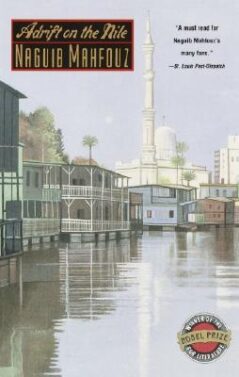
Adrift on the Nile (originally published in Arabic in 1966 as Tharthara fawq al-Nil) is one of Nobel laureate Naguib Mahfouz’s most critically acclaimed, experimental, and politically charged novels. Set in Cairo during the late 1960s under the regime of Gamal Abdel Nasser, the novel serves as a devastating allegorical critique of the Egyptian intellectual class’s flight into nihilism, existential apathy, and drug-induced oblivion following the social and political upheavals of the post-revolutionary era.
Through the micro-society of a single houseboat moored on the banks of the Nile, Mahfouz explores the profound clash between “Seriousness” (the demands of historical responsibility, social realism, and political commitment) and the “Absurd” (the retreat into existential dread, drug addiction, and moral paralysis).
PART I: THE HISTORICAL AND SOCIO-POLITICAL FRAMEWORK
To understand the narrative trajectory of Adrift on the Nile, one must understand the socio-political climate of late 1960s Egypt in which Mahfouz set his characters. Nasser’s revolution had promised a glorious rebirth of Arab nationalism, industrial progress, and social justice. Yet, for the middle-class, educated daughters and sons of the old bourgeoisie, the reality was a suffocating bureaucratic apparatus where freedom of thought was constrained, and individual agency felt entirely meaningless.
In this serious, state-mandated world, the state demanded absolute commitment to the collective struggle. Art for the sake of entertainment or pure aesthetic beauty was usurped by “committed theater,” “social realism,” and “art with a message for the people”. This left a generation of pre-revolutionary intellectuals high and dry. Unwilling or unable to conform to the rigid demands of the state, and profoundly disillusioned by the corruption, hollow propaganda, and creeping authoritarianism of the regime, they retreated from the public sphere.
Their sanctuary became the houseboat a literal and metaphorical vessel detached from the solid ground of Egyptian reality, floating listlessly on the timeless waters of the Nile. Within this enclosed space, under the heavy, fragrant smoke of the water pipe (shisha) filled with kif (hashish), they sought to recreate a cozy, enchanted, and consequence-free world. Here, the laws of the state did not apply; the passage of time was rendered circular and meaningless, and the terrifying realities of the world were laughed away as inconsequential jokes.
PART II: DETAILED CHAPTER-BY-CHAPTER NARRATIVE SUMMARY
Chapter 1: The Gloomy Ministry and the Month of Dust
The novel opens in April, a period the narrator immediately defines as the “month of dust and lies”. The setting is a long, high-ceilinged government office in Cairo, which has transformed into a gloomy, stagnant storeroom for cigarette smoke. On the shelves, administrative files “enjoy an easeful death,” serving as a silent, mocking witness to the civil servants who carry out utterly trivial tasks with absurdly serious expressions. The office is plagued by the physical encroachment of decay: ants, cockroaches, spiders, and the constant smell of dust stealing through the closed windows.
Our protagonist, Anis Zaki, is a heavy-boned, forty-something clerk in the Archives Department of the Ministry of Health. Anis is introduced in a state of profound, drug-induced indolence. When asked by his Head of Department whether he has completed an urgent report on incoming correspondence, Anis vaguely replies that he has sent it to the Director General. As his boss glints at him through thick spectacles, Anis’s mind, heavily clouded by kif, begins to hallucinate. He watches in fascination as the Head of Department’s body begins a slow, undulating swelling. The swelling spreads from the man’s chest to his neck and face, turning him into a giant, weightless globe of flesh that rises slowly and floats like a gas balloon, bobbing uselessly against the high ceiling.
Anis is abruptly snapped back to reality by the boss asking why he is staring at the ceiling. His colleagues shake their heads in mockery and ostentatious sympathy for the boss. Deeply alienated from his peers, whom he views as time-serving hypocrites waiting for a dream that will never come true, Anis finds solace only in the thoughts of his sanctuary. A song filtering in from a street radio “Mama, the moon is at the door” prompts him to mutter, “Wonderful!”. He views himself as the only true miracle in the office, “speeding without a rocket into outer space”.
Summoned to the office of the Director General, Anis stands meekly before a desk. The Director’s bald head strikes him as looking like an upturned boat. The Director, fixing Anis with a bristling glare, demands to know what happened to the report on incoming correspondence for March. When Anis points to the folder, the Director orders him to read it.
To Anis’s horror, the pages are entirely blank, save for a single, clearly written opening line followed by empty space. Dumbfounded, Anis gapes at the Director, who dryly points out that the marks of the pen nib are visible on the paper, but there is no ink. The Director snatches Anis’s pen and tries to write on the cover; nothing comes out.
Anis had failed to notice that his pen had run out of ink, and had continued writing pages of invisible, non-existent text. The Director caustically diagnoses the issue: Anis did not see the blank pages because he was heavily drugged. Despite Anis’s desperate protests that he is merely ill, the Director gestures threateningly with his white-haired hands, noting that Anis’s eyes are permanently red, cloudy, and heavy, “looking inward, instead of outward like the rest of God’s creatures”. The Director cuts two days’ pay from Anis’s salary, warning him with a contemptuous parting shot: “When will you learn the difference between a government department and a smoking den?”.
Returned to his desk, Anis fills his pen from an inkwell to rewrite the report. He reflects bitterly on the “Movement of Incoming Correspondence”. To him, it is not a movement at all, but a “revolution around a fixed axis, round and round, distracted by its own futility”. In this whirling giddiness, everything of value has disappeared: science, medicine, law, his forgotten village family, and his late wife and small daughter who lie buried under the earth. His mind wanders into violent historical reveries of Mameluke soldiers letting loose yells of joy on the road to the hunt, turning innocent citizens into targets for sport while bereaved mothers scream for mercy.
Chapter 2: The Houseboat Sanctuary and Amm Abduh
At the end of the working day, a cheerful animation spreads through the office as the clerks prepare to go home. Anis makes his way to the Nile, where his houseboat lies still on the leaden waters. The boat is moored next to an empty space formerly occupied by another houseboat before the current swept it away and a simple mosque surrounded by a mud-brick wall. To reach the boat, Anis passes through a white wooden gate in a hedge of violet and jasmine, walking down a tiled path flanked by grassy lawns, a watercress bed, a wild patch of hyacinth bean, and a towering guava tree.
He is greeted by Amm Abduh, the giant night watchman of the houseboat. Amm Abduh is a towering, deeply lined figure with thick white hair springing like date blossoms from his robe. Built like a giant, his head grazes the ceiling of the houseboat. To Anis, the old man is an irresistible symbol of ancient resistance in the face of death, and he enjoys his company immensely.
Anis changes into his long white tunic and sits on the balcony overlooking the Nile. As Amm Abduh sets the table, Anis complains of the “disgusting, rotten atmosphere” of the city that drove away his good mood. Eating a chop with his fingers, Anis watches a small gecko scuttle across the sky-blue partition to hide behind a light switch. The gecko inexplicably reminds him of his Head of Department. He asks Amm Abduh how old he is, but the giant merely smiles and says, “Who knows?”.
Amm Abduh is the backbone of the houseboat: he looks after the big floats, pulls the boat on a rope to its berth, waters the plants, leads the prayers at the neighboring mosque, cooks, and acts as a pimp and errand-runner for the smokers, fetching kif and street girls when required. When Anis asks him what the most important thing in the world is, Amm Abduh replies simply: “To be hale and hearty”. Anis takes down a book on Coptic monasticism from his extensive historical library, which covers the long left wall of the room, and prepares for his afternoon siesta.
Chapter 3: The Assembly of the Smoking Circle
As dusk descends over the Nile, the houseboat is prepared for the nightly ritual. Mattresses are arranged in a large semicircle just inside the balcony door, with a brass tray holding a water pipe and a charcoal brazier in the center. Anis sits cross-legged, waiting for the lump of kif dissolved in his bitter black coffee to work its magic. Once the drug takes hold, the evergreen and acacia trees dissolve into abstract, cubist, and surrealist forms.
The first guest to arrive is Layla Zaydan, a thirty-five-year-old unmarried translator at the Ministry of Foreign Affairs. Layla has been a friend of the circle for ten years, representing one of the early, bold explorers of female liberty in Egypt, though Anis notes with clinical detachment that age has begun to touch her clear skin with tiny wrinkles. Layla complains of her exhausting day translating twenty pages of foolscap, and asks about the evening’s foreign policy.
As they share the first pulls of the pipe, Anis suggestively proposes that Layla should become his lover. Layla smiles coldly, reminding him of their established friendship. Anis’s mind drifts back to a chaotic night when he had grabbed her arm and claimed her, only for Layla to weep and confess her love for another member of the circle, Khalid Azzuz. She had raised a philosophical riddle: if she gave in to Anis while loving Khalid, she would be a whore. Anis had yelled in response that the dawn call to prayer was easier to understand than her riddles.
The houseboat shakes violently as the rest of the nightly companions arrive: Ahmad Nasr (Director of Accounts at the Ministry of Social Affairs), Mustafa Rashid (a prominent lawyer), Ali al-Sayyid (a famous art critic), and Khalid Azzuz (a short-story writer). The water pipe is passed around the circle in a continuous, gurgling rhythm.
The smokers discuss the state of the world with cynical detachment. When Khalid asks if the press has any news, Ali points to Layla as the representative of the Foreign Ministry, but Anis cynically interrupts: “Don’t bother our brains with it. Whatever else we get to hear, this world of ours will still be here, the same as ever it was, absolutely nothing happening at all”. Mustafa Rashid agrees, stating that the world does not concern them any more than they concern it. To this group of educated men, as long as the pipe is being passed and the floats of the houseboat are sound, nothing else in the universe matters.
Chapter 4: The Introduction of Sana, the Minor
The circle is joined by Saniya Kamil, a dark, nervous, married woman who has temporarily abandoned her husband and children after catching him flirting with a neighbor. Saniya eagerly takes the water pipe, seeking refuge in the intoxication of kif. Anis observes her, noting that despite her escapades, Saniya is a mother who will ultimately return to her husband, repeating a cyclic pattern of leaving and returning.
The door screen sways again to reveal Ragab al-Qadi, the handsome, charismatic film actor. Ragab is accompanied by a teenage girl, Sana al-Rashidi, a student at the Faculty of Arts. Ragab introduces Sana to the group, playfully presenting them as her new family.
In a series of theatrical introductions, Ragab outlines the hypocrisies of the circle’s members. He mocks Saniya as the “wife and mother” who flees to her friends in times of domestic distress; Layla as the “cultured” translator whose golden hair is surprisingly real; and Ahmad Nasr as the saintly accountant who has been married for twenty years and has never once deceived his wife. Ragab describes Mustafa Rashid as a successful lawyer who “searches earnestly for the Absolute” but has never found his perfect ideal of womanhood. He introduces Ali al-Sayyid as an art critic who dreams of an imaginary, ideal city but keeps two traditional wives in reality, and Khalid Azzuz as a wealthy, share-owning writer who practices promiscuity as a personal philosophy.
Finally, Ragab introduces Anis Zaki as the “master of ceremonies and Minister for Pipe-Smoking Affairs,” a highly cultured man who drifted through the faculties of Medicine, Science, and Law, departing each time with knowledge instead of qualifications, and who now roams permanently in another realm.
Sana, looking at the open door, asks anxiously if they are not afraid of the police. Ali replies with drugged bravado: “Because we are afraid of the police and the army, and the English and the Americans, and the visible and the invisible, we have reached the point where we’re not afraid of anything!”. Ragab rolls a joint for Sana to ease her worries.
Ahmad Nasr looks at the young girl with visible, fatherly sympathy, worrying about his own daughter who is the same age. Anis, observing the scene, reflects that historical time is nothing compared to cosmic time, and that Sana is merely a contemporary of Eve.
Ragab, examining Sana’s fresh, youthful face, playfully suggests she has the artistic instinct to play the role of a bedouin girl in an upcoming film, The Mystery of the Lake. He demands that she demonstrate how she kisses to prove she is free of “embarrassment,” the enemy of acting.
In the silence of the room, Ragab embraces her and kisses her with force and warmth. Khalid Azzuz gushingly congratulates them, calling the kiss a “splendid moment of civilization” where Euclid’s axioms have been demolished and Fascism routed.
As the night winds down, the couples retreat to the private bedrooms of the houseboat: Layla and Khalid in one, Saniya and Ali in another, while Ragab and Sana whisper on the balcony. Anis is left alone in the main room, his leg knocking over the water pipe, spilling black spittle across the floor. Amm Abduh cleans up the mess, and Anis prepares to sleep on the balcony, watching the stars and hallucinating a grand meeting with the Caliph Harun al-Rashid.
Chapter 5: The Intrusion of Seriousness (Samara Bahgat)
After a cold shower, Anis prepares for another sunset, mixing kif into his bitter black coffee. The friends arrive, including Ragab and Sana, who have been inseparable all week. Sana has now become fully accustomed to the water pipe, prompting Ahmad to whisper anxiously in Ragab’s ear that she is a minor, to which Ragab callously replies that he is not the first artist in her life.
The lazy atmosphere is shattered when Ali al-Sayyid snaps his fingers to deliver an important message: Samara Bahgat, a prominent and serious journalist, wishes to visit the houseboat. The news is digested with universal concern and unreadable glances. Ahmad Nasr immediately worries that her presence will constrain their freedom. Ali defends her, stating that while Samara is an alarmingly serious, progressive writer who looks at life from a serious angle, she is also pleasant company and wants to get to know them. He reveals that she recently refused to marry a very wealthy bourgeois relative because she did not love him, choosing instead to live on her small journalist’s salary.
The smokers debate whether to allow this “unreformed bourgeoise” or “radical” into their sanctuary. Sana asks why they want to invite such a “dangerous woman” who cannot entertain them. Layla, however, argues that the houseboat needs “new blood,” and Ali goes to the telephone to invite her over.
Chapter 6: The Arrival of the “Investigator”
Half an hour later, Samara Bahgat arrives on the houseboat. The smokers rise to their feet; even Anis stands, his white robe rumpled over his shins. Samara meets their gazes in a calm, friendly, and unembarrassed manner. Anis, stealing furtive glances from under drooping lids, is struck by her natural beauty; her dark complexion is free of makeup, her features are open, and her eyes possess a disquieting intelligence.
Samara politely declines to smoke the water pipe, merely putting the mouthpiece to her lips by way of salutation. She immediately engages the group in intellectual conversation, praising Ragab’s performance in his latest film, Tree Without Fruit, and discussing Khalid Azzuz’s short stories.
Mustafa Rashid cynically warns her that she has entered a bastion of “nihilism itself,” but Samara replies progressively that one cannot judge people on what they do in their free time. Sincere and dedicated, she represents everything the group has abandoned.
When the giant Amm Abduh enters to change the water, Samara is fascinated by him. Ali al-Sayyid humorously describes the watchman’s dual nature: “He is a giant… strong and weak, there and not there; he is the prayer leader at the neighboring mosque and a pimp!”.
The intellectual clash deepens as Samara asks the smokers whether they are concerned by the massive political and social events occurring around them. Mustafa Rashid proudly replies: “We belong to nothing and no one except this houseboat… As long as the floats are sound, and the ropes and chains strong, and Amm Abduh is awake, and the pipe filled, then we have no concerns”.
Ali al-Sayyid adds that the “ship of state sails on without need of our opinion or support,” and that thinking about politics only brings distress and high blood pressure.
Samara, passionate about the theater, argues that in a play, every word must have a concentrated meaning. Mustafa smiles, noting that this is the fundamental difference between the theater and their group.
Suddenly, Samara turns her attention to Anis, asking why he remains so silent. When she demands to know what he thinks about during his rare moments of clarity, Anis replies with detached honesty: “I ask myself why I am alive… Generally, I’m high again before I get the chance”.
As the guests prepare to leave, Ragab expresses his hope that Samara will become a permanent part of their circle, to which she cautiously agrees. Left alone, Anis commands Amm Abduh to fetch him a street girl to match the pitch-dark night, and falls into a daze, clutching a squashed orange filter from one of Samara’s cigarettes.
Chapter 7: The Stolen Heart and the Stolen Words
During an official holiday, Anis sits on the balcony in a state of complete harmony, having mixed kif into his black coffee. He is surprised by the early arrival of Samara Bahgat. They sit together in the main room.
Samara, driven by professional curiosity, asks Anis about his past. Anis confesses that twenty years ago, while he was a lonely student in Cairo, his wife and infant daughter died within the same month from the same illness.
She asks why he stopped studying, and Anis explains that he ran out of money and secured his current clerk job at the Ministry of Health through a former professor.
As the kif begins to work, Anis exultantly tells her: “The journey has begun, and your eyes are beautiful”. Samara confesses she came early specifically to be alone with him because he is the only one who rarely speaks. She asks if he would accept an invitation to join her at the Semiramis Hotel, but Anis uncomfortably refuses, stating he never leaves the houseboat except to go to the office.
The rest of the friends arrive, and the water pipe begins its rounds. The conversation drifts through global crises: American airstrikes on North Vietnam, the Cuban missile crisis, inflation, and the lack of hard currency. To Anis, all these heavy topics lie in the bowl of the pipe, destined to go up in smoke.
Samara eager to deepen their connection, proposes a game: everyone must reveal their “primary concern” in life. The smokers mock the premise, but participate. Samara declares her primary concern is writing a play about the Serious and the Absurd, driven by a “will to live” that allows humanity to rise above intellect and avoid suicide.
The others reveal their hollow priorities: Ragab’s concern is women and art; Ali’s is dream-like artistic criticism; Ahmad’s is protecting his reputation and marrying off his daughter; Khalid’s is complete anarchy; and Saniya’s is securing a mutual divorce for herself and Ali’s wives. Sana remains entirely silent.
The game is interrupted by Amm Abduh delivering shocking news: a woman has just committed suicide by jumping from the eighth floor of the Suya Company building after a quarrel with her lover.
The news temporarily soberers the group. Samara, moved, murmurs that “there is still love after all,” but Khalid cynically replies that the woman killed herself because she was serious, whereas they will never do such a thing.
As Samara prepares to leave at midnight, Ragab invites her to stay until dawn to watch the sun rise, but she firmly declines. Anis, left alone, notices a large white handbag left behind by Samara on a mattress.
Overwhelmed by a violent urge to commit a “dreadful deed,” Anis opens the bag. He finds a handkerchief, a comb with a silver handle, a purse, and a pocket notebook. He pockets fifty piasters from her purse to pay for a street girl, and slides her pocket notebook into his tunic.
He shakes with manic laughter, feeling that by reading her private thoughts, he will finally perform “surgery” on a closed heart and renew his lost youth. His mind slips into a hallucination where he confronts the Pharaoh Thutmose III sharing a throne with Queen Hatshepsut.
Chapter 8: Sana’s Grief and the Flight of the Actor
The next evening, the sky is moonlit, and a dim blue lamp is hung over the balcony door. The smokers discuss Samara’s latest film article, which Khalid sardonically notes smacks of political “commitment”. Sana, feeling neglected and desperate for attention, begs Ragab to dance with her, but he placidly refuses because there is no music.
Ragab callously reveals to the group that he visited Samara at her apartment to thank her for the article, and found Ali al-Sayyid already there. He describes Samara as being “swathed in a veil of femininity, like a butterfly flitting from flower to flower”.
Sana, hurt by Ragab’s blatant interest in Samara, snaps that the people on the boat quickly turn into “heartless beasts”.
The telephone rings, and Ragab answers it. He abruptly announces that he must leave to meet a producer, promising to return by the end of the evening. Sana twitches, visibly on the verge of tears.
The group attempts to comfort her with cynical realism; Mustafa tells her the romantic era is dead, and Saniya bluntly suggests she still has Ahmad and Mustafa as backups. Anis wildly shouts at them: “Addicted, dissipated wretches!”.
Sana retreats to the balcony to sit in isolation. Anis crawls out on all fours to join her, and she asks him if he thinks Ragab will ever return. Anis replies with detached wisdom: “People have been waiting for their saviors for a thousand years”. Sana tells him he is the nicest because he does not say evil things.
Left alone as the couples go to the bedrooms, Anis hallucinates the victorious Persian King Cambyses standing over the defeated Egyptian Pharaoh, who weeps at the sight of his glorious general bound in chains.
PART III: THE STOLEN NOTEBOOK AND THE PLAY SCENARIO
Chapter 9 & 10: “Scenario for a Play”
This section of the novel represents a brilliant meta-narrative shift. Anis, alone in his room, takes out Samara’s stolen pocket notebook and reads her private drafts. The entire Chapter 10 consists of the text of Samara’s notebook, titled “Scenario for a Play”. Her notes reveal her true, clinical purpose for visiting the houseboat: she is using the smokers as raw material for a drama exploring the conflict between the Serious and the Absurd.
Samara’s Philosophical Premises:
- The Absurd: Defined as the complete loss of meaning, belief, and conviction. It is a passage through life propelled by necessity alone, resulting in dissipation, nihilism, and the transformation of heroism into mockery. Under the absurd, good and evil are equalized, and individuals adopt courses of action based solely on egotism, cowardice, or opportunism.
- The Problem of Religious Absurdists: Samara notes the strange phenomenon of religious people (like Ahmad Nasr) who pray and fast but lead entirely futile, stagnant lives. She questions whether their faith is merely a matter of routine and a cover for opportunism and exploitation.
- The Serious: Defined as true belief with the power to inspire acts of heroism. She argues that while ancient humanity escaped absurdity through religion, modern humanity must escape it through Science the only language capable of articulating greater and lesser truths in the modern era.
- The Scientists as Models: She praises scientists because they are permanently in contact with reality and a successful methodology. A scientist who spends twenty years solving a single equation is free from doubt and despair, embodying a monastic devotion to work, integrity in judgment, and a humanist attitude.
Samara’s Character Analyses of the Smokers:
- Ahmad Nasr: A competent civil servant and religious family man who smokes the water pipe to escape an unconscious, secret misery. He is grieved by his own insignificance, and his obsession with small household problems is a form of flight. Samara plans for the heroine (herself) to reveal his true, repressed self through love.
- Mustafa Rashid: An cynical, spiritually empty lawyer married to a woman he does not love for her salary. He uses the impossible search for the “Absolute” as a grand excuse for his addiction, pretending to have risen above his own vapidity while inwardly crumbling and “stinking of his own miserable decay”.
- Ali al-Sayyid: A highly opportunistic “scoundrel” and hypocrite who maintains traditional, conservative authority over his two traditional wives while carrying on a sordid affair with Saniya Kamil. As a critic, his aesthetic is founded entirely on material gain. Harried by worthlessness, he devotes himself to the pipe and vague dreams of a “new humanism” seen through a lethal fog of smoke. He is a man who would not shrink from committing a physical crime if he was sure he would not be caught.
- Khalid Azzuz: An idle, mediocre writer who lives off an inherited apartment block, escaping into sex, the pipe, and “degenerate, promiscuous literature”. Samara notes that he takes everything from society and gives nothing back, and predicts he will eventually return to traditional faith when his creative spring dries up.
- Ragab al-Qadi: The “hope of the drama”. The handsome, powerful actor who represents the “god of passion”. Unlike the others, Ragab displays a nervous tension and a capacity for development, though he currently lives without beliefs or principles, finding his release in sex.
- Anis Zaki: Described by Samara as a “failed civil servant… silent and dazed, morning and night”. She writes that he is “half mad, or half dead,” having managed to completely forget what he is escaping from. To her, Anis is a static, useless figure: “One can be sure of him in the same way that one can be sure of an empty chair. Useful for comic exploitation, but he will not play a positive role in the play”.
Reading this brutal, clinical assessment of himself and his friends, Anis laughs. He puts the notebook back in his pocket, muttering, “The little… !” as Amm Abduh calls the sunset prayer.
PART IV: THE FRACTURING OF THE CIRCLE AND THE CRITICAL DEBATES
Chapter 11: The Subversion of the Master of Ceremonies
Samara returns to the houseboat, visibly preoccupied and searching high and low for her lost notebook and money. Anis, possessing the notebook, watches her with a new, alert malice, his internal “demons” inciting him to mischief.
The friends arrive, and Amm Abduh delivers news that a houseboat has sunk at Imbaba because its watchman was negligent. Khalid Azzuz jokingly remarks that the Almighty was angry about what went on inside, and Ali al-Sayyid confesses that he recently dreamed of becoming as tall and broad as Amm Abduh.
Anis, armed with the knowledge of Samara’s private notebook, suddenly breaks his customary silence to launch a devastating attack on the group. When Ali asks why he took refuge in a dream, Anis snaps: “From your own emptiness! You are all modern-day scoundrels, escaping into addiction and groundless delusions”.
He systematically unmasks each of them, hurling Samara’s own written criticisms back at their faces. He tells Mustafa he is hounded by worthlessness and escapes into the Absolute; he calls Khalid a “depraved degenerate” with no belief; he tells Layla she is a pioneer only in dissipation and addiction, not a martyr; and he brands Saniya Kamil a “bigamist” and a “dope fiend”.
Saniya screams in rage, calling him mad, to which Anis replies: “No. Merely half mad. And also half dead”.
When Ragab attempts to laugh off the outburst, Anis turns his venom on him, declaring that Samara does not care about a man who flees from his own emptiness into addiction and sex.
The smokers, stunned by the outburst, begin a defensive intellectual debate, arguing that their retreat is not an escape, but “life itself”. Left alone at the end of the night, Anis crawls to the balcony, shouting to the moon and summoning the ancient Egyptian sage Ibur to sing of corruption gnawing at the land and orders held in contempt.
Chapter 12: The Balcony Confrontation
Anis is awakened on the balcony by a voice whispering his name. He opens his eyes to find Samara Bahgat standing before him in the middle of the night. She has returned to the houseboat after Ragab dropped her in Tahrir Square, desperate to retrieve her notebook.
Anis plays the role of the malicious, teasing antagonist, accusing her of branding him a thief. When Samara insists she heard him repeating her written words verbatim, Anis finally holds out his hand and returns the notebook. He confesses that he also stole her fifty piasters to pay for a street girl, laughing that on the houseboat, everything is considered public property.
Anis confronts her with her true motives, telling her she is a “vile girl” who came not for friendship, but for “snooping around”. He points to the bedroom, warning her not to wake the lovers, and tells her she is only on the boat because of her attraction to Ragab.
Samara protests, but Anis mocks her seriousness: “How sweet you are but you wouldn’t care for me… Because it is too much if the girl is serious… I only ever invite serious girls… All the street girls are serious… They don’t know what absurdity is. They work until the crack of dawn… to lead better lives!”.
Samara sighs, asking if he intends to tell the others about the notebook, but Anis promises to keep her secret. They shake hands in silent, complicated farewell as the dawn prayer echoes across the river.
Chapter 13: The Drunken Return of Sana
The next evening, the circle is joined by a surprise guest. Sana al-Rashidi returns to the houseboat, visibly drunk, dragging a well-dressed young man by the hand. The man is Ra’uf, a famous film star and her new fiancé.
Sana boldly mocks the circle, pointing at the water pipe and laughing that the pipe “makes strange bedfellows”. She introduces Samara and Ali to Ra’uf with dripping sarcasm.
An uncomfortable, tense silence descends upon the room for fifteen minutes, until Ra’uf, embarrassed by Sana’s drunken behavior, takes her by the arm and leaves.
Ragab remains gloomy, and Samara observes that despite their intellectual pretensions, no one believes her serious warnings. Ragab simple-mindedly tries to comfort her, but Khalid Azzuz raises a cynical question: “What could be the role of a serious woman in love whose lover is futile?”.
Ragab romanticizes the situation, claiming her role is “cathartic to purify him of his futility,” and declaring that love must be victorious in the end.
Khalid and Ali debate whether there is any hope for their generation to change, concluding that they only ever change in “plays and films,” and that their lives are home-grown comedies that end in sudden, preachy character changes written solely to appease the government censors.
PART V: THE SAQQARA ROAD AND THE FATAL COLLISION
Chapter 14 & 15: The Unholy Expedition
On an official holiday, the friends arrive at the houseboat earlier than usual. Ragab announces his plan to raise his acting fee to five thousand pounds per film, and Khalid sarcastically congratulates him on his loyalty to Arab socialism.
The smokers discuss Samara’s impending arrival. Ragab confesses to Khalid that he is genuinely in love with her, experiencing a “Platonic love” for the first time. Saniya Kamil warns him that Samara’s strong, serious personality is repellent in a woman, but Ragab declares: “The more impregnable the fortress, the greater the glory of those who take her”.
Samara arrives, greeting them warmly. Ragab, looking to celebrate the holiday, proposes a spontaneous trip to the country in his car.
The smokers are enthusiastic, but Anis, hunched in his corner, repeatedly mutters, “No…”.
However, they insist on taking him, refusing to let the master of ceremonies stay behind. At midnight, they drag Anis out in his long white tunic and pile into Ragab’s car.
The car sets off with nine passengers. Ragab, Samara, and Ahmad sit in the front, while the remaining six are squashed together in the back like “one flattened body with six heads”. They drive through Pyramids Road and turn left onto the dark, deserted road leading to Saqqara.
The road is bordered by great evergreens whose branches meet overhead, with a gray canal running alongside under the faint starlight.
Ragab stops the car on a dusty patch of ground, and the passengers get out to stroll in the dark fields, leaving Anis alone in the back seat. Ragab stays behind to hold Samara’s hand, forcing her to remain in the car with him.
Under the cover of the night, Ragab attempts to declare his love to Samara. Samara dismisses his advances as “Don Juan mentality,” refusing to trust his words.
Anis, sitting in the back, suddenly bellows into the darkness: “Rulings and classifications of age and love and sex? You damn grammarians!”.
The strollers return, boasting that they spent their walk conducting a “confession of sins,” deciding who among them had committed the most misdeeds. They conclude that they are in a state of immaculate nature, and that the morals they lack are merely the “dead morals of a dead age”.
They pile back into the car, and Ragab starts the engine. Driven by a sudden, terrifying frenzy, Ragab begins to drive at an insane, accelerating speed, whooping like a Red Indian.
The passengers scream in terror as the tall trees fly past, feeling as if they are plummeting into a deep gulf. Layla begins to cry, and Samara desperately grasps Ragab’s arm, whispering, “Please!”.
Suddenly, a horrifying scream rings out.
Anis opens his eyes to see a black shape flying through the air. The car jolts violently with the shock of a massive impact, nearly turning over as Ragab slams on the brakes.
Sobs and cries of “God forbid!” erupt in the car.
Ragab looks out the back window and realizes they have struck a pedestrian. Decisively, he starts the car again to flee the scene.
Samara, shocked, whispers that the man might need help, but Ragab harshly replies that the victim is already finished. He stops the car briefly, demanding a consensus: “Let no one say tomorrow that I took this decision into my own hands… What do you think we should do?”.
Khalid and Mustafa, panicked by the prospect of prison and public disgrace, urge him to drive on.
Samara remains silent, paralyzed by the horror, and Ragab accelerates. He contemptuously mutters to her: “We’re living in the world… Not in a play”.
PART VI: THE CRITICAL RESOLUTION AND THE COLLAPSE OF ABSURDITY
Chapter 16: The Agonies of Sobriety
The group returns to the houseboat in a funereal, devastated silence. Their faces look pallid and ruined under the blue lamp. Ali desperately tries to suggest that they might have hit an animal, but Ahmad flatly replies: “That scream was human”.
Ragab insists that the impact was accidental, but that running away is a crime. He tells them they must forget the incident to protect their reputations and the honor of the three ladies.
Anis spent the rest of the night in a state of agonizing sobriety, his mind stripped of all drug-induced illusions. He is haunted by the phantom of the Caliph al-Hakim, who claimed to be a god, banned the eating of mulukhiya, and eventually went up on a mountain to commit suicide when he realized his struggle was absurd.
To Anis, the pedestrian’s scream has “murdered sleep”.
The next morning, clearheaded for the first time in years, Anis leaves the houseboat early. He views the city with raw, painful clarity, noticing the splayed roots of a massive tree driving deep into the pavement like talons in a rigid frenzy of defiance and pain.
He arrives at the Ministry of Health early, only to fall into a deep, exhausted sleep at his desk. His mind is plagued by nightmares of his childhood village, his late wife Adila telling him their daughter is in Paradise, and the black shape flying through the air on the Saqqara road.
He is shaken awake by a colleague and ordered to see the Director General.
The Director, cold and furious, catches him sleeping and calls him a chronic, incurable drug addict.
Anis, seized by a sudden, volatile rage, shouts back: “I said that I am ill! Do not make fun of me!”.
When the Director calls him an insolent evildoer, Anis snatches a heavy desk blotter and hurls it at the Director’s chest, yelling: “If you had said another word, I would have killed you!”.
Returned to his desk, Anis is quietly informed by a sympathetic colleague that an order has been issued for his immediate dismissal, and that he is to be sent to a civil service tribunal.
Chapter 17 & 18: The Judgment of the Houseboat
Anis returns to the houseboat, surrendering himself to the grim humor of his fate. He reads a book on Christian martyrs, finding a strange, mad joy in his complete ruin.
Samara Bahgat arrives early, looking pale, harried, and broken. She holds out the evening newspaper to Anis.
The paper reports the discovery of a half-naked man in his fifties with fractures to his spine, legs, and skull, killed by a hit-and-run driver on the Saqqara road.
Samara whispers in horror: “We are really murderers”.
Anis bitterly agrees, adding that he has also been dismissed from his job.
The rest of the friends arrive, their faces filled with apprehension.
Ahmad Nasr, terrified that the Director General will order a police raid on the houseboat, takes the water pipe and the tobacco and hurls them into the Nile, declaring the houseboat a danger zone.
Anis looks at the water, muttering: “Paradise has gone”.
A fierce, moral debate erupts on the houseboat.
Ragab demands that they must forget the past, but Samara snorts: “How can we forget, when there is a murdered man behind us!”.
Ali al-Sayyid delivers a grave, pleading speech to Samara, begging her not to go to the police. He argues that going to the police will not bring the poor, unknown country man back to life, but will result in prison for Ragab and appalling public disgrace for everyone, including her.
He pleads with her to be adaptable: “The question is simple. An unknown man was killed by mistake… Do you really wish to sacrifice our happiness and honor… for the sake of nothing?”.
Samara, weeping with bitter grief, murmurs: “So I am going to certain death, then!… The death that seizes you when you are still alive”.
When Ragab furiously accuses her of bluffing, she screams: “Lies!”.
Ragab, losing his mind with rage and fear, bellows that she is the root of all misfortune. He yells: “If there has to be an accusation of murder, then let there be a real murder!”.
Anis, who has sat in silent, sober judgment, suddenly speaks with a strange, terrifying calm: “Nothing is important… Except the murder… I mean the murder of the unknown man… I mean that justice must be done… We must inform the authorities of our involvement at once”.
The smokers stare at him, stunned and terrified.
Ragab, convinced that Anis is a desperate, ruined man who wants to bring the temple down on everyone’s heads, charges at him in a bloodlust.
Ahmad Nasr tries to separate them, but Ragab strikes Anis with a violent, thunderous slap to the face.
Anis takes the slap without moving, his eyes staring at Ragab.
When Mustafa tries to apologize for Ragab, Anis bellows with a voice like thunder: “No!”.
A physical brawl erupts; Anis leaps upon Ragab, fastening his hands around his throat, and butting him on the nose. The others rush to separate them, and Anis is pushed into an armchair, bleeding from his lower lip and eyebrows.
Anis stands up, vanishes into the side room, and returns brandishing a kitchen knife. He crouches between the door and the refrigerator, ready to defend himself to the death.
The women scream, and Khalid shouts that they must leave the houseboat immediately before a tragedy occurs.
Ragab, wrestling with his friends who are pinning his arms, looks at Anis with a face of insane, defeated fury. Suddenly, he desists. Standing motionless and panting, Ragab screams at his friends: “I am going myself! I will go to the police myself, and nothing will stand in my way not ruin, death, or demons!”.
Ragab rushes out of the houseboat, and the other men and women run at his heels. The boat rocks and shakes convulsively under their heavy, angry, retreating feet.
Anis puts the knife down and sits on a mattress next to Samara.
Amm Abduh enters, carrying a cup of fresh coffee. The old man whispers to Anis: “I had made up my mind to break the moorings if he hit you again!”.
Anis laughs faintly, realizing that if Amm Abduh had broken the moorings, they all would have drowned together in the dark Nile.
Samara asks Anis if Ragab will truly go to the police, and Anis replies that he has no idea what is happening in the world outside.
Anis confesses to Samara that his strange behavior was partially motivated by jealousy, wanting to ensure she did not write a false, trite ending to her play where the characters suddenly develop into moral heroes.
In the final, profound exchange of the novel, Samara confesses her own weakness: “I confess… that I try to be more serious than I really am… In my moments of leisure, absurdity gnaws at me like a toothache”.
Anis asks her for an explanation of their generation’s doom, and Samara uses the metaphor of the big wheel at a fairground. The wheel takes passengers from the bottom to the top, and down again from the top to the bottom, without the intervention of intellect or will.
She sighs: “We are the people descending… We have only will and intellect”.
Anis looks out at the Nile, his mind beginning to slip back into the comfortable daze of his dreams. He stops listening to her words, which die to a whisper in his ears.
He mutters to himself about the primeval history of humanity: “The cleverness of the ape is the root of all misfortune. He learned how to walk on two legs, and his hands were free… And he came down from the apes’ paradise in the trees to the forest floor… and they said to him: Come back to the trees, or the beasts will get you… But he took a branch in one hand and a stone in the other and set off cautiously, looking away down a road that had no end…”.
With these words of evolutionary isolation and existential wandering, the novel ends.
PART VII: IN-DEPTH CHARACTER ANALYSIS
| Character | Social Role / Profession | Stated Primary Concern | Actual Escape Mechanism | Fate / Narrative Role |
| Anis Zaki | Archives Clerk, Ministry of Health | “To be Samara’s lover” | Kif, historical hallucinations, complete dissociation | Dismissed from his job; left alone on the boat in a state of primitive sanity |
| Samara Bahgat | Progressive Journalist & Playwright | Writing a committed play; “The will to live” | Intellectualizing, using the circle as clinical research | Defeated by her own heart and the harsh reality of the hit-and-run |
| Ragab al-Qadi | Charismatic Film Actor | “Art” and women | Casual sex, physical dominance, performance | Driven to a frenzy of guilt and rage; rushes to confess to the police |
| Amm Abduh | Houseboat Night Watchman | None (Sustenance and prayer) | Religious routine, serving the smokers’ vices | The “Ropes and Floats”; represents the ancient, resilient folk-soul of Egypt |
| Mustafa Rashid | Defense Lawyer | None (Cynicism) | Searching for the “Absolute” through kif | Panics after the hit-and-run; demands immediate flight to save his career |
| Ahmad Nasr | Accounts Director, Ministry of Social Affairs | “To keep up my reputation” | Excessive domesticity, routine religious faith, kif | Throws the water pipe into the Nile in a fit of careerist terror |
| Ali al-Sayyid | Art Critic | “Artistic criticism” | Hypocritical opportunism, dreaming of a “new humanism” | Attempts to manipulate Samara into silence with pragmatic arguments |
| Khalid Azzuz | Landlord / Mediocre Storyteller | “Anarchy” | Sex, cheap literature, total idleness | Cynically dismisses the victim’s death; flees the boat to avoid drama |
| Layla Zaydan | Translator, Ministry of Foreign Affairs | None | Bitter, unrequited love; kif | Breaks down in tears during the Saqqara trip; unmasked as a dissipated pioneer |
PART VIII: CORE THEMATIC AND SYMBOLIC ANALYSES
1. The Metaphor of the Houseboat vs. Solid Ground
The houseboat is the central physical and symbolic structure of the novel. Moored on the water, it represents a state of permanent suspension. It is physically connected to the land by a single, fragile gangway, yet it is entirely detached from the social and moral obligations of Egyptian society. On the houseboat, the characters exist in a state of “zero gravity,” where values are inverted. As Anis observes:
“Fornication is held as a vice by councils and institutions, but it is freedom on our houseboat. Women are all conventions and marriage deeds in the home, but they are nubile and alluring on the houseboat… and madness is everywhere an illness, but here it is philosophy, and something was something everywhere else but here; for here it was nothing”.
The river Nile, which carries the houseboat, represents the flow of history. Yet, for the smokers, the river’s movement is ignored in favor of the circular, stagnant revolutions of the water pipe. The crisis of the novel occurs when they are forced to leave this floating sanctuary and travel by car onto the solid, historical ground of Egypt. On the Saqqara road, their “zero gravity” state collides violently with physical reality, resulting in a death that they cannot smoke away.
2. Nihilism and the Absurd vs. Commitment and Seriousness
Mahfouz uses the intellectual battles between Samara and the smokers to dramatize the existential crisis of post-revolutionary Egypt. Samara represents Nasser’s new generation: serious, committed, belief-driven, and focused on social progress through the language of science and collective action. She views the smokers’ withdrawal as a shameful, cowardly escape from their patriotic duties.
The smokers, however, mount a sophisticated, cynical defense of their absurdity. They argue that their withdrawal is a logical response to a world where individual opinion is meaningless and the “ship of state sails on” without them. Mustafa Rashid notes that seriousness is merely a form of self-deception, and Khalid Azzuz points out that the “serious, committed heroes” of modern literature are insufferable bores who kill off their audience with hollow slogans.
The tragic irony of the novel is that both positions are ultimately defeated. The smokers’ “immaculate state of nature” is revealed to be a fragile cover for cowardice and criminal negligence when they choose to let an innocent man die to protect their own comfort.
At the same time, Samara’s lofty “seriousness” is completely shattered. When faced with the physical reality of the hit-and-run, she is paralyzed by fear and goes along with the group’s flight, ultimately admitting that she merely uses seriousness as an intellectual shield to fight the absurdity that “gnaws at her like a toothache”.
3. History and Hallucination as an Existential Shield
Throughout the novel, Anis Zaki’s mind constantly slips into vivid, historical hallucinations. He wanders through the reigns of Harun al-Rashid, the Pharaoh Thutmose III, Julius Caesar and Cleopatra, the victorious King Cambyses, and the mad Caliph al-Hakim.
These historical reveries are not merely drug-induced dazes; they are existential shields. History, to Anis, is a “magnificent tomb” where all human suffering, glory, and conflict have already been finalized and rendered harmless. By living in the past, Anis avoids the painful reality of his present: his dead wife and daughter, his stagnant clerk job, and his complete lack of agency in modern Egypt.
When the hit-and-run occurs, this shield begins to fail. The physical scream of the dying pedestrian cannot be integrated into his historical daze; it is an active, modern horror that “murders sleep”.
Even when his mind attempts to transform the accident into a dream of a car hitting a man, he wakes up to the cold, sober reality of his dismissal and his moral guilt.
4. The Metaphor of the Descending Big Wheel
In the novel’s final pages, Samara introduces the metaphor of the big wheel at a fairground to explain their generation’s collapse. The wheel represents the cyclical, unstoppable rise and fall of civilizations and intellectual movements.
When the wheel is rising, the passengers experience an automatic sensation of rising; when it is sinking, they experience an automatic sensation of sinking, entirely independent of their individual will or intellect.
The middle-aged, middle-class intellectuals of Nasser’s Egypt are the “people descending”. They are caught in the downward turn of history’s tide, where all their education, culture, and potential are rendered useless by the weight of a collapsing era.
In this downward phase, even their attempts at “seriousness” are revealed to be futile struggles against gravity.
The novel ends on a deeply pessimistic note, with Anis’s mind retreating back to the dawn of humanity to the primitive ape who climbed down from the paradise of the trees to wander cautiously down a dark, endless road on the forest floor, clutching a stone and a branch for survival. It is a stark warning that without true moral responsibility, civilization itself must inevitably return to the dust.
PART IX: LITERARY SIGNIFICANCE AND LEGACY
First published in Arabic in 1966, Adrift on the Nile represents a radical departure from the traditional realism of Mahfouz’s earlier masterpieces, such as The Cairo Trilogy. With its fragmented structure, surrealist hallucinations, and sharp, dialogue-driven chapters, the novel aligns more closely with modern experimental European fiction (such as the works of Camus, Sartre, and the Theater of the Absurd) while remaining deeply rooted in the unique cultural geography of Cairo.
The novel was highly controversial upon its release, as its depiction of a drug-addled, morally bankrupt intellectual class was seen as a direct attack on the integrity of the socialist revolutionary state. Yet, history vindicated Mahfouz’s vision; the devastating defeat of Egypt in the 1967 Six-Day War, which occurred shortly after the novel’s publication, was viewed by many critics as the tragic, real-world fulfillment of the “hit-and-run” metaphor that Mahfouz had so brilliantly constructed on the Saqqara road.
Today, Adrift on the Nile remains one of the most powerful literary explorations of existential despair, political disillusionment, and the terrifying cost of moral apathy in modern times. It stands as a testament to Mahfouz’s Nobel Prize-winning genius a work that is at once local and universal, deeply ironic and profoundly serious, capturing the tragic daze of a generation drifting listlessly toward its own destruction.