
Listen to this Book Summary Below
Playback speed:
Summary of African Pharmakon: The Asylum as Shrine from Slavery to the Return
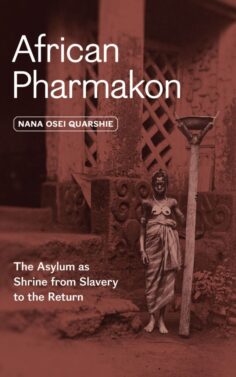
Nana Osei Quarshie’s African Pharmakon provides a comprehensive historical and ethnographic analysis of the management of mental distress in Ghana from the 15th century to the present day. The book’s central thesis is that psychiatry in West Africa was not a colonial imposition that replaced indigenous systems; rather, it was “Africanized” and grafted onto a pre-existing “West African pharmakon” a repertoire of therapeutic techniques used to heal or harm the mind for political and ritual purposes.
The term “pharmakon” refers to substances or practices that can be both palliative and poisonous, as well as the ritual of sacrificing a scapegoat to purify a territory. Quarshie identifies five historically recurring techniques characterizing this regional pharmakon: logging (restraint), spiritual pawning (ritual servitude), manhunting (capture), mass expulsion (territorial removal), and pharmacotherapy (herbal and pharmaceutical substances).
Part One: The Atlantic Era and the Roots of Spiritual Pawning
The origins of psychiatry in West Africa are rooted in the transatlantic slave trade, where European merchants and African elites negotiated the value of “mad slaves”. Madness was an economic limit to the commodification of human life; a “mad slave” lacked exchange value as labor capital. In this era, the Ga people, the founders of Accra, acted as crucial middlemen.
The Concept of Spiritual Capture
In the 18th-century Gold Coast, mental distress was often understood through the diagnostic category of spiritual capture (wɔnmɔmɔ). This condition was framed as a person being “hunted and caught” by a spirit (wɔn), reflecting the ubiquitous reality of panyarring (manhunting for debt) in the visible world. Spiritual capture was polyvalent; it was a ritual manifestation of the trauma of enslavement, a debt owed to a spirit, or a calling into the priesthood.
Spiritual Pawning at Ga Shrines
Quarshie introduces the concept of “spiritual pawning” to describe how Ga shrine priests treated the mentally distressed. In the Atlantic era, pawning involved giving kin to a creditor as security for a debt. Similarly, families pawned mentally distressed relatives to shrine priests, who acted as “psychotherapeutic creditors”. The priest would perform propitiation rituals to heal the patient, while the patient (as a spiritual pawn) would provide labor to the shrine during recovery. If healed, the family paid a “thanksgiving fee” (awrɔke hamɔ) to retrieve their kin. This system converted individuals deemed “unfit” for the slave trade back into productive laboring subjects.
Early Therapeutic Techniques
By the mid-19th century, Ga shrines utilized several techniques that would later be mirrored in colonial psychiatry:
- Urban-Rural Manhunts: Families and authorities would “hunt” individuals exhibiting “maniacal paroxysms” in urban Accra and transport them to rural “native asylums,” such as those in Teshie.
- Logging: The primary method of restraint was logging fastening the wrists or ankles to a heavy log of wood. This was the same technique used to transport enslaved captives in caravans.
- Cooling Leaves: Pharmacotherapy involved shaving the head and applying pounded “cooling leaves” to reduce “mental irritation”.
Part Two: The Colonial Asylum as an “Enshrined” Institution
With the formal establishment of the Gold Coast Colony (1874), the British began to intervene directly in psychiatric care. The Accra Asylum, built in 1887 at Victoriaborg, was constructed literally and figuratively on the foundation of Ga ritual power.
Tumotey and the Fetish Rock
The asylum was built using limestone quarried from Tumotey (“jumping rock”), a sacred site belonging to the sea deity Nai. Ga chiefs petitioned the British against this “defilement,” and some residents retaliated by throwing blasted rock back into the ocean. This literal incorporation of “fetish rock” into the psychiatric edifice meant that for many African patients, the asylum was inherently a ritualized and potentially dangerous space.
The Africanization of Colonial Staff
Unlike other colonial medical institutions that excluded Africans, the Accra Asylum was staffed almost exclusively by African warders and nurses because European doctors found asylum posts undesirable. These African staffers imported the techniques of the West African pharmakon into the institution:
- They practiced logging with wooden planks when cells were unavailable.
- They cultivated and administered herbal sedatives alongside European patent medicines.
- They engaged in “contracted intimacies,” such as borrowing money from patients, which mirrored the debt-based relationships found in shrine care.
Fetish Petitions and Oaths
African families navigated the colonial asylum system through “fetish petitions”. To have a relative confined, families had to swear an oath to the police that the person was insane. Petitioners for release often used reconciliatory oaths (taame), arguing that the patient had “offended a domestic fetish” and needed to be released for “native treatment” to appease the spirit. These petitions were sophisticated evidentiary contests that forced colonial authorities to recognize African ritual laws and lay observational power.
Part Three: Asante, Migration, and Political Lunacy
The book shifts focus to Kumasi, the heart of the Asante Empire, to explore how migration and “moral panics” shaped the demographic of the asylum.
The Zongo and the “Criminal Lunatic”
The zongos (immigrant quarters) of Kumasi were populated by Nkramu Muslim labor migrants from the Northern Territories and French West Africa. Asante elites, serving on municipal bodies like the Kumasi Public Health Board, pushed the colonial state to clear the streets of these “strangers”. They framed unhoused migrants as dangerous “criminal lunatics” to justify their removal to the Accra Asylum. Quarshie argues that the over-confinement of migrants in the asylum was not a result of increased disease, but a psychopolitical technology of territorial control used to stabilize the Asante mind politic (oman).
The Rise of Political Lunacy
In the late colonial and early independence periods, the Convention People’s Party (CPP) weaponized the category of the “alien”. Opposition supporters were labeled “political lunatics,” and laws like the Preventative Detention Act (1958) were used to indefinitely confine or expel those deemed a threat to the “national interest”. These laws shared the enforcement mechanism of the psychiatric manhunt: the power of the police to capture individuals based on their noncompliance with state-defined social order.
Part Four: Consciencism and the Post-Independence Crisis
Under Kwame Nkrumah, the quest for “Africanization” extended to the psyche through the philosophy of Consciencism.
Nkrumah vs. Forster
Nkrumah argued that Africa suffered from a “malignant schizophrenia” caused by colonial cultural fragmentation. He sought to restore a collective “African personality” and encouraged the study of traditional healing through the Ghana Psychic and Traditional Healers Association.
In contrast, Dr. E.B. Forster, Ghana’s chief psychiatrist, rejected the concept of a unique “African mind”. He introduced the antipsychotic drug Thorazine in 1956 and expanded outpatient care, allowing patients to receive treatment while living with their families. Forster theorized that the spike in mental distress during the “Period of Crisis” (1961–66) was not caused by “primitive” African culture but by the state terror and rapid economic changes enforced by Nkrumah’s CPP.
Sikadiciousness and Money Doubling
As the economy faltered, the idiom of “money doubling” (atsrɛlɛ) became a way for citizens to critique the state. Politicians like Ebenezer Ako-Adjei were accused of treason after claiming they gave state funds to Zebus, a money-doubling spirit from the Kingdom of Uranus. Citizens coined the term “sikadiciousness” (money-eating disorder) to describe the perceived avarice and corruption of the Nkrumahist elite, whom they viewed as “modern healers” who were poisoning the body politic for their own gain.
Part Five: Mass Expulsion and the Spiritual Revolution
Following the 1966 coup, Prime Minister Kofi Abrefa Busia initiated a “spiritual revolution” that led to a brutal application of the West African pharmakon.
The Aliens Compliance Order (1969)
Busia’s Aliens Compliance Order mandated that all undocumented immigrants leave Ghana within two weeks. This mass expulsion was a nativist politics of enmity that targeted the same migrant groups previously framed as lunatics in Asante. The order resulted in the exodus of 140,000 people and the arrest of thousands in Dawn Raids. For many, the psychiatric hospital served as a “waiting space” of internal exclusion before deportation. Patients like Souleyman were only released from the asylum on the condition that they accepted immediate exile from Ghana.
Deliverance in Prayer Camps
While the state practiced mass expulsion, the populace turned to Christian spiritualist prayer camps like Kyindom. These camps were a recrudescence of spiritual pawning. Families gave mentally distressed kin to church “fathers” for healing through “deliverance rituals,” ecstatic dance, and intensive labor. These camps revived the practice of chaining patients to wooden logs in the forest, a technique long central to the West African pharmakon.
Conclusion: The Recrudescent Pharmakon in the Global Era
Quarshie concludes by analyzing the current landscape of mental health in Ghana, marked by a tension between the “Year of Return” and ongoing manhunting.
- Year of Return (2019): While Ghana invites the African diaspora back to invest and settle (granting the “Right of Abode”), it simultaneously carries out military operations (e.g., Operation Conquered Fist) to expel regional West African migrants.
- Operation Clear the Streets: In 2014, the Mental Health Authority launched a campaign to “clear the streets” of vagrants and “unchain” patients in prayer camps. Quarshie argues this is a modern articulation of psychiatric manhunting; the “unchain” discourse acts as a “smokescreen” for the violence of state-sanctioned street clearing.
- Purchasable Manhunts: Today, wealthy neighborhoods in Accra can effectively “purchase” psychiatric manhunts by offering donations to the Mental Health Authority to clear their local streets.
Ultimately, African Pharmakon argues that psychiatry in Ghana is not an external “master’s tool” but a dynamic regional practice. Mental distress is not just a medical state but a “mind politic” a struggle to define political membership and ideological unanimity that has been mediated through the techniques of the pharmakon for over five centuries.