
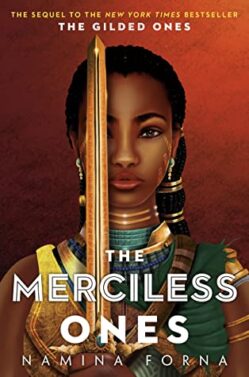
Listen to the Book Summary Below
In Namina Forna’s The Merciless Ones, the second installment of the Gilded Ones trilogy, the story begins six months after Deka freed the ancient goddesses of Otera and discovered her true nature as the Nuru, the only full-blooded daughter of the divine. While a new era of freedom was promised, the kingdom of Otera remains a battlefield. The goddesses have raised the city of Abeya from the salt flats of the N’Oyo Mountains, turning the desolate landscape into a lush paradise known as “The Bloom”. However, the human forces of the former empire the jatu and the priests of Oyomo have not surrendered. Led by the mysterious and powerful Elder Kadiri, they have gathered an army to reclaim the kingdom and extinguish the alaki once and for all.
The Rescue of Melanis and the Discovery of the Forsworn
The narrative opens with Deka and her closest companions Britta, Belcalis, Asha, Adwapa, and the deathshriek Katya on a raid in the Southern provinces. They are confronted with the brutality of the ongoing war: young girls mounted on stakes as warnings to any woman who dares speak the name of the Gilded Ones. During this mission, an elderly Northern woman blames Deka for the chaos, claiming that the “lies of freedom” have brought only death to innocent human women. This encounter shakes Deka, who realizes that her actions have consequences for all Oteran women, not just the alaki.
The group’s primary objective is the Oyomosin, a temple carved into a volcano, where the Firstborn war queen Melanis, known as the “Light of the Alaki,” has been held captive for a millennium. At the temple, Deka witnesses the horrifying extent of the priests’ cruelty: Melanis is chained over a cauldron of magma, her eyes burned out and her body in a constant state of agony and regeneration. Deka frees Melanis using her own golden blood, which acts as an antidote to the ichor (divine blood) used in the chains.
However, the rescue is interrupted by the arrival of true jatu descendants of the Gilded Ones who possess superhuman strength and speed but, unlike alaki, only a single life. These jatu wear a new arcane symbol on their breastplates: the kaduth. To Deka’s horror, the kaduth vibrates with a power that blocks her divine voice, rendering her unable to command them. In the ensuing battle, Melanis displays a terrifying level of power, her gold-tipped white wings returning as she massacres the jatu with “feathery white swords”. The most shocking revelation occurs when a fallen jatu reassembles his severed limbs and resurrects, claiming to be blessed by Idugu, a warrior aspect of Oyomo.
The Lies of the Mothers
Upon returning to Abeya, Deka finds the city thriving under the influence of the mothers. White Hands, now the Firstborn general, continues to guide Deka, but a rift of mistrust begins to grow. Deka is troubled by the goddesses’ dedication ceremonies, where new converts have their memories of their past lives completely erased to ensure their absolute loyalty a process the mothers call “cleansing”.
Deka seeks counsel from the goddesses Anok, Etzli, Hui Li, and Beda regarding the resurrecting jatu. The mothers reveal that an ancient arcane object called the angoro (the golden throne) has been awakened. They claim the angoro is siphoning their power and enabling the jatu’s “miracles”. They charge Deka with finding the angoro, killing its wielder, and returning it to them so they can regain their full strength and protect Otera.
Deka also discovers that her own body is changing. She experiences “waking dreams” of a white chamber and a bronzed man, which Melanis claims is a divine gift only gods should possess. White Hands encourages Deka to trust her own mind, noting that the mothers are growing in power and so is she. Yet, Deka remains haunted by her trauma and the pressure of being the goddesses’ “Deliverer”.
The Trap at Zhúshan
To find the angoro, Deka and her friends go undercover, disguised as newlyweds traveling to the city of Zhúshan. They hope to capture Elder Kadiri, who is reportedly using Zhúshan as a base. In the city, they find a new, insidious form of propaganda: the Wumi Kaduth, or “Lady of the Heart,” a female priestess of Oyomo.
To Deka’s devastation, the priestess is revealed to be Elfriede, her only friend from her childhood village of Irfut. Elfriede delivers a speech denouncing the Gilded Ones as “demons” and “monsters” who devour children. She identifies Deka in the crowd, triggering a massive ambush. The jatu forces are joined by Forsworn massive purple deathshrieks with gold veins who are clearly male.
During the chaos, Elder Kadiri sacrifices a young alaki girl to Idugu. Deka is the only one who can see the girl’s blood glow with a celestial light as it is consumed by a dark, oily presence in the air. She realizes that Idugu is not a myth or an object, but a real, parasitic deity. As the group is cornered, a mysterious door opens, sucking them across the continent to the capital city of Hemaira.
The Reality of Hemaira and the Death of Father
The group lands in the Grand Temple of Hemaira, the holiest site of the priesthood and the seat of Idugu’s power. Deka discovers a new ability: she can sense the doors and even change their direction through her own will. They escape the temple and hide in a river market, where Acalan shares the trauma he suffered at the hands of the priests during his time as a recruit.
Deka is visited by an illusion of White Hands, who reveals that her own memories of Idugu have been erased. This confirms Deka’s suspicion: the mothers are lying. They have always known about Idugu and the male deathshrieks but have kept the truth hidden.
In Sanusi Square, they witness the horrifying transformation of Hemaira: the streets are lined with the corpses of women and the city is patrolled by the Forsworn. Elder Kadiri reveals he has captured Deka’s human father. In a desperate attempt to rescue him, Deka and Britta are cornered in an alleyway. Deka’s father dies in her arms, but not before he apologizes for his cruelty and reveals that Deka’s birth mother, Umu, is still alive and waiting for her in the mythical land of Gar Nasim.
Following Father’s death, Elder Kadiri and Elfriede mock Deka, revealing that they have been executing alaki girls across Otera on Elfriede’s recommendation. In a fit of cold, divine rage, Deka massacres the jatu guards, but she is unable to stop the corpses from resurrecting due to the power of the kaduth. They are saved by the timely arrival of Karmoko Thandiwe and Lady Kamanda, who evacuate them by boat. Thandiwe executes Kadiri and Elfriede, but the “Merciless One” (Idugu) laughs at Deka from the shadows.
The Truth in the Blood
The group finds refuge at the Kamanda estate in Lake Iyema. There, Deka experiences a series of revelations that dismantle everything she believed. She discovers that the ansetha necklace gifted to her by the mothers was actually a “collar” designed to suppress her true power and keep her subservient. When she removes it, her abilities and those of her friends begin to grow exponentially.
Deka uses the ichor in the necklace and the Idugu’s blood she collected to peer into the memories of the gods. She learns the true history of the Divine Wars: the Gilded Ones and the Idugu were once a single collective being that split into male and female pairs, similar to the indolo. The mothers, fearful of their brothers’ aggression, imprisoned the Idugu behind the veil and starved them of worship. In response, the Idugu created the persona of Oyomo and the Infinite Wisdoms to feed on the suffering and obedience of humanity.
Deka realizes that the goddesses are just as monstrous as their brothers. They have been secretly “eating” male deathshrieks in the Chamber of the Goddesses to sustain their power. Most importantly, she discovers her own origin: she is not the daughter of the Gilded Ones, but an intermediary sent by the Singular the fifth, neutral god who remained unified to destroy the warring deities before their madness consumes the world.
The Fall of the Warthu Bera and the Rebirth of Keita
The group decides to free the bloodsisters still imprisoned at the Warthu Bera. They infiltrate the training ground via secret caverns, rescuing Karmoko Huon, Gazal, and scores of alaki who were being bled for their gold to power the jatu’s forges. During this mission, they encounter Sayuri (Rattle), who is revealed to be the third Firstborn war queen. Sayuri leads the Warthu Bera deathshrieks in a rebellion against the Forsworn.
The escape from the Warthu Bera is achieved through the combined divine gifts of the group: Britta creates massive stone shields, Belcalis armors herself in gold, and Ixa transforms into a colossal sea drakos capable of flight. They travel to the Grand Temple to confront Idugu, where Elder Kadiri (resurrected again) slits Keita’s throat as a sacrifice to the male gods.
Deka’s grief and power call Keita back from the Afterlands. Keita resurrects as a “true jatu” with the power of fire, burning the Forsworn and jatu in the chamber to ash. Deka decisively kills Elder Kadiri by decapitation, ensuring he cannot return.
The Final Battle at Abeya
Deka returns to Abeya, no longer as a loyal daughter but as a god-killer. She enters the Chamber of the Goddesses and finds the mothers in the midst of a gruesome “harvest,” feeding on thousands of male deathshrieks trapped in an abyss beneath their thrones. Etzli attempts to re-collar Deka, but Ixa rips the ansetha necklace from Deka’s body.
A final, apocalyptic battle erupts. Melanis, choosing the mothers over her sisters, attacks Deka, but Deka severes her wings. White Hands, realizing the truth of her brothers’ suffering, turns against Etzli. In a surprising turn, Anok, the wisest of the goddesses, acknowledges the madness that has consumed her sisters and helps Deka escape, urging her to find the rest of her power and end the cycle.
Deka awakens the true divine gifts of her friends and White Hands whose power is to turn everything to ash. Together, they destroy the Temple of the Gilded Ones, bringing it crashing down to prevent the goddesses from using it to feed ever again. Melanis is lost in the collapse, and the survivors flee the mountain.
Conclusion: The Rise of the Angoro
The novel concludes with Deka and her friends traveling toward Gar Nasim to find her mother and the final answers to her divinity. Deka’s body is beginning to break down under the strain of the power she has wielded, and White Hands informs her that the only way to survive is to fully embrace her role as a god.
Deka accepts her new identity. She is no longer the Nuru, the pawn of the goddesses. She takes the name the Idugu gave her: The Angoro, slayer of the gods. With her friends now powerful, immortal-ish beings themselves at her side, Deka prepares for the final war to liberate Otera from the tyranny of all deities, both male and female.